Others
Found 6274 products of "Others"
Sort by
Purity (%)
0
100
|
0
|
50
|
90
|
95
|
100
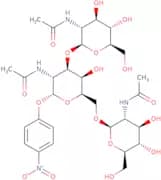
4-Nitrophenyl 2-acetamido-2-deoxy-3-O-(2,3,4,6-tetra-O-acetyl-β-D-galactopyranosyl)-α-D-galactopyranoside
CAS:<p>4-Nitrophenyl 2-acetamido-2-deoxy-3-O-(2,3,4,6-tetra-O-acetyl-β-D-galactopyranosyl)-α-D-galactopyranoside is a chemiluminescent substrate that has been used in the detection of bacterial activity. It is used in the detection of bacterial activity through chemiluminescence and can be conjugated to an enzyme or protein for increased sensitivity. This product has been shown to have high purity and quality and is suitable for use in diagnostic applications.</p>Formula:C28H36N2O17Purity:Min. 95%Color and Shape:PowderMolecular weight:672.59 g/molOstazin brilliant red H-3B hydroxyethylcellulose
<p>Ostazin brilliant red H-3B hydroxyethylcellulose is a chromogenic enzyme substrate that produces a bright red color upon reaction with specific enzymes. This substrate is particularly useful for the detection and visualization of enzyme activity in histochemical and cytochemical staining techniques. The vibrant red color produced by the reaction allows for easy observation and analysis of enzyme distribution and localization in cells and tissues. Ostazin brilliant red H-3B hydroxyethylcellulose is often used in combination with other substrates to study the presence and activity of multiple enzymes simultaneously, providing valuable insights into the complex interactions and functions of enzymes in biological systems.</p>Purity:Min. 95%2,4-Dinitrophenyl 2-deoxy-2-fluoro-b-xylobioside
CAS:<p>2,4-Dinitrophenyl 2-deoxy-2-fluoro-beta-xylobioside, also known as DNFPX, is a substrate to study the activity of glycosidases. It is a derivative of xylobiose, which is a disaccharide composed of two xylose units. The 2-deoxy-2-fluoro modification on one of the xylose units makes the compound resistant to further hydrolysis by the enzyme, allowing it to be used as a reporter of enzyme activity. The 2,4-Dinitrophenyl group is used as a chromogenic group that enables rapid detection and measurement of the enzyme activity that can be quantitatively measured by monitoring the appearance of the yellow 2,4-dinitrophenyl group when cleavage of the glycosidic bond.</p>Purity:Min. 95%Molecular weight:450.33 g/mol4-Nitrophenyl 2,3-di-O-(2,3,4,6-tetra-O-acetyl-b-D-glucopyranosyl)-4,6-benzylidene-b-D-glucopyranoside
<p>4-Nitrophenyl 2,3-di-O-(2,3,4,6-tetra-O-acetyl-b-D-glucopyranosyl)-4,6-benzylidene-b-D-glucopyranoside is a high purity, high quality 4nitrophenol derivative that is used as a food testing substrate. It is also used for the detection of fluorescence in environmental testing. This product can be conjugated with ligands for use in diagnostic assays.</p>Purity:Min. 95%Molecular weight:1,049.93 g/mol4-Nitrophenyl b-D-cellohexaoside
CAS:<p>4-Nitrophenyl b-D-cellohexaoside is a substrate for many enzymes and can be used to detect the presence of these enzymes in biological samples. It can also be used to detect the presence of bacteria, fungi, parasites, and viruses. 4-Nitrophenyl b-D-cellohexaoside is an excellent substrate for enzyme reactions that produce a chromogenic or fluorogenic product. This product is often conjugated with other compounds such as antibodies or antigens to form an immunoassay. 4-Nitrophenyl b-D-cellohexaoside is made from a high purity chemical by a process called nitration with sodium nitrate and sulfuric acid.</p>Purity:Min. 95%Molecular weight:1,111.95 g/molAldol® 544 β-D-galactopyranoside, Biosynth Patent: EP 2427431 and US 8940909
CAS:<p>Aldol 544 beta-D-galactopyranoside is a chromogenic substrate for the detection of beta-galactosidase activity in food testing and diagnostics. Aldol 544 beta-D-galactopyranoside is used as a conjugate to detect the presence of an enzyme, such as beta-galactosidase, in biological samples. It has been used in environmental testing and as a fluorogenic substrate for the detection of β-galactosidase activity.</p>Formula:C33H33ClN2O7Purity:Min. 95.0 Area-%Molecular weight:605.08 g/mol4-Methyl-2-nitrophenyl b-D-galactopyranoside
<p>4-Methyl-2-nitrophenyl b-D-galactopyranoside is a fluorogenic substrate for β-galactosidase. It has a high purity and is of high quality. 4-Methyl-2-nitrophenyl b-D-galactopyranoside is used as an enzyme substrate in diagnostics, as a chromogenic substrate in staining, and as a conjugate in chemiluminescence. It can be used for the detection of β-galactosidase in culture media and for the detection of β-galactosidase in environmental testing. This chemical also has bioluminescent properties that make it useful for food testing.</p>Purity:Min. 95%Molecular weight:315.28 g/mol4-Nitrophenyl 4,6-O-benzylidene-b-D-glucopyranoside
CAS:<p>4-Nitrophenyl 4,6-O-benzylidene-b-D-glucopyranoside is a fluorescent compound that is used in diagnostics and research. The compound is an enzyme substrate, a ligand for metal ions, and a chromogenic substrate. It can be used to test cultures of bacteria in culture media, as well as for food testing and environmental testing. 4-Nitrophenyl 4,6-O-benzylidene-b-D-glucopyranoside has high purity and quality due to its high fluorescence intensity. This product has been shown to be highly stable in various conditions and may be used in conjugates with other compounds.</p>Purity:Min. 95%Molecular weight:389.36 g/mol3-Nitrophenyl 2-acetamido-2-deoxy-b-D-glucopyranoside
CAS:<p>3-Nitrophenyl 2-acetamido-2-deoxy-b-D-glucopyranoside is a chemiluminescent substrate that is used for the detection of glycosidases. It has been shown to be a good ligand for the study of nucleic acid hybridization, and it can also be used in enzyme assays. 3NPPAG is available in high purity and high quality. This product has been tested for use in culture media, environmental testing, bioluminescence, staining, fluorogenic substrate, CAS No. 61894-63-1, diagnostics, chromogenic substrate, enzyme substrate, food testing and conjugate applications.</p>Purity:Min. 95%2-Methyl-4-nitrophenyl b-D-galactopyranoside
<p>2-Methyl-4-nitrophenyl b-D-galactopyranoside is a chemiluminescent substrate that is used in various applications. It is a ligand that binds to the enzyme beta-galactosidase and is used in diagnostics for detecting the presence of the enzyme. 2-Methyl-4-nitrophenyl b-D-galactopyranoside has been shown to be an appropriate substrate for chemiluminescence reactions, such as those used in diagnostic or research applications. The product also has been tested for potential toxicity and found not to be toxic at concentrations up to 100mg/mL. This product can be used in a variety of applications, including food testing, bacterial culture media, and environmental testing.</p>Purity:Min. 95%Molecular weight:315.28 g/mol5-Bromo-6-chloro-1H-indol-3-yl-a-D-mannopyranoside
CAS:<p>5-Bromo-6-chloro-1H-indol-3-yl-a-D-mannopyranoside is a chromogenic substrate that yields a magenta-colored product after cleavage. The chromophore 5-bromo-6-chloro-indoxyl is released, generating the observable color. It is used in lysosomal storage disorder screening.</p>Formula:C14H15BrClNO6Purity:Min. 95 Area-%Color and Shape:White Off-White PowderMolecular weight:408.63 g/mol4-Nitrophenyl 2,3,4-tri-O-acetyl-b-D-glucuronide methyl ester
CAS:<p>4-Nitrophenyl 2,3,4-tri-O-acetyl-b-D-glucuronide methyl ester is a fluorescent substrate for the beta-glucuronidase enzyme. It can be used to detect the presence of this enzyme in bacteria and other microorganisms by means of fluorometric or colorimetric assays. It has been shown to have an excellent stability in a variety of culture media and food testing applications. This product is available in high purity and quality, with a CAS number of 18472-49-6.</p>Purity:Min. 95%Molecular weight:455.37 g/molN-Methyl-3-indolyl a-D-arabinopyranoside
<p>3-indolyl-N-methyl a-D-arabinopyranoside is a fluorogenic substrate for the detection of beta-galactosidase. It also has been used as a chromogenic substrate for the detection of beta-glucuronidase. This product can be conjugated to an enzyme and used in enzyme substrates for the detection of beta-galactosidase, beta-glucuronidase, and other enzymes. 3-indolyl-N-methyl a-D-arabinopyranoside is also commonly used in culture media to detect bacteria and yeast.</p>Purity:Min. 95%Molecular weight:279.29 g/mol6-Chloro-1H-indol-3-yl b-D-mannopyranoside
CAS:<p>6-Chloro-1H-indol-3-yl b-D-mannopyranoside is an enzyme substrate that is used in the fluorogenic and chromogenic assays for detecting indoleamines. This compound has a conjugate, which is a fluorescent molecule that can be attached to an antibody to target specific proteins or cells. 6-Chloro-1H-indol-3-yl b-D-mannopyranoside is used as a diagnostic agent in the detection of bacterial and fungal infections. It is also used as an indicator of cell growth in culture media.</p>Purity:Min. 95%Molecular weight:329.73 g/mol4-Nitrophenyl 2-O-(2,3,4-tri-O-acetyl-a-L-fucopyranosyl)-6-O-benzoyl-3,4-O-isopropylidene-a-D-galactopyranoside
CAS:<p>4-Nitrophenyl 2-O-(2,3,4-tri-O-acetyl-a-L-fucopyranosyl)-6-O-benzoyl-3,4-O-isopropylidene a D galactopyranoside is an analog of galactose that binds to the DNA and regulates gene expression. This compound has been shown to be able to regulate gene expression levels in cells. 4NP2B6OB was used as a probe for microarray analysis of gene expression profiles from environmental samples. It was found that 4NP2B6OB could be used as a probe for the identification of genes in high density arrays.</p>Purity:Min. 95%Molecular weight:717.67 g/molAldol® 495 phosphate, disodium salt, Biosynth Patent: EP 2427431 and US 8940909
CAS:<p>Aldol® 495 phosphate is a chromogenic and fluorogenic enzyme substrate used for detection of phosphatase activity. The colorless enzyme substrate is cleaved by acid and alkaline phosphatases secreted by bacteria in liquid or solid media, yielding orange color and green fluorescence. Aldol® 495 phosphate can also be used in Western blots and other immunoassay applications with phosphatase-coupled secondary antibodies. Aldol® 495 phosphate can be used under aerobic and anaerobic conditions.</p>Formula:C20H14ClN2Na2O5PPurity:Min. 98.0 Area-%Molecular weight:474.74 g/mol4-Nitrophenyl b-D-glucuronide sodium salt
CAS:<p>4-Nitrophenyl b-D-glucuronide sodium salt is a high-quality chromogenic substrate specifically designed for the colorimetric detection and measurement of β-glucuronidase activity. Upon enzymatic cleavage, it releases the yellow 4-nitrophenol, enabling quantitative analysis via spectroscopy. This compound is conveniently provided as a sodium salt to ensure enhanced solubility, stability, and shelf life. It is an ideal choice for biochemical, research, and diagnostic applications requiring a reliable and efficient b-D-glucuronide substrate.</p>Purity:Min. 95%Molecular weight:337.21 g/mol4-Nitrophenyl D-maltopentaoside
CAS:<p>Chromogenic substrate targeting amylase and maltase</p>Formula:C36H55NO28Purity:Min. 95%Molecular weight:949.81 g/mol5-Bromo-6-chloro-3-indolyl palmitate
CAS:<p>5-Bromo-6-chloro-3-indolyl palmitate is a magenta enzyme substrate that is widely used in the study of lipase and esterase enzymes. This compound consists of an indole ring with bromine and chlorine atoms at positions 5 and 6, respectively, and a palmitate moiety esterified to the indolyl ring. The palmitate group is a long-chain fatty acid, making this substrate particularly useful for investigating enzymes that hydrolyze ester bonds in lipids. Upon cleavage by lipases or esterases, 5-Bromo-6-chloro-3-indolyl palmitate releases a magenta-colored product, which can be easily detected and quantified to measure enzyme activity.</p>Purity:Min. 95%Molecular weight:484.9 g/mol4-Nitrophenyl 2-O-(a-D-mannopyranosyl)-a-D-mannopyranoside
CAS:<p>4-Nitrophenyl 2-O-(a-D-mannopyranosyl)-a-D-mannopyranoside is a chromogenic substrate for the enzyme, beta-glucosidase. It is used as a food additive to test for the presence of alpha and beta glucosidases in foods. This product is also commonly used as an enzyme substrate and conjugate in biochemical research and diagnostic applications.</p>Purity:Min. 95%Color and Shape:White To Off-White SolidMolecular weight:463.39 g/mol