


Aminoacids and derivatives
Amino acids are compounds with a structure based on an amino group (-NH₂) and a carboxyl group (-COOH), both attached to a central carbon atom. This structure makes them essential for the synthesis of proteins and other biomolecules. Their derivatives can have regulatory properties over metabolic processes and biological systems, with applications in nutrition, health, and regenerative medicine.
At CymitQuimica, we offer a wide range of amino acids and their derivatives, ideal for research and the formulation of bioactive products.
Found 12278 products of "Aminoacids and derivatives"
Sort by
Purity (%)
0
100
|
0
|
50
|
90
|
95
|
100
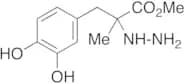
Carbidopa Methyl Ester
CAS:Controlled ProductFormula:C11H16N2O4Color and Shape:NeatMolecular weight:240.256Methyl 1-benzyl-4-(phenylamino)piperidine-4-carboxylate
CAS:Purity:95.0%Molecular weight:324.424011230468758-Benzyl-1-cyclohexyl-1,3,8-triazaspiro[4.5]decan-4-one
CAS:Purity:97.0%Molecular weight:327.471984863281252-[4-(3-Chlorophenyl)piperazin-1-yl]-2-(3-methylphenyl)acetic acid
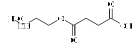
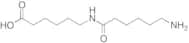
CAS:Molecular weight:344.83999633789066-Aminocaproic Acid Dimer
CAS:<p>Applications 6-Aminocaproic Acid Dimer is a reactant with citric acid in the formation of 3-hydroxy-3,4-dicarboxy-butanamide-N-hexanoic acid.<br>References Schou-Pedersen, A. V., et al.: J. Pharm. Biomed. Anal., 107, 333-340 (2015)<br></p>Formula:C12H24N2O3Color and Shape:White To Off-WhiteMolecular weight:244.33Lacosamide impurity I: (R)-N-benzyl-2-(3-benzylureido)-3-methoxypropanamide
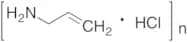
CAS:Controlled Product<p>Applications Lacosamide impurity I: (R)-N-benzyl-2-(3-benzylureido)-3-methoxypropanamide is an impurity of lacosamide (L098500), a medication used for the adjunctive treatment of partial-onset seizures and diabetic neuropathic pain. Lacosamide is a potent anticonvulsant.<br>References Lees, G., et al.: Brain Res., 612, 190 (1993), Kuo, C., et al.: Mol. Pharmacol., 51, 1077 (1997), Barton, M., et al.: Epilepsy Res., 47, 217 (2001), Beyreuther, B., et al.: Eur. J. Pharmacol., 539, 64 (2006), Beyreuther, B., et al.: CNS Drug Rev., 13, 21 (2007),<br></p>Formula:C19H23N3O3Color and Shape:NeatMolecular weight:341.4Poly(allylamine Hydrochloride) (Technical Grade)
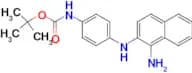
CAS:Controlled ProductFormula:(C3H8ClN)monColor and Shape:NeatMolecular weight:93.56TERT-BUTYL (4-((1-AMINONAPHTHALEN-2-YL)AMINO)PHENYL)CARBAMATE
CAS:Purity:90.0%Molecular weight:349.4339904785156Oleoyl-L-carnitine
CAS:Controlled Product<p>Stability Hygroscopic<br>Applications Oleoyl-L-carnitine is a long-chain fatty ester of carnitine which is accumulated and released into the circulation, in fatty-acid oxidation defects. Pattern of Oleoyl-L-carnitine can be diagnostic for a number of ß-oxidation defects.<br>References Adams, S., et al.: J. Nutrition, 139, 1073 (2009); Ventura, F., et al.: Clinica Chimica Acta, 281, 1 (1999); Pourfarzam, M., et al.: Clinical Chem,, 40, 2267 (1994); Schaefer, J., et al.: Pediatric Res., 37, 354 (1995)<br></p>Formula:C25H47NO4Color and Shape:NeatMolecular weight:425.64









![8-Benzyl-1-cyclohexyl-1,3,8-triazaspiro[4.5]decan-4-one](/_next/image/?url=https%3A%2Fstatic.cymitquimica.com%2Fproducts%2F10%2Fthumb-webp%2FF517778.webp&w=3840&q=75)
![2-[4-(3-Chlorophenyl)piperazin-1-yl]-2-(3-methylphenyl)acetic acid](/_next/image/?url=https%3A%2Fstatic.cymitquimica.com%2Fproducts%2F10%2Fthumb-webp%2FF300388.webp&w=3840&q=75)


![(R)-5-METHYL-4,7-DIAZASPIRO[2.5]OCTANE 2HCL](/_next/image/?url=https%3A%2Fstatic.cymitquimica.com%2Fproducts%2F10%2Fthumb-webp%2FF331581.webp&w=3840&q=75)
