


Aminoacids and derivatives
Amino acids are compounds with a structure based on an amino group (-NH₂) and a carboxyl group (-COOH), both attached to a central carbon atom. This structure makes them essential for the synthesis of proteins and other biomolecules. Their derivatives can have regulatory properties over metabolic processes and biological systems, with applications in nutrition, health, and regenerative medicine.
At CymitQuimica, we offer a wide range of amino acids and their derivatives, ideal for research and the formulation of bioactive products.
Found 12278 products of "Aminoacids and derivatives"
Sort by
Purity (%)
0
100
|
0
|
50
|
90
|
95
|
100
6-(6-(6-Aminohexanamido)hexanamido)hexanoic Acid
CAS:<p>Applications 6-(6-(6-Aminohexanamido)hexanamido)hexanoic Acid is used in the making of a preconjugate which serves as immunoreactive conjugate useful as a developer antigen in a competitive inhibition immunoassay for the polymorphic analyte. Also used in the efficient synthesis of a heterobifunctional coupling agent.<br>References Oh, C. S., et al.: PCT Int. Appl. (1994), WO 9416330 A1 19940721; Reddy, R. E., et al.: Bioconjug. Chem., 16, 1323 (2005)<br></p>Formula:C18H35N3O4Color and Shape:White To Off-WhiteMolecular weight:357.492-[2-[(5-carboxypentyl)amino]-2-oxoethyl]-2-hydroxybutanedioic Acid
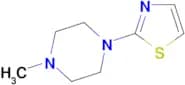
CAS:Controlled ProductFormula:C12H19NO8Color and Shape:NeatMolecular weight:305.282-(4-Methylpiperazin-1-yl)thiazole
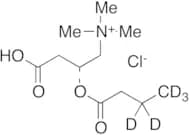
CAS:Formula:C8H13N3SPurity:95.0%Color and Shape:LiquidMolecular weight:183.27(R)-Butyryl Carnitine-d5 Chloride
CAS:Controlled ProductFormula:C11H17D5ClNO4Color and Shape:NeatMolecular weight:272.782-(2-piperazin-1-ylethyl)-1H-benzo[de]isoquinoline-1,3(2H)-dione
CAS:Purity:95.0%Molecular weight:309.36898803710944-Piperazin-1-yl-thieno[2,3-d]pyrimidine
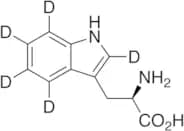
CAS:Color and Shape:Liquid, No data available.Molecular weight:220.2899932861328D-Tryptophan-d5
CAS:Controlled Product<p>Applications Labelled analogue of an essential amino acid found in naturally produced peptides. Unlike its stereoisomer, L-tryptophan, it is not used in structural or enzyme proteins.<br>References Karunakaran, S.et al.: Bochem. J., 414, 343 (2008); Pallaghy, P.K. et al.: Biochem., 38, 11553 (1999);<br></p>Formula:C112H5H7N2O2Color and Shape:NeatMolecular weight:209.26ε-Aminocaproic Acid-d10 Hydrochloride
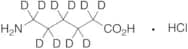
CAS:Controlled Product<p>Applications Labelled ε-Aminocaproic Acid. Used in the preparatiom of esters of 6-aminohexanoic acid as antibacterial agents. EACA is reported to inhibit chymotrypsin, Factor VIIa, lysine carbo xy peptidase, plasmin, and plasminogen activator.<br>References Dolezal, P., et al.: Pharm. Res., 10, 1015 (1993), Vavrova, K., et al.: Curr. Med. Chem., 12, 2273 (2005), Holas, T., et al.: Bioorg. Med. Chem., 14, 7671 (2006),<br></p>Formula:C6H4D10ClNO2Color and Shape:NeatMolecular weight:177.7Succinyl Carnitine Chloride Salt
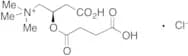
CAS:Controlled Product<p>Stability Very Very Hygroscopic<br>Applications A metabolic intermediate of L-Carnitine.<br>References Huffman, K. et al.: Diab. Care, 32, 1678 (2009);<br></p>Formula:C11H20NO6ClColor and Shape:NeatMolecular weight:297.73Indole-3-carboxaldehyde
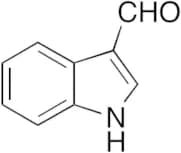
CAS:Controlled ProductFormula:C9H7NOColor and Shape:NeatMolecular weight:145.16Lacosamide impurity I: (R)-N-benzyl-2-(3-benzylureido)-3-methoxypropanamide
CAS:Controlled Product<p>Applications Lacosamide impurity I: (R)-N-benzyl-2-(3-benzylureido)-3-methoxypropanamide is an impurity of lacosamide (L098500), a medication used for the adjunctive treatment of partial-onset seizures and diabetic neuropathic pain. Lacosamide is a potent anticonvulsant.<br>References Lees, G., et al.: Brain Res., 612, 190 (1993), Kuo, C., et al.: Mol. Pharmacol., 51, 1077 (1997), Barton, M., et al.: Epilepsy Res., 47, 217 (2001), Beyreuther, B., et al.: Eur. J. Pharmacol., 539, 64 (2006), Beyreuther, B., et al.: CNS Drug Rev., 13, 21 (2007),<br></p>Formula:C19H23N3O3Color and Shape:NeatMolecular weight:341.42-N-Boc-amino-2-cyclopentyl-ethylamine
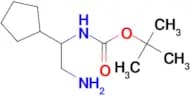
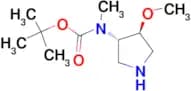
CAS:Purity:97.0%Color and Shape:SolidMolecular weight:228.33599853515625TERT-BUTYL (3S,4S)-4-METHOXYPYRROLIDIN-3-YL(METHYL)CARBAMATE
CAS:Purity:95.0%Molecular weight:230.30799865722656Cadaverine
CAS:Controlled Product<p>Applications Cadaverine is a polyamine produced by the decarboxylation of L-lysine, and is also produced by Escherichia coli (E.coli) cells when grown in acidic pH. Cadaverine is known to inhibit porin-mediated outer membrane permeability in E.coli.<br> Not a dangerous good if item is equal to or less than 1g/ml and there is less than 100g/ml in the package<br>References Mimitsuka, T., et al.: Biosci., Biotech., Bioch., 71, 2130 (2007); Sanartzidou, H., et al.: J. Bacteriol., 185, 13 (2003)<br></p>Formula:C5H14N2Color and Shape:NeatMolecular weight:102.182-Hydroxy L-Tryptophan Hydrochloride
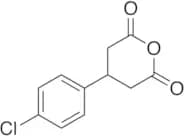
CAS:Controlled Product<p>Applications 2-Hydroxy L-Tryptophan is a metabolic intermediate in the biosynthesis of the neurotransmitters serotonin and melatonin from Tryptophan.<br>References Southan, M.D., et al.: Med. Chem. Res., 6, 343 (1996);<br></p>Formula:C11H13ClN2O3Color and Shape:Off-WhiteMolecular weight:256.693-(4-Chlorophenyl)glutaric Anhydride
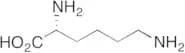
CAS:Controlled Product<p>Stability Moisture Sensitive<br>Applications 3-(4-Chlorophenyl)glutaric Anhydride (cas# 53911-68-5) is a compound useful in organic synthesis.<br></p>Formula:C11H9ClO3Color and Shape:Off-WhiteMolecular weight:224.64D-Lysine(>90%)
CAS:Controlled Product<p>Applications D-Lysine is the unnatural isomer of L-Lysine (L468895) that has the ability to reduce non-enzymatic glycation in vitro. D-Lysine also exists as polypeptide chains of poly-D-lysine, a nonspecific adhesion-promoting molecule that has the potential to be a polymeric drug carrier.<br>References Chen, Q., et al.: J. Biol. Chem., 269, 26602 (1994); Sensi, M., et al.: Diabetologia, 36, 797 (1993); Vermeersch, H., & Remon, J.: J. Control. Rel., 32, 225 (1994)<br></p>Formula:C6H14N2O2Purity:>90%Color and Shape:NeatMolecular weight:146.19(3S,3'S)-4,4'-(7-Chloropyrido[2,3-d]pyrimidine-2,4-diyl)bis(3-methylmorpholine)
CAS:Purity:95.0%Molecular weight:363.8500061035156


![2-[2-[(5-carboxypentyl)amino]-2-oxoethyl]-2-hydroxybutanedioic Acid](/_next/image/?url=https%3A%2Fstatic.cymitquimica.com%2Fproducts%2FTR%2Fthumb-webp%2FC181175.webp&w=3840&q=75)

![2-(2-piperazin-1-ylethyl)-1H-benzo[de]isoquinoline-1,3(2H)-dione](/_next/image/?url=https%3A%2Fstatic.cymitquimica.com%2Fproducts%2F10%2Fthumb-webp%2FF494483.webp&w=3840&q=75)
![4-Piperazin-1-yl-thieno[2,3-d]pyrimidine](/_next/image/?url=https%3A%2Fstatic.cymitquimica.com%2Fproducts%2F10%2Fthumb-webp%2FF044292.webp&w=3840&q=75)




![(3S,3'S)-4,4'-(7-Chloropyrido[2,3-d]pyrimidine-2,4-diyl)bis(3-methylmorpholine)](/_next/image/?url=https%3A%2Fstatic.cymitquimica.com%2Fproducts%2F10%2Fthumb-webp%2FF229684.webp&w=3840&q=75)