Carbohydrates and glycoconjugates
Carbohydrates are organic compounds composed of carbon, hydrogen, and oxygen, with a basic structure formed by monosaccharides. These can combine to form disaccharides, oligosaccharides, or polysaccharides, depending on the number of monomeric units. Carbohydrates play a fundamental role in energy storage, cell structure, and cellular communication. Their derivatives are used in pharmaceutical products, such as sweeteners and excipients.
At CymitQuimica, we offer a wide range of carbohydrates and their derivatives for research and industrial applications.
Found 5010 products of "Carbohydrates and glycoconjugates"
Sort by
Purity (%)
0
100
|
0
|
50
|
90
|
95
|
100
Hexasaccharide dp6
<p>Hexasaccharide dp6 is a synthetic hexasaccharide that mimics heparin. It binds to the antithrombin III and pentasaccharide in human plasma, which are proteins that inhibit blood clotting. Hexasaccharide dp6 also has affinity for peptides from HIV-1 and anti-HIV activity. Hexasaccharide dp6 can be used to prevent coagulation or as an antithrombotic agent.</p>Formula:C36H93N15O57S9Purity:Min. 95%Molecular weight:1,936.78 g/molA2F Glycan, 2-AB labelled
<p>A2F Glycan is an oligosaccharide that is synthesized from 2-AB labelled methylated saccharides. It can be used in the synthesis of polysaccharides and as a click modification. A2F Glycan has a CAS number, which allows for custom synthesis, and it is available in high purity. The glycosylation of this product can be modified to suit the needs of the customer. The fluorination of A2F Glycan helps with the synthesis process and provides a complex carbohydrate with few impurities.</p>Purity:Min. 95%Blood group B trisaccharide-GEL
<p>Gala1-3(Fuca1-2)Gal Conjugated to BSA on Fractogel with glycosylamine formation</p>Purity:Min. 95%N-Methyl acarbose
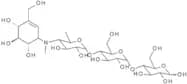
<p>N-Methyl acarbose is a synthetic, high purity, fluorinated carbohydrate with a variety of applications. It has been modified to contain methyl groups on the carbons adjacent to the anomeric carbon, which are used for click chemistry and other bioconjugation reactions. N-Methyl acarbose can be used in glycosylation reactions and offers a wide range of custom synthesis options. This compound is a complex sugar that contains both glucose and fructose monomers.</p>Formula:C26H45NO18Purity:Min. 95%Molecular weight:659.63 g/mola1,3-Mannobiose-BSA
<p>Methylation is the addition of a methyl group to a molecule. The mannobiose-BSA is a methylated derivative of mannobiose, which has been modified by adding BSA. The modification of mannobiose-BSA with BSA facilitates its use in glycosylation reactions and as an intermediate in the synthesis of other complex carbohydrates. Methylation is also used to modify saccharides, polysaccharides, and oligosaccharides. Methyl groups are typically added using an organic chemical called dimethylamine or using an enzymatic reaction with SAM-dependent methyltransferases.</p>Purity:Min. 95%4-Methoxyphenyl 4-O-[6-O-(methyl 5-acetamido-4,7,8,9-tetra-O-acetyl-3,5-dideoxy-D-glycero-a-D-galacto-2-nonulopyranosylonate)-2,3-di -O-benzyl-b-D-galactopyranosyl]-2,3,6-tri-O-benzyl-b-D-glucopyranoside
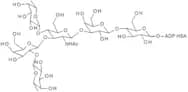
<p>This is a custom synthesis of a polysaccharide.</p>Formula:C74H85NO24Purity:Min. 95%Molecular weight:1,372.46 g/molLacto-N-difucohexaose I-APD-HSA
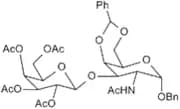
<p>Lacto-N-difucohexaose I-APD-HSA is a custom synthesis of an oligosaccharide with a molecular weight of 5,000 Da. It is modified with fluorine and methyl groups at the C6 and C1 positions. Lacto-N-difucohexaose I-APD-HSA is synthesized by click chemistry and has been shown to be effective in inhibiting the growth of cancer cells. This sugar can be modified by glycosylation or carbohydrate modification.</p>Purity:Min. 95%Benzyl 2-acetamido-4,6-O-benzylidene-3-O-(2,3,4,6-tetra-O-acetyl-b-D-galactopyranosyl)-2-deoxy-a-D-glucopyranoside
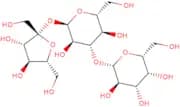
CAS:<p>The compound is a synthetic fluorinated carbohydrate that contains an acetamido group. It has been shown to inhibit the growth of Mycobacterium tuberculosis and Mycobacterium avium complex in vitro. The compound has shown anti-inflammatory properties and immunomodulatory effects, which may be due to its ability to bind to the CD1d receptor on macrophages.</p>Formula:C36H43NO15Purity:Min. 95%Molecular weight:729.72 g/mol3-O-b-D-Galactosylsucrose
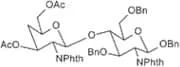
CAS:<p>3-O-b-D-Galactosylsucrose is a synthetic, fluorinated, high purity, oligosaccharide. It is a complex carbohydrate that contains an O-linked glycosylated monosaccharide. This product has been modified with a click modification. The CAS number for this product is 686717-73-7 and it can be synthesized to order.</p>Formula:C18H32O16Purity:Min. 95%Color and Shape:PowderMolecular weight:504.44 g/mol1,3,6-Tri-O-benzyl-4-O-(3,6-di-O-acetyl-2,4-dideoxy-2-phthalimido-b-D-glucopyranosyl)-2-deoxy-2-phthalimido-b-D-glucopyranoside
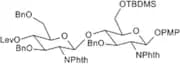
<p>Methylated, saccharide-containing, polysaccharide-containing, carbohydrate-containing. CAS No.: 169800-74-1. Click modification: Click chemistry reaction with a reactive group on the saccharide or polysaccharide to form a bond with another molecule. Modification: The addition of one or more side chains to a saccharide or polysaccharide to produce a modified carbohydrate. Oligosaccharides: Carbohydrates that are composed of only two to ten monosaccharides. Glycosylation: The process in which a glycosyl group is transferred from an activated donor sugar to an acceptor molecule, forming glycosidic linkage (e.g., between sugars). High purity: The degree of chemical purity as expressed by the percent of impurities that may be present in the product (e.g., 99% pure). Carbohydrate: A class of organic compounds that includes sugars and starches and functions</p>Formula:C53H50N2O14Purity:Min. 95%Molecular weight:938.97 g/mol4-Methoxyphenyl 4-O-(3,6-di-O-benzyl-2-deoxy-4-O-levulinoyl-2-phthalimido-b-D-glucopyranosyl)-3-O-benzyl-6-O-tert-butyldimethylsilyl -2-deoxy-2-phthalimido-b-D-glucopyranoside
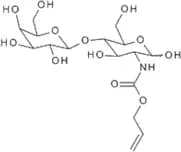
<p>4-Methoxyphenyl 4-O-(3,6-di-O-benzyl-2-deoxy-4-O-levulinoyl-2-phthalimido-b-D-glucopyranosyl)-3,6,3'-tri O -benzylidene -2,4′-(1,3,5) triazine -6,7′-[1,3]dioxane</p>Formula:C67H72N2O16SiPurity:Min. 95%Molecular weight:1,189.38 g/molN-Allyloxycarbonyl-b-lactosamine
CAS:<p>The linker N-Allyloxycarbonyl-b-lactosamine (NALB) is a bifunctional molecule that can be used to form triplexes with DNA. The NALB has been shown to inhibit the growth of gram-negative bacteria such as Escherichia coli and Haemophilus influenzae by binding to the bacterial cell wall and disrupting its permeability. The linker is synthesized by solid phase synthesis. This process involves the stepwise addition of building blocks in a sequence that is predetermined. The residues are usually protected with protecting groups, which are then removed at the end of the synthesis process.</p>Formula:C16H27NO12Purity:Min. 95%Molecular weight:425.38 g/molA2 N-Glycan
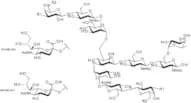
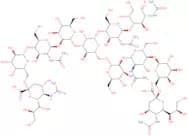
CAS:<p>A2 N-glycan is a complex carbohydrate that is found in invertebrates and mammals. The A2 N-glycan was found to be the most abundant of all glycoproteins in invertebrates, with a relative abundance of over 50%. It has been shown that the A2 N-glycan can be modified by covalent linking to proteins, differentiating it from other glycans. These modifications may have an effect on the structural stability of the molecule and its susceptibility to environmental degradation. The A2 N-glycan also plays an important role in immunity, as it is immunogenic and can stimulate antibody production. This carbohydrate is uniquely found in humans, which suggests that it may have some importance in human physiology.</p>Formula:C84H138N6O62Purity:Min. 95%Color and Shape:SolidMolecular weight:2,224 g/molAcarbose EP Impurity D
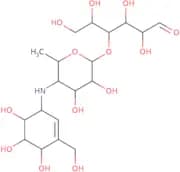
CAS:<p>Acarbose EP Impurity D is a polymerase chain reaction (PCR) product that is produced by the subtilis, which is a bacterium. Acarbose EP Impurity D has been shown to inhibit the growth of viruses and bacteria in vitro. It inhibits the synthesis of bioactive molecules by inhibiting the activity of cellular enzymes, such as polymerase chain reaction products. Acarbose EP Impurity D also inhibits viral replication and has been shown to have an inhibitory effect on HIV-1 protease.</p>Formula:C19H33NO13Purity:Min. 95%Molecular weight:483.46 g/molMethyl (4S)-b-cellobiosyl-4-thio-b-cellobioside
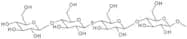
CAS:<p>Methyl (4S)-b-cellobiosyl-4-thio-b-cellobioside is a custom synthesis, modification and fluorination of methyl 4-thioacetate with b-D-cellobiosyl 4-thioacetate. This complex carbohydrate has been shown to have antiviral activity against herpes simplex virus type 1 (HSV1), and can be used as a monotherapy or in combination therapy for HSV1 infections. It inhibits the viral process by inhibiting the viral DNA polymerase and preventing DNA replication. Methyl (4S)-b-cellobiosyl-4-thio-b-cellobioside also inhibits the enzyme glycosyltransferase that is required for HSV1 replication.<br>Methyl (4S)-b - cellobiosyl - 4 - thio - b - cellobioside is a sugar that can be modified with click chemistry to produce different derivatives such as phosph</p>Formula:C25H44O20SPurity:Min. 95%Molecular weight:696.67 g/molCarboxymethyl cellulose sodium - Viscosity 300-600 mPa·s
CAS:<p>Food additive; soil suspension polymer in detergents; thickening agent</p>Purity:Min. 95%Methyl 2-acetamido-2-deoxy-3-O-(2,3,4,6-tetra-O-acetyl-b-D-galactopyranosyl)-a-D-glucopyranoside
CAS:<p>Methyl 2-acetamido-2-deoxy-3-O-(2,3,4,6-tetra-O-acetyl-b-D-galactopyranosyl)-a-D-glucopyranoside is a custom synthetic product. It is a complex carbohydrate made of an oligosaccharide and polysaccharide. This product is modified with saccharide and methylation. Methyl 2-acetamido-2-deoxy 3 O-(2,3,4,6 tetra -O acetyl b -D galactopyranosyl) a D glucopyranoside has CAS number 62998 28 1 and its purity level is high. The fluorination of this compound provides it with an additional feature of being water soluble. The synthesis of this product involves the use of the sugar in order to produce glycosylations.</p>Formula:C23H35NO15Purity:Min. 95%Molecular weight:565.52 g/molTetradecasaccharide dp14
<p>Tetradecasaccharide dp14 is a custom-synthesized, fluorinated, methylated, and modified saccharide. Tetradecasaccharide dp14 has been shown to have a variety of biological activities that are dependent on the type of modification. For example, this compound inhibits the enzyme alpha-glucosidase in vitro and in vivo. This enzyme is responsible for breaking down complex carbohydrates into simple sugars. Tetradecasaccharide dp14 also has anti-inflammatory properties and can be used as an antifungal agent against Candida albicans.</p>Formula:C84H217N35O133S21Purity:Min. 95%Molecular weight:4,519.16 g/molD-Cellohexaose
CAS:<p>Substrate for β-glucosidase</p>Formula:C36H62O31Purity:Min. 95%Color and Shape:White Off-White PowderMolecular weight:990.86 g/mol