Carbohydrates and glycoconjugates
Carbohydrates are organic compounds composed of carbon, hydrogen, and oxygen, with a basic structure formed by monosaccharides. These can combine to form disaccharides, oligosaccharides, or polysaccharides, depending on the number of monomeric units. Carbohydrates play a fundamental role in energy storage, cell structure, and cellular communication. Their derivatives are used in pharmaceutical products, such as sweeteners and excipients.
At CymitQuimica, we offer a wide range of carbohydrates and their derivatives for research and industrial applications.
Found 5012 products of "Carbohydrates and glycoconjugates"
Sort by
Purity (%)
0
100
|
0
|
50
|
90
|
95
|
100
APF Sialoglycopeptide ammonium
CAS:<p>APF Sialoglycopeptide ammonium salt is a custom synthesis of sialoglycopeptides. The molecule is modified with fluorination, methylation and click modification. It contains a monosaccharide and an oligosaccharide. The saccharide is glycosylated to a complex carbohydrate. APF Sialoglycopeptide ammonium salt has CAS No.:</p>Formula:C63H107N11O29Purity:Min. 95%Color and Shape:PowderMolecular weight:1,482.58 g/molMaltohexaose
CAS:<p>Maltohexaose is a polysaccharide formed by 6 units of glucose and can be metabolised inside the cell to a substrate-based inhibitor of fucosyltransferases. It can also be converted to GDP-2-deoxy-2-fluoro-L-fucose, a competitive inhibitor of α-1,3-fucosyltransferase. Matohexaose is used as acceptor for measuring the activity of 4-Alpha-Glucanotransferase.</p>Formula:C36H62O31Purity:Min. 95.0 Area-%Molecular weight:990.86 g/molHyaluronate biotin - Molecular Weight - 1000kDa
<p>Hyaluronate biotin (HB) is a modified form of hyaluronic acid. It is produced by the methylation and glycosylation of hyaluronic acid and it has an average molecular weight of 1000 kDa. HB is used in tissue engineering, cell culture, and as a contrast agent for magnetic resonance imaging. The modification of hyaluronate with biotin allows for the visualization of HB using immunofluorescence microscopy. Hyaluronate biotin is a synthetic product that can be custom-synthesized to customer specifications, such as purity level, oligosaccharide content, and monosaccharide content.</p>Purity:Min. 95%T-antigen-HSA
<p>T-antigen-HSA is a synthetic, high-purity, custom synthesis glycoprotein with click modification. It is a complex carbohydrate that contains an oligosaccharide and a saccharide, which are attached to the protein backbone through an amide linkage. T-antigen-HSA is synthesized using recombinant DNA technology and can be modified by fluorination, methylation, or other modifications. This product has CAS No.</p>Purity:Min. 95%Color and Shape:White PowderHeparin disaccharide II-H disodium salt
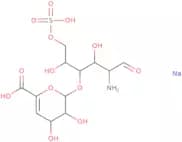
CAS:<p>Heparin disaccharide II-H disodium salt is a complex carbohydrate with the chemical formula C3H6Na2O14. It has a molecular weight of 617.8 and a melting point of 204.5°C. The compound has been modified by methylation, glycosylation, fluorination, and click modification. It is a synthetic oligosaccharide with high purity and custom synthesis.</p>Formula:C12H18NNaO13SPurity:Min. 95%Molecular weight:439.33 g/mol6-O-(a-D-Maltotriosyl)-D-glucopyranose tetradecaacetate
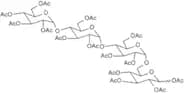
<p>6-O-(a-D-Maltotriosyl)-D-glucopyranose tetradecaacetate is a carbohydrate that belongs to the class of saccharides. It is synthesized from D-glucose by glycosylation and methylation. 6-O-(a-D-Maltotriosyl)-D-glucopyranose tetradecaacetate is a complex carbohydrate with a high purity and custom synthesis. It can be used in click chemistry, due to its reactive group on the C6 position.</p>Formula:C52H70O35Purity:Min. 95%Molecular weight:1,255.09 g/molDNS-SGN
<p>DNS-SGN is a synthetic, high purity, methylated, glycosylated, complex carbohydrate. This product is custom synthesized and has been fluorinated with a click modification. DNS-SGN is CAS Number: 598-02-3.</p>Formula:C100H155N9O66SPurity:Min. 95%Molecular weight:2,571.39 g/mol1,5-α-L-Arabinotetraose
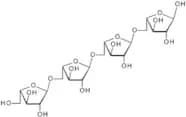
CAS:<p>1,5-alpha-L-Arabinotetraose is a methylated and glycosylated tetrasaccharide with a molecular weight of 720. It is a custom synthesis product with high purity and it can be used for the modification of proteins, polysaccharides, or other compounds. 1,5-alpha-L-Arabinotetraose has been shown to have fluoroquinolone resistance due to its methylation and glycosylation. The compound is an oligosaccharide that is synthesized from arabinose. It can be modified by click chemistry to introduce fluorine atoms at desired positions.</p>Formula:C20H34O17Purity:(%) Min. 95%Color and Shape:Clear Viscous LiquidMolecular weight:546.47 g/molBlood Group A tetrasaccharide type II
CAS:<p>A antigen tetrasaccharide Type I I, possible use in antiviral development</p>Formula:C28H48N2O20Purity:Min. 95%Color and Shape:PowderMolecular weight:732.68 g/molGalacturonan DP3/DP4 sodium salt
<p>A mixture of sodium trigalacturonate & tetragalacturonate (α-1,4 sodium galacturonotriose + α-1,4 sodium galacturonotetraose) is derived from pectin or pectic acid, by enzymatic or partial acid hydrolysis (Combo, 2012). It is used inâ¯galacturonic acidâ¯metabolism research as a substrate to identify, differentiate, and characterize endo- and exopolygalacturonase(s), and gluconase(s) (Jayani, 2005). The addition of very short fragments of homogalacturonan, tri-galacturonate, and tetra-galacturonate oligosaccharides, restore development in dark-grown, de-etiolated seedling mutants, suggesting that they are unable to generate de-methylesterified pectin fragments. A model of spatiotemporally separated photoreceptive and signal-responsive cell types has been proposed, that contains overlapping subsets of the regulatory network of light-dependent seedling development (Sinclair, 2017).</p>Purity:Min. 95%Color and Shape:Powdera1,2-Mannobiose-BSA
<p>a1,2-Mannobiose-BSA is a glycosylation that can be used for the synthesis of complex carbohydrate. It is methylated and click modified with fluorine, which renders it resistant to proteolytic degradation. This product is also available in various purities and modifications.</p>Purity:Min. 95%N-Acetyl-D-lactosamine-sp-biotin
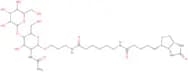
<p>N-Acetyl-D-lactosamine-sp-biotin is an oligosaccharide that is synthesized by the condensation of N-acetylglucosamine and sphingosine. It is a complex carbohydrate that can be modified with fluorination, monosaccharide, and polysaccharides. N-Acetyl-D-lactosamine-sp-biotin has been shown to have a high purity and can be used in the synthesis of glycosylation, methylation, or click chemistry.</p>Formula:C33H57N5O15SPurity:Min. 95%Color and Shape:PowderMolecular weight:795.9 g/mol1,4-b-D-Cellopentaitol
CAS:<p>1,4-B-D-Cellopentaitol is a high purity and custom synthesis sugar. It can be modified with fluorination, glycosylation, methylation, or modification. It has CAS No. 61473-65-2 and is an oligosaccharide with a saccharide backbone consisting of 1,4-linked D-glucopyranosyl units joined by alpha-(1,4) linkages and containing one or more monosaccharides (e.g., glucose) or disaccharides (e.g., cellobiose). The carbohydrate may be in the form of a complex carbohydrate.</p>Formula:C30H54O26Purity:Min. 95%Molecular weight:830.73 g/mol8-Methoxycarbonyloctyl-6-O-(a-L-fucopyranosyl)-N,N'-diacetyl-chitobioside
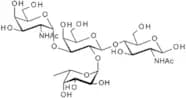
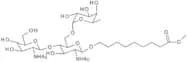
CAS:<p>8-Methoxycarbonyloctyl-6-O-(a-L-fucopyranosyl)-N,N'-diacetylchitobioside is a synthetic carbohydrate that has been fluorinated at the 8 position and acetylated at the 6 position. It is a custom synthesis that can be modified with methylation and other modifications. This compound is used in biochemical research as well as for medical purposes. It has a CAS number of 106445-35-6, and has been shown to have glycosylation, oligosaccharide, sugar, methylation, monosaccharide, polysaccharide, saccharide click modification properties.</p>Formula:C32H56N2O17Purity:Min. 95%Molecular weight:740.79 g/molBenzyl 2-acetamido-4,6-O-benzylidene-2-deoxy-3-O-(b-D-galactopyranosyl)-a-D-galactopyranoside
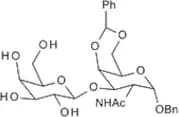
<p>Benzyl 2-acetamido-4,6-O-benzylidene-2-deoxy-3-O-(b-D-galactopyranosyl)-a-D-galactopyranoside is a methylated and fluorinated monosaccharide. It is used in the synthesis of complex carbohydrates and oligosaccharides. The modification of this compound can be done with click chemistry, which is a process that allows for the rapid assembly of molecules on surfaces. This product has been shown to have high purity, making it suitable for use in research or production.</p>Formula:C28H35NO11Purity:Min. 95%Molecular weight:561.58 g/molGlobotriaosylceramide
CAS:<p>Globotriaosylceramide (Gb3) is a glycolipid that has been shown to be an activator of the protein growth factor-β1. It is involved in the regulation of tumor cell proliferation and may have potential as a biomarker for cancer. Gb3 is also a drug transporter and it has been shown to have long-term efficacy in the treatment of sarcoidosis. Gb3 has been found in high concentrations in patients with HIV infection, suggesting that it may play a role in HIV replication. Studies have also shown that Gb3 may be involved in cardiac pathology and its structural analysis can help in understanding its function. Symptoms or conditions associated with elevated levels of globotriaosylceramide include: <br>• Carcinoma<br>• Cardiac disease<br>• Infectious diseases<br>• HIV infection</p>Formula:C53H99NO18Purity:Min. 95%Molecular weight:1,038.35 g/mol2-Acetamido-4-O-(2-acetamido-2-deoxy-b-D-galactopyranosyl)-2-deoxy-D-glucopyranose
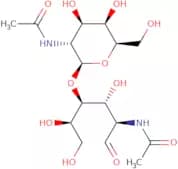
CAS:<p>A di-acetamido LacNAc analogue</p>Formula:C16H28N2O11Purity:Min. 95%Color and Shape:White PowderMolecular weight:424.4 g/mol4-O-b-D-Galactosyl maltose
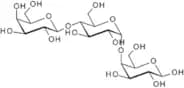
CAS:<p>4-O-b-D-Galactosyl maltose is a Glycosylation, Oligosaccharide, sugar, Synthetic, CAS No. 143444-32-0 that is custom synthesized and fluorinated. It is a complex carbohydrate with high purity and modification. The 4-O-b-D-Galactosyl maltose has the following properties: Methylation, Monosaccharide, Polysaccharide, saccharide, Click modification.</p>Formula:C18H32O16Purity:Min. 95%Molecular weight:504.44 g/molGlobo-N-tetraose-APD-HSA
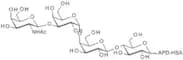
<p>Globo-N-tetraose conjugated to HSA with acetyl-phenylenediamine spacer</p>Purity:Min. 95%4-Methoxyphenyl 4-O-[3,6-di-O-benzyl-2-deoxy-4-O-(4,6-O-benzylidene-2-O-levulinoyl-b-D-glucopyranosyl)-2-phthalimido-b-D-glucopyrano sy]-3-O-benzyl-2-deoxy-6-O-(4-methoxybenzyl)-2-phthalimido-b-D-glucopyranoside
<p>4-Methoxyphenyl 4-O-[3,6-di-O-benzyl-2-deoxy-4-O-(4,6-O-benzylidene-2-O-levulinoyl)-bDglucopyranosyl]-2-phthalimido -bDglucopyranoside is a modification of the natural compound 3,6 di O benzyl 2 deoxy 4 O (4,6 O benzylidene 2 O levulinoyl) b D glucopyranosyld. It is a synthetic oligosaccharide that contains one monosaccharide and two polysaccharides. The synthesis of this product involves methylation and glycosylation. This compound has CAS number 5374031 and can be used as an intermediate in the synthesis of other products with fluorination or saccharide modifications.</p>Formula:C82H80N2O22Purity:Min. 95%Color and Shape:White to off-white crystalline powder.Molecular weight:1,445.51 g/mol