Carbohydrates and glycoconjugates
Carbohydrates are organic compounds composed of carbon, hydrogen, and oxygen, with a basic structure formed by monosaccharides. These can combine to form disaccharides, oligosaccharides, or polysaccharides, depending on the number of monomeric units. Carbohydrates play a fundamental role in energy storage, cell structure, and cellular communication. Their derivatives are used in pharmaceutical products, such as sweeteners and excipients.
At CymitQuimica, we offer a wide range of carbohydrates and their derivatives for research and industrial applications.
Found 5013 products of "Carbohydrates and glycoconjugates"
Sort by
Purity (%)
0
100
|
0
|
50
|
90
|
95
|
100
O-(Methyl b-d-glucopyranosyluronate)-(1,3)-2-amino-2-deoxy-D-galactopyranose HCl
<p>O-(Methyl b-d-glucopyranosyluronate)-(1,3)-2-amino-2-deoxy-D-galactopyranose HCl is a synthetic monosaccharide with a molecular weight of 338.18 g/mol. It has very high purity and can be custom synthesized to suit customer needs. This product is used in glycosylation reactions and as a sugar donor in click chemistry reactions.</p>Purity:Min. 95%Acarbose tridecaacetate
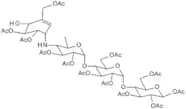
CAS:<p>Acarbose tridecaacetate is a bacterial extract that has been shown to inhibit the growth of various strains of bacteria. This extract was extracted from the fields and contains aluminum oxide impurities. Acarbose tridecaacetate has shown efficacy in seed culture and actinomyces, which are two types of bacteria. The sequence of this extract has been determined using aluminum oxide. Acarbose tridecaacetate is soluble in a variety of solvents, including organic solvents and solvents. It can be purified by chromatography to remove any bulk drug or organic solvent that may be present.</p>Formula:C51H69NO31Purity:Min. 95%Color and Shape:White PowderMolecular weight:1,192.08 g/molXylosyl-cellobiose
CAS:<p>Xylosyl-cellobiose is a monosaccharide that was synthesized and modified by methylation, click modification, and fluorination. The compound has been shown to be complex carbohydrate and an oligosaccharide with a polysaccharide. It is a high-purity substance that can be used for the synthesis of saccharides, carbohydrates, or sugars. CAS No. 129865-02-7</p>Purity:Min. 95%Molecular weight:476.43 g/mol2,3,2',3',4',6'-Hexa-O-acetyl-1,6-anhydro-b-D-maltose
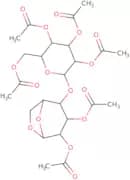
CAS:<p>2,3,2',3',4',6'-Hexa-O-acetyl-1,6-anhydro-b-D-maltose (HAP) is a custom synthesis that can be modified with fluorination, methylation, and monosaccharide. HAP is a synthetic oligosaccharide that is glycosylated and has a saccharide and sugar. HAP has the CAS No. 28868-67-9. This product can be used as an additive in food production or as a pharmaceutical agent.</p>Formula:C24H32O16Purity:Min. 95%Molecular weight:576.5 g/molMan-7 N-Glycan
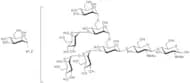
<p>Man-7 N-Glycan is a sugar that is composed of an oligosaccharide and a monosaccharide. The oligosaccharide is composed of an alpha-1,6-linked mannose, an alpha-1,2-linked mannose, and a beta-1,2-linked mannose. The monosaccharide is composed of glucose. This sugar has been modified with methylation and fluorination on the mannose side chains. It also contains glycosylation in the form of O-(alpha-D-mannopyranosyl)-(alpha-D-mannopyranosyl)n or O-(alpha-D-mannopyranosyl)-(beta-D-mannopyranosyl)m. A CAS number for this carbohydrate has not yet been assigned because it is custom synthesized. Man 7 N Glycan can be found in nature as a component of glycogen</p>Formula:C58H98N2O46Purity:Min. 90 Area-%Color and Shape:PowderMolecular weight:1,559.38 g/mol1,6-Anhydro-2,3-O-isopropylidene-4-O-(2,3,4,6-tetra-O-acetyl-a-D-mannopyranosyl)-b-D-mannopyranose
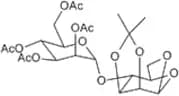
CAS:<p>1,6-Anhydro-2,3-O-isopropylidene-4-O-(2,3,4,6-tetra-O-acetyl-a-D-mannopyranosyl)-b-D-mannopyranose is a methylated saccharide that has been modified with a click reaction. This product is available for custom synthesis and modification. It is an oligosaccharide with high purity and can be synthesized or modified to be glycosylated or fluorinated. The CAS number for this product is 67591 05 3.</p>Formula:C23H32O14Purity:Min. 95%Molecular weight:532.5 g/mol4-O-(b-D-Galactopyranosyl)-D-glucosamine
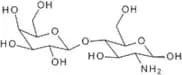
CAS:<p>4-O-(b-D-Galactopyranosyl)-D-glucosamine is a sugar that is found in the human body. It has been shown to have anti-cancer properties and is being studied as a potential therapeutic agent for squamous cell carcinoma. Basic structural analysis of 4-O-(b-D-Galactopyranosyl)-D-glucosamine has been performed on methyl glycosides, oligosaccharides, and bovine serum albumin. The sugar can be used to inhibit transcriptional regulation through its interactions with DNA. 4-O-(b-D-Galactopyranosyl)-D-glucosamine has also been found to inhibit the activities of enzymes involved in methyl glycoside synthesis, which may be related to its effects on cancer cells.</p>Formula:C12H23NO10Purity:Min. 95%Color and Shape:White PowderMolecular weight:341.31 g/molBlood Group A type I linear trisaccharide
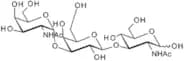
CAS:<p>GalNAca1-3Galb1-3GlcNAc</p>Formula:C22H38N2O16Purity:Min. 95%Molecular weight:586.54 g/mol6-O-(a-D-Galactopyranosyl)-D-mannopyranose
<p>The 6-O-(a-D-galactopyranosyl)-D-mannopyranose, also known as epimelibiose, is an oligosaccharide formed by linking an α-D-galactose molecule to a D-mannose molecule. It could be found in various natural products or glycoconjugates, such as glycolipids or glycoproteins. The configuration and linkage of sugars in such molecules often play a crucial role in their biological functions. 6-O-(a-D-galactopyranosyl)-D-mannopyranose can be used in research to modify polysaccharides and glycans. It has a role as a plant metabolite and a mouse metabolite.</p>Formula:C12H22O11Purity:Min. 95%O-(Methyl b-D-glucopyranosyluronate)-(1,3)-2-deoxy-2-trichloroacetamido-D-galactopyranose
<p>Methyl b-D-glucopyranosyluronate- (1,3)-2-deoxy-2-trichloroacetamido-D-galactopyranose is a fluorinated sugar that is synthesized from the glycosylation of methyl 2,3,4,6-tetrafluoro-b-D-(1,3) glucopyranoside with trichloroacetyl D-(1,3) galactopyranose. This compound is soluble in water and has a CAS number of 1058858. This product can be used as a reagent for glycosylation reactions such as Click chemistry and Methylation. It also has applications in carbohydrate modification and high purity custom synthesis.</p>Purity:Min. 95%1,3-a-1,6-a-D-Mannotriosyl trichloroacetimidate
<p>1,3-α-D-mannopyranosyl trichloroacetimidate (1,3-α-DMTCA) is a fluorinated monosaccharide that is used as a building block for the synthesis of oligosaccharides and polysaccharides. The synthesis of 1,3-α-DMTCA involves the reaction of α,β-unsaturated chloral hydrate with mannose in aqueous solution. This produces an intermediate product that undergoes glycosylation with glycosylation reagents like glycosyl chloride to yield 1,3-α-DMTCA. The chemical structure of 1,3-α-DMTCA can be modified by various reactions including methylation or click modification. 1,3 DMTCA is also available as a high purity material.<br>1,3 α - D - mannosyltetrahydrochlorofonuimidoksyl</p>Purity:Min. 95%Methyl 4-O-[4,6-O-(benzylidene)-b-D-galactopyranosyl] b-D-galactopyranoside tribenzoate
<p>Methyl 4-O-[4,6-O-(benzylidene)-b-D-galactopyranosyl] b-D-galactopyranoside tribenzoate is a synthetic carbohydrate. It is an oligosaccharide that contains a complex carbohydrate. It is a high purity product and has been custom synthesized. The CAS number for Methyl 4-O-[4,6-O-(benzylidene)-b-D-galactopyranosyl] b-D-galactopyranoside tribenzoate is 59414-33-2. This product has been fluorinated and methylated. It also contains glycosylation and click modification.</p>Purity:Min. 95%a1,4-Mannobiose-BSA
<p>a1,4-Mannobiose-BSA is a complex carbohydrate that can be synthesized in the laboratory. It is composed of mannose and glucose units. This molecule has been modified with methyl groups, which can be used for click chemistry reactions. Mannobiose-BSA is a polysaccharide with CAS number 56938-64-2. It has been modified by Click chemistry and glycosylation to yield high purity compounds.</p>Purity:Min. 95%N,N'-Diacetylchitobiosyl allosamizoline
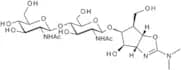
CAS:<p>N,N'-Diacetylchitobiosyl allosamizoline is an analog of the insect-inhibiting allosamidin. It has been shown to have inhibitory activity against chitinases and it is a stereoselective inhibitor of chitin synthase. N,N'-Diacetylchitobiosyl allosamizoline is used as a substrate in coupling reactions to produce disaccharides that contain the chitobiose unit. This type of enzyme inhibition may be useful in combating insects that feed on plants or other organisms with exoskeletons made up of chitin.</p>Formula:C25H42N4O14Purity:Min. 95%Molecular weight:622.62 g/molb-Cellobiosyl azide
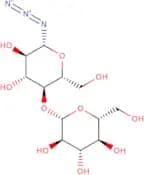
CAS:<p>b-Cellobiosyl azide is a carbohydrate that has been modified with fluorine. It has not been characterized by X-Ray diffraction and therefore has no known crystalline form. The chemical formula for b-Cellobiosyl azide is C6H9NO2F3. This product is available for custom synthesis to your specifications, please contact us for more information.</p>Formula:C12H21N3O10Purity:Min. 95%Molecular weight:367.3 g/mol[UL-13C18]Maltotriose hydrate
<p>Maltotriose hydrate is a synthetic glycosylation product that is synthesized by the fluorination of maltotriose. Maltotriose hydrate is a sugar with a 3-D structure that is similar to maltodextrin, but with one less glucose residue. Maltotriose hydrate can be used in the synthesis of oligosaccharides and polysaccharides and has been shown to have high purity. Maltotriose hydrate can be modified by a variety of reactions, such as methylation, monosaccharide modification, or click chemistry. It has an CAS number and can be custom synthesized for clients' needs.</p>Formula:C18H32O16·xH2OPurity:Min. 95%Color and Shape:White SolidMolecular weight:522.3 g/molD-Cellohexaose
CAS:<p>Substrate for β-glucosidase</p>Formula:C36H62O31Purity:Min. 95%Color and Shape:White Off-White PowderMolecular weight:990.86 g/molLacto-N-tetraose-BSA
<p>Lacto-N-tetraose-BSA is a carbohydrate that contains four monosaccharides. It has been shown to be an autoantibody in patients with myasthenia gravis and can cause muscle weakness by binding to the muscle protein, actin. Lacto-N-tetraose-BSA has also been found to bind with nerve tissue and may be involved in the development of sclerosis. This carbohydrate is also negatively charged and agglutinates red blood cells. When used for immunofluorescence, it shows a strong reaction against glycoconjugates on the surface of neurons and nerve tissue. Lacto-N-tetraose-BSA binds specifically to bovine serum albumin (BSA) containing antibodies, which are produced by immune cells called B cells. The binding sites are located on the outer part of the molecule, near the sugar residues.</p>Purity:Min. 95%Color and Shape:Powder4-Methoxyphenyl 4-O-(3-O-allyl-b-D-galactopyranosyl)-3-O-allyl-b-D-glucopyranoside
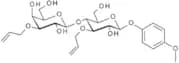
<p>4-Methoxyphenyl 4-O-(3-O-allyl-b-D-galactopyranosyl)-3-O-allyl-b-D-glucopyranoside is a custom synthesis product that is used as a synthetic intermediate in the modification of complex carbohydrates. This product is a fluorinated sugar, with a high purity and high quality. It has been modified to include methyl groups at specific positions on the sugar molecule. The CAS number for this product is 8721401.</p>Formula:C25H36O12Purity:Min. 95%Molecular weight:528.55 g/molTrifluoroacetamidopropyl b-D-lactose
<p>Trifluoroacetamidopropyl b-D-lactose is a modification of the sugar, b-D-lactose. It is synthesized by methylation and glycosylation. Trifluoroacetamidopropyl b-D-lactose has high purity and can be used as a monosaccharide or polysaccharide to make other carbohydrates. Trifluoroacetamidopropyl b-D-lactose can be modified by fluorination or saccharide modifications to produce other products. The CAS number for trifluoroacetamidopropyl b-D-lactose is 87890-36-6.</p>Purity:Min. 95%


![Methyl 4-O-[4,6-O-(benzylidene)-b-D-galactopyranosyl] b-D-galactopyranoside tribenzoate](/_next/image/?url=https%3A%2Fstatic.cymitquimica.com%2Fproducts%2F3D%2Fthumb-webp%2FOM30775.webp&w=3840&q=75)
![[UL-13C18]Maltotriose hydrate](/_next/image/?url=https%3A%2Fstatic.cymitquimica.com%2Fproducts%2F3D%2Fthumb-webp%2FOM45239.webp&w=3840&q=75)