Carbohydrates and glycoconjugates
Carbohydrates are organic compounds composed of carbon, hydrogen, and oxygen, with a basic structure formed by monosaccharides. These can combine to form disaccharides, oligosaccharides, or polysaccharides, depending on the number of monomeric units. Carbohydrates play a fundamental role in energy storage, cell structure, and cellular communication. Their derivatives are used in pharmaceutical products, such as sweeteners and excipients.
At CymitQuimica, we offer a wide range of carbohydrates and their derivatives for research and industrial applications.
Found 5010 products of "Carbohydrates and glycoconjugates"
Sort by
Purity (%)
0
100
|
0
|
50
|
90
|
95
|
100
Blood group A trisaccharide-APE-[biotin]-HSA
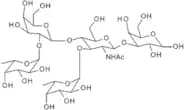
<p>ABO trisaccharide conjugated to HSA via Biotin & an aminophenyl ethyl spacer</p>Purity:Min. 95%Lewis Y pentasaccharide
<p>Lewis Y pentasaccharide is a carbohydrate antigen that is expressed on the surface of cells in the cancer, tissue and lymphatic system. It has been shown to be a polyvalent carbohydrate ligand for lectins, which are proteins that bind carbohydrates. Lewis Y pentasaccharide has a high affinity for erythrocytes of blood group A and B, which makes it useful as an antigen for detection of these blood groups. The binding of Lewis Y pentasaccharide to glycolipids on tumor cells initiates complement-dependent cytotoxicity (CDC) by activating the classical pathway of the immune system. CDC can be used as an adjuvant therapy in cancer treatment.</p>Formula:C32H55NO24Purity:Min. 95%Color and Shape:PowderMolecular weight:837.79 g/molChitobiose dihydrochloride
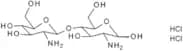
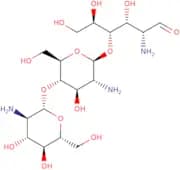
CAS:<p>Chitobiose is a dimer formed by beta-1,4-linked glucosamine units.<br>It is also the repeated dimer of chitin, a polysaccharide.</p>Formula:C12H24N2O9·2HClPurity:Min. 98 Area-%Color and Shape:White PowderMolecular weight:413.25 g/molLactobionic acid ethyl ester
<p>Lactobionic acid ethyl ester is a custom synthesis of an oligosaccharide that is modified by fluorination, methylation, and click modification. Lactobionic acid ethyl ester is synthesized from the sugar D-glucose and the monosaccharide D-galactose. This product can be used as a substitute for sucrose in food products as it has similar taste, texture and sweetness. It also has many other applications such as being used in the manufacture of polysaccharides and complex carbohydrates.</p>Purity:Min. 95%Chitotriose trihydrochloride
CAS:<p>Chitotriose trihydrochloride is a modification of chitin, an oligosaccharide. Chitotriose trihydrochloride is a synthetic carbohydrate which is used as a raw material for the production of fibers, films, and adhesives. It can be used in the synthesis of complex carbohydrates such as starch and glycogen. Chitotriose trihydrochloride is a high purity carbohydrate with CAS No. 41708-93-4 that can be used to produce glycosylated proteins or polysaccharides.</p>Formula:C18H35N3O13·3HClPurity:Min. 95 Area-%Color and Shape:PowderMolecular weight:610.87 g/mol2-O-a-D-Glucopyranosyl-D-galactopyranose
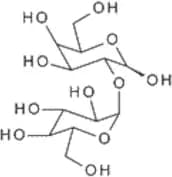
CAS:<p>2-O-a-D-Glucopyranosyl-D-galactopyranose is a synthetic monosaccharide that can be used as a glycosylate building block in the synthesis of oligosaccharides. It has been fluorinated, methylated, and click modified. This high purity material is available for custom synthesis. 2-O-a-D-Glucopyranosyl-D-galactopyranose is also known by its CAS number 7368-73-2.</p>Formula:C12H22O11Purity:Min. 95%Color and Shape:White PowderMolecular weight:342.3 g/molD-Cello-oligosaccharides
<p>This mixture contains all the members of the series up to DP9</p>Purity:Min. 90 Area-%Color and Shape:White Powder1,6-Anhydro-b-D-cellopentose
CAS:<p>1,6-Anhydro-b-D-cellopentose is a synthetic cello-oligomer</p>Formula:C30H50O25Purity:Min. 95%Color and Shape:PowderMolecular weight:810.7 g/mol4-Aminophenyl 3-O-(a-D-mannopyranosyl)-a-D-mannopyranoside
<p>4-Aminophenyl 3-O-(a-D-mannopyranosyl)-a-D-mannopyranoside is a synthetic, high purity, custom synthesis carbohydrate that is modified with fluorination and glycosylation. It is a sugar that has a molecular weight of 578.5, and its CAS Number is 68856-68-2. 4-Aminophenyl 3-O-(a-D-mannopyranosyl)-a-D-mannopyranoside can be used in applications such as Click modification, fluorination, glycosylation, and methylation. This carbohydrate has many uses including being an intermediate for saccharide or complex carbohydrate synthesis.</p>Purity:Min. 95%D-Raffinose pentahydrate
CAS:<p>Raffinose is the most abundant of the family of oligosaccharides that are α-galactosyl derivatives of sucrose (Collins, 2006). The other main member of the group is the tetrasaccharide stachyose. Raffinose is found in sugar beet molasses and whole grains. Soybean oligosaccharides make up approximately 5% of dry matter in whole beans and up to 8% of dry matter in soybean meal. Together raffinose and stachyose rank second only to sucrose in abundance, as water-soluble carbohydrates (Kumar, 2010).</p>Formula:C18H42O21Purity:Min. 97 Area-%Molecular weight:594.52 g/molRef: 3D-R-1000
10gTo inquire1kgTo inquire5kgTo inquire10kgTo inquire2500gTo inquire-Unit-kgkgTo inquireRutinose
CAS:<p>Rutinose is a naturally occurring polyphenol found in many plants, including the leaves and bark of rue plants. It is a glycoside derivative that has been shown to inhibit human colorectal adenocarcinoma cells (HL-60) by binding to DNA and inhibiting RNA synthesis. Rutinose also has been shown to have anti-inflammatory effects and has been used in the treatment of metabolic disorders such as diabetes mellitus. Rutinose is a bioactive compound with antioxidant properties that may be related to its ability to bind metal ions, including calcium ions at physiological pH levels. Rutinose also has been shown to have a signal peptide sequence that targets it for secretion into the blood stream, where it may act on brain functions.</p>Formula:C12H22O10Purity:Min. 90%Color and Shape:White PowderMolecular weight:326.3 g/molMethyl 3-O-[(6-O-b-D-galactopyranosyl)-b-D-galactopyranosyl]-b-D-galactopyranoside
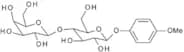
<p>Methyl 3-O-[(6-O-b-D-galactopyranosyl)-b-D-galactopyranosyl]-b-D-galactopyranoside is a white crystalline powder that is soluble in water. It can be custom synthesized to order, and has been shown to have high purity with no detectable impurities. This product can be used in Click chemistry, fluorination, glycosylation, or synthesis of complex carbohydrates. The CAS number for this product is <br>56919-86-4.</p>Formula:C19H34O16Purity:Min. 95%Molecular weight:518.46 g/mol4-Methoxyphenyl 4-O-(b-D-galactopyranosyl)-b-D-glucopyranoside
CAS:<p>4-Methoxyphenyl 4-O-(b-D-galactopyranosyl)-b-D-glucopyranoside is a carbohydrate with the CAS number 150412-80-9. It is an Oligosaccharide that is synthesized from monosaccharides and saccharides. This product can be custom synthesized to produce high purity, methylated, glycosylated and fluorinated products. There are many modifications that can be made to this carbohydrate using Click chemistry.</p>Formula:C19H28O12Purity:Min. 95%Color and Shape:PowderMolecular weight:448.42 g/mola-Maltotetraosyl-a,a-trehalose
CAS:<p>a-Maltotetraosyl-a,a-trehalose is a carbohydrate that is modified with fluorine. It is a complex carbohydrate with four maltotriose units linked by alpha,alpha-trehalose units. This compound can be custom synthesized and has high purity. It can also be methylated and glycosylated. Click modification can be done to the sugar in order to modify its properties.</p>Formula:C36H62O31Purity:Min. 95%Molecular weight:990.86 g/molCellobionic acid ammonium salt
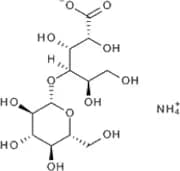
CAS:<p>Cellobionic acid is produced by oxidative enzymes working on cellulose. These compounds have found application in cosmetic antiaging formulations, moisturizers, and peels, and in treatment products to improve hyperpigmentation and acne. The bionic acids such as cellobionic acid offer the benefits of α-hydroxyacids without irritation. They also provide additional antioxidant/chelation, barrier strengthening, and moisturizing effects.</p>Formula:C12H25NO12Purity:Min. 95%Color and Shape:Off-White PowderMolecular weight:375.33 g/molLacto-N-triose I
CAS:<p>Lacto-N-triose I is a carbohydrate antigen that is used as an acceptor in the synthesis of trisaccharides. Lacto-N-triose I has been shown to have acidic hydrolysis and gel permeation chromatography. It can be used for the synthesis of oligosaccharides, which are important for glycosylation reactions. Lacto-N-triose I also has a glycosylation reaction that can be activated by desulfurization.</p>Formula:C20H35NO16Purity:Min. 95%Molecular weight:545.49 g/molMaltose syrup
<p>Used for making baked goods, soft drinks, sweets, alcoholic drinks, and infant food. It is also used to produce the sugar substitute maltitol.</p>Purity:Min. 95%2,4,6-Tri-O-(3,4,6-tri-O-benzyl-2-deoxy-2-phthalimido-β-D-glucopyranosyl)-3-O-benzyl-α-D-mannopyranose
<p>2,4,6-Tri-O-(3,4,6-tri-O-benzyl-2-deoxy-2-phthalimido-b-D-glucopyranosyl)-3-O-benzyl a -D -mannopyranose is a synthetic oligosaccharide that is synthesized by the click chemistry reaction. It is an example of a glycosylation reaction, in which the sugar is conjugated to an amine group on the triphosphate moiety of uridine diphosphate glucose. The product has been modified with fluorination and methylation to improve its stability.</p>Formula:C118H111N3O24Purity:Min. 95%Molecular weight:1,955.15 g/mol4-O-Methyl-α-D-glucurono-β-D-xylan
CAS:<p>4-O-Methyl-alpha-D-glucurono-beta-D-xylan is produced by the hydrolysis of xylan. It can be used in studies to find new soluble chromogenic substrates for the assay of xylanases and glucanases.</p>Color and Shape:PowderN-Acetylneuraminic acid-OVA
<p>N-Acetylneuraminic acid-OVA refers to ovalbumin that has been conjugated with N-acetylneuraminic acid (Neu5Ac), a type of sialic acid. Sialic acids are important components of glycan structures and play various roles in biological processes, such as cell-cell interactions, immune response, and pathogen recognition. Conjugation of ovalbumin with N-acetylneuraminic acid can be used as a tool to study sialic acid-mediated biological phenomena or as an immunogen to elicit a specific immune response.</p>Color and Shape:Powder
![Blood group A trisaccharide-APE-[biotin]-HSA](/_next/image/?url=https%3A%2Fstatic.cymitquimica.com%2Fproducts%2F3D%2Fthumb-webp%2FOB01687.webp&w=3840&q=75)



![Methyl 3-O-[(6-O-b-D-galactopyranosyl)-b-D-galactopyranosyl]-b-D-galactopyranoside](/_next/image/?url=https%3A%2Fstatic.cymitquimica.com%2Fproducts%2F3D%2Fthumb-webp%2FOM10181.webp&w=3840&q=75)