Carbohydrates and glycoconjugates
Carbohydrates are organic compounds composed of carbon, hydrogen, and oxygen, with a basic structure formed by monosaccharides. These can combine to form disaccharides, oligosaccharides, or polysaccharides, depending on the number of monomeric units. Carbohydrates play a fundamental role in energy storage, cell structure, and cellular communication. Their derivatives are used in pharmaceutical products, such as sweeteners and excipients.
At CymitQuimica, we offer a wide range of carbohydrates and their derivatives for research and industrial applications.
Found 5013 products of "Carbohydrates and glycoconjugates"
Sort by
Purity (%)
0
100
|
0
|
50
|
90
|
95
|
100
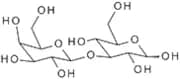
3-O-(β-D-Galactopyranosyl)-D-glucopyranose
CAS:<p>3-O-(β-D-Galactopyranosyl)-D-glucopyranose is a custom synthesis, modification, and fluorination of a monosaccharide. It is a synthetic and modified saccharide. The molecular formula for this compound is C6H10O5 and its molecular weight is 180.17 g/mol. This chemical has been assigned CAS No. 28447-38-3 and has the following structure:</p>Formula:C12H22O11Purity:Min. 95%Color and Shape:White PowderMolecular weight:342.3 g/molGT1b-Ganglioside ammonium
CAS:<p>GT1b ganglioside (ammonium salt) has a core tetrasaccharide structure (Galβ1,3GalNAcβ1,4Galβ1,4Glc) with two sialic acids (NeuAc) linked α2,3/α2,8 to the inner galactose residue, sialic acid (NeuAc) linked α2,3 to the terminal galactose residue, and ceramide linked β to position 1 on the reducing terminal glucose residue (Ledeen, 2009). GT1b ganglioside is one of the major gangliosides in neuronal and glial membranes. It interacts with myelin-associated glycoprotein (MAG) and is essential for long-term axon-myelin stability. GT1b ganglioside also acts as a receptor for bacterial toxins, such as, tetanus and botulinum toxins (Nishiki, 1996), as well as for viruses. A few examples of which include: Merkel cell polyomavirus, JC virus, BK virus, norovirus, and others (Low, 2006).</p>Formula:C95H165N5O48·xNH4Purity:Min. 95%Color and Shape:PowderMolecular weight:2,145.33 g/mol6-O-(2-Acetamido-2-deoxy-b-D-galactopyranosyl)-D-galactopyranose
<p>6-O-(2-Acetamido-2-deoxy-b-D-galactopyranosyl)-D-galactopyranose is a fluorinated carbohydrate that belongs to the group of saccharides. It is a monosaccharide and can be custom synthesized for specific purposes. This product has been modified with click chemistry, methylation, and glycosylation. 6-O-(2-Acetamido-2-deoxy-b-D-galactopyranosyl)-D-galactopyranose is soluble in water and has high purity.</p>Formula:C14H25NO11Purity:Min. 90 Area-%Color and Shape:PowderMolecular weight:383.35 g/molMethyl 2-O-(a-D-mannopyranosyl)-a-D-mannopyranoside
CAS:<p>Used for structural and conformational studies and as enzyme substrates</p>Formula:C13H24O11Purity:Min. 95%Color and Shape:PowderMolecular weight:356.32 g/molGD3-Ganglioside sodium
CAS:<p>GD3 (shown as sodium salt) has a core disaccharide structure (Galβ1,4Glc) with two sialic acids linked α2,3/α2,8 to the non-reducing galactose residue and ceramide linked β to position 1 on the reducing terminal glucose residue (Ledeen, 2009). GD3 is a minor ganglioside in most normal tissues but plays a crucial role in the development of the brain; it is significantly reduced in adults. However, expression of GD3 is increased in pathological conditions, such as, cancers and neurodegenerative disorders (Malisan, 2002). GD3 was the first cancer-associated ganglioside discovered that promotes adhesion and invasion of cancers. GD3 and GD2 are highly expressed in a various malignant tumours and have become potential targets for next-generation cancer therapy (Liu, 2018).</p>Formula:C70H125N3O29·xNaPurity:One SpotColor and Shape:White/Off-White SolidMolecular weight:1,472.74 g/molBlood Group A tetrasaccharide type V
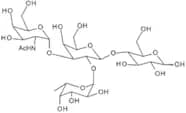
CAS:<p>Core antigen fragment in ABO blood group system</p>Formula:C26H45NO20Purity:Min. 90%Color and Shape:White PowderMolecular weight:691.63 g/mol3'-Sialyllactose-sp-biotin
CAS:<p>3'-Sialyllactose-sp-biotin is a monosaccharide that is modified with fluorine. It has been used in the synthesis of glycosylated proteins and peptides. 3'-Sialyllactose-sp-biotin is also used to modify glycoproteins, which are proteins that contain carbohydrate chains. The modification with fluorine makes this product ideal for use in the synthesis of glycosylated proteins and peptides.</p>Formula:C42H71N5O22SPurity:Min. 95%Color and Shape:White Off-White PowderMolecular weight:1,030.1 g/molIsomalt
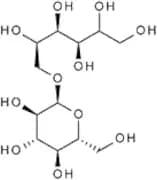
CAS:<p>Used as a sugar replacer in sugar-free confectionery and beverages</p>Formula:C12H24O11Purity:Min. 98 Area-%Color and Shape:White PowderMolecular weight:344.31 g/molLS-tetrasaccharide C -sp-biotin
<p>LS-tetrasaccharide C -sp-biotin is a custom synthesis of an oligosaccharide with modifications. It is a high purity, synthetic biotinylated polysaccharide. LS-tetrasaccharide C -sp-biotin has been fluorinated and glycosylated. This product is a complex carbohydrate that has been modified with methylation and click chemistry.</p>Purity:Min. 95%Glycyl-6'-sialyllactose
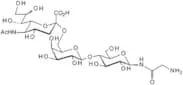
<p>Glycyl-6'-sialyllactose is a custom synthesis that modifies glycyl 6'-sialyllactose. It has been fluorinated, methylated and then monosaccharide and synthetic. This product has been Click modified, which is an oligosaccharide. The CAS number for this product is 1040391-14-8. Glycyl-6'-sialyllactose is a saccharide with a complex carbohydrate structure. It is a sugar that contains the carbohydrates glucose, galactose and sialic acid.</p>Formula:C25H43N3O19Purity:Min. 95%Molecular weight:689.62 g/mol4-Cyclohexylbutyl-4-O-(α-D-glucopyranosyl)-β-D-glucopyranoside
CAS:<p>For more than two decades, there has been substantial interest in developing novel membrane mimics specifically targeted for the biochemical and biophysical characterization of membrane proteins. Examples include new types of detergents, such as cycloalkyl maltosides (CYMAL detergents).</p>Formula:C22H40O11Color and Shape:PowderMolecular weight:480.55 g/mol1,1,1,1-Kestohexose
CAS:<p>Non-reducing sucrose analog containing glucose and fructose</p>Formula:C36H62O31Purity:Min. 90%Color and Shape:White PowderMolecular weight:990.86 g/molGalacturonan DP3 sodium salt
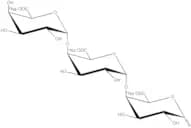
<p>Sodium Trigalacturonate (α-1,4 sodium galacturonotriose) is derived from pectin or pectic acid, by enzymatic or partial acid hydrolysis (Combo, 2012). It is used inâ¯galacturonic acidâ¯metabolism research as a substrate to identify, differentiate, and characterize endo- and exopolygalacturonase(s), and gluconase(s) (Jayani, 2005). The addition of very short fragments of homogalacturonan, tri-galacturonate, and tetra-galacturonate oligosaccharides, restore development in dark-grown, de-etiolated seedling mutants, suggesting that they are unable to generate de-methylesterified pectin fragments. A model of spatiotemporally separated photoreceptive and signal-responsive cell types has been proposed, that contains overlapping subsets of the regulatory network of light-dependent seedling development (Sinclair, 2017).</p>Purity:Min. 75 Area-%Color and Shape:PowderLaminaritriose hendecaacetate
<p>Fully acetylated laminaritriose</p>Formula:C40H54O27Purity:Min. 95%Molecular weight:966.84 g/molLacto-N-fucopentaose V
CAS:<p>Human milk oligosaccharide; binds cholera toxin TcdA</p>Formula:C32H55NO25Purity:Min. 80%Color and Shape:PowderMolecular weight:853.77 g/molHyaluronic acid tetrasaccharide
CAS:<p>Hyaluronic acid is a polysaccharide containing repeating disaccharide units of 1,3-N-acetyl glucosamine and 1, 4-glucuronic acid. This tetrasaccharide and other enzymatically produced polymer homologs have been of value in the study of hyaluronic acid metabolism in both healthy and diseased tissues (Hascall, 2019).</p>Formula:C28H44N2O23Purity:Min. 95%Color and Shape:White PowderMolecular weight:776.65 g/mol6-o-a-D-Glucosyl-maltose
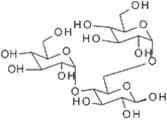
CAS:<p>Minor trisaccharide component of honey</p>Formula:C18H32O16Purity:Min. 95%Color and Shape:White Off-White PowderMolecular weight:504.44 g/molD-Celloheptaose
CAS:<p>D-Celloheptaose is a modified glycosylated oligosaccharide. It is synthesized by the methylation of D-cellotriose with 3-aminopropyl-trimethoxysilane and the subsequent reaction with bromoethanol. The product is purified by fractional crystallization from methanol to give a white crystalline solid. This product has CAS No. 52646-27-2 and is soluble in methanol, ethanol, water, acetone and chloroform.</p>Formula:C42H72O36Purity:Min. 95 Area-%Color and Shape:PowderMolecular weight:1,153.02 g/molLewis A tetrasaccharide
CAS:<p>Lewis A tetrasaccharide is a glycosylated oligosaccharide with the following chemical structure: The Lewis A tetrasaccharide is a carbohydrate that has been modified with fluorination and methylation. This modification has been shown to increase its stability in aqueous environments. The Lewis A tetrasaccharide may be used as a synthetic monosaccharide for custom synthesis. It is also used as an intermediate for the synthesis of glycosylated oligosacscharsides.</p>Formula:C26H45NO20Purity:90%Color and Shape:White PowderMolecular weight:691.64 g/mol3'-Sialyllactose sodium salt
CAS:<p>3'-Sialyllactose is found in milk with immunoprotective effects against pathogens in newborns and aids development and maturation of the immune system and gut microbiota. It suppresses adhesion and infectivity of bacteria and viruses, such as influenza viruses, HIV-1 and rotaviruses and inhibits binding of cholera toxin.</p>Formula:C23H38NO19NaPurity:Min. 90%Color and Shape:White PowderMolecular weight:655.53 g/mol