Benzimidazole and Imidazole Derivatives
Benzimidazole is a compound consisting of a benzene ring fused to an imidazole ring, a five-membered structure containing two nitrogen atoms. Benzimidazole derivatives, such as albendazole, are known for their antiparasitic and antifungal activity, used in the treatment of parasitic infections and certain parasitic diseases in animals and humans. Imidazole, on the other hand, is a five-membered structure with two nitrogen atoms found in various biologically active compounds. Imidazole derivatives, such as metronidazole, have antimicrobial and antiparasitic properties. These compounds are also used in the pharmaceutical industry for treating bacterial infections, parasitic diseases, and some fungal infections, as well as in organic chemistry as catalysts.
At CymitQuimica, we offer high-purity benzimidazoles and imidazoles for research in medicinal chemistry, pharmacology, and biotechnology.
Found 10376 products of "Benzimidazole and Imidazole Derivatives"
Sort by
Purity (%)
0
100
|
0
|
50
|
90
|
95
|
100
PD 224378
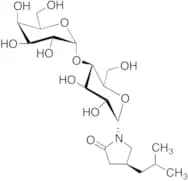
CAS:Controlled Product<p>Stability Very Hygroscopic<br>Applications PD 224378 is a lactose conjugate degradation product of pregabalin (P704800), a GABA analogue used as an anticonvulsant.<br>References Lovdahl, M.J., et al.: J. Pharma. Biomed. Anal., 28, 917 (2002);<br></p>Formula:C20H35NO11Color and Shape:NeatMolecular weight:465.49ent-Voriconazole
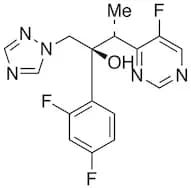
CAS:Controlled Product<p>Impurity Voriconazole EP Impurity D; Voriconazole USP Related Compound B<br>Applications ent-Voriconazole (Voriconazole USP Related Compound B; Voriconazole EP Impurity D) is the (2S,3R) enantiomer in Voriconazole (V760000) drug substance.<br> Not a dangerous good if item is equal to or less than 1g/ml and there is less than 100g/ml in the package<br>References Gage, R., et al.: J. Pharm. Biomed. Anal., 17, 1449 (1998), Owens, P., et al.: Enantiomer, 4, 79 (1999), Pehourcq, F., et al.: Biomed. Chromatogr., 18, 719 (2004), Sellers, J., et al.: J. Pharm. Biomed. Anal., 41, 1088 (2006),<br></p>Formula:C16H14F3N5OColor and Shape:NeatMolecular weight:349.31N-Nitroso Albendazole (mixtures of regional isomers)
Controlled ProductFormula:C13H16N4O3SColor and Shape:NeatMolecular weight:616.7122-(Chloromethyl)-3,5-dimethylpyridine Hydrochloride
CAS:Controlled Product<p>Applications Intermediate in the preparation of Omeprazole metabolites<br></p>Formula:C8H10ClN·ClHColor and Shape:NeatMolecular weight:192.094-Acetoxy Midazolam
CAS:Controlled Product<p>Applications A metabolite of Midazolam (M343000).<br></p>Formula:C20H15ClFN3O2Color and Shape:NeatMolecular weight:383.801-(1H-Benzo[d]imidazol-2-yl)-3-methyl-4-oxo-1,4-dihydropyridine-2-carboxylic acid Sodium Salt
CAS:<p>Applications 1-(1H-Benzo[d]imidazol-2-yl)-3-methyl-4-oxo-1,4-dihydropyridine-2-carboxylic acid is an impurity of Rabeprazole. It is also a degradation product formed in stressed tablets of Rabeprazole sodium.<br>References Kommanaboyina, B., et al.: Drug Dev. Ind. Pharm., 25, 857 (1999); Carswel, C., et al.: Drugs, 61, 2327 (2001); Garcia, C., et al.: J. Pharm. Biomed. Anal., 46, 88 (2008)<br></p>Formula:C14H10N3NaO3Color and Shape:NeatMolecular weight:291.24N-Carbamoyl Carbamazepine
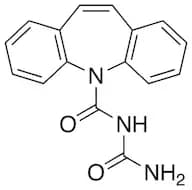
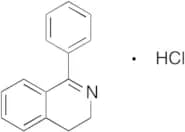
CAS:Controlled Product<p>Impurity Carbamazepine EP Impurity C<br>Applications Carbamazepine (C175840) impurity.<br></p>Formula:C16H13N3O2Color and Shape:NeatMolecular weight:279.293,4-Dihydro-1-phenylisoquinoline Hydrochloride
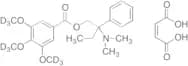
CAS:Controlled Product<p>Stability Light Sensitive<br>Applications 3,4-Dihydro-1-phenylisoquinoline has been shown to have anesthetic properties.<br> Not a dangerous good if item is equal to or less than 1g/ml and there is less than 100g/ml in the package<br>References Moore, M.B., et. al.: J. Am. Chem. Soc., 76, 3656 (1954)<br></p>Formula:C15H13N·ClHColor and Shape:NeatMolecular weight:243.73Trimebutine-d9 Maleate Salt
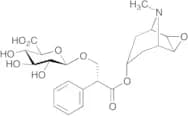
CAS:Controlled Product<p>Applications Trimebutine-d9 Maleate Salt, is the labeled analogue of Trimebutine Maleate Salt (T795605), acting as an opioid receptor agonist. Antispasmodic.<br>References Delvaux, M., et al.: J. Int. Med. Res., 25, 225 (1997), Lavit, M., et al.: Arzneim.-Forsch., 50, 640 (2000),<br></p>Formula:C22H20D9NO5·C4H4O4Color and Shape:NeatMolecular weight:512.6Scopolamine β-D-Glucuronide
CAS:Controlled Product<p>Stability Hygroscopic<br>Applications A metabolite of Scopolamine.<br>References Shutt, L., et al.: Anaesthesia, 34, 476 (1979), Wada, S., et al.: Xenobiotica, 21, 1289 (1991), Chen, X., et al.: Acta Pharm. Sin., 33, 849(1998),<br></p>Formula:C23H29NO10Purity:>85%Color and Shape:NeatMolecular weight:479.481-(1H-Benzo[d]imidazol-2-yl)-3-methyl-4-oxo-1,4-dihydropyridine-2-carboxylic acid (>75%)
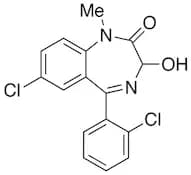
CAS:<p>Impurity Rabeprazole EP Impurity C<br>Applications 1-(1H-Benzo[d]imidazol-2-yl)-3-methyl-4-oxo-1,4-dihydropyridine-2-carboxylic acid (>75%) (Rabeprazole EP Impurity C) is a Rabeprazole (R070500) impurity. A degradation product formed in stressed tablets of Rabeprazole sodium.<br>References Kommanaboyina, B., et al.: Drug Dev. Ind. Pharm., 25, 857 (1999), Carswel, C., et al.: Drugs, 61, 2327 (2001), Garcia, C., et al.: J. Pharm. Biomed. Anal., 46, 88 (2008),<br></p>Formula:C14H11N3O3Purity:>75%Color and Shape:NeatMolecular weight:269.26Lormetazepam
CAS:Controlled Product<p>Applications An analog of Lorazepam (L469850). Sedative, hypnotic.Controlled substance (depressant).<br>References Nudelman, A., et al.: J. Pharma. Sci., 63, 1886 (1974), Humpel, M., et al.: Eur. J. Drug Metab. Pharmacokinet., 4, 237 (1979), Girkin, R., et al.: Xenobiotica, 10, 401 (1980),<br></p>Formula:C16H12Cl2N2O2Color and Shape:Light Yellow To Light GreenMolecular weight:335.182,12-Dihydro-1,3-dimethyl-8-methoxy-12-thioxobenzo [4,5] pyrido [1,2-c] imidazo [1,2-a] imidazol-2-one
CAS:<p>2,12-Dihydro-1,3-dimethyl-8-methoxy-12-thioxobenzo [4,5] pyrido [1,2-c] imidazo [1,2-a] imidazol-2-one is a metabolite of the drug 2-[2-(4,5,-dihydroimidazo[1,2a]imidazol -2(3H)-yl)ethoxy]-N-(methylsulfonyl)benzamide. It can be used as an impurity standard for the manufacture of drugs and as a research chemical.</p>Formula:C16H13N3O2SPurity:Min. 95%Molecular weight:311.36 g/mol6-Methyl-4-phenyl-3,4-dihydro-1-benzopyran-2-one
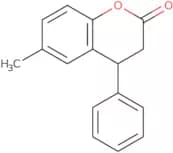
CAS:<p>6-Methyl-4-phenyl-3,4-dihydro-1-benzopyran-2-one is an analog of the natural product zearalenone, which can be used as an acid catalyst for the synthesis of various pharmaceuticals. It has a linear range and is structurally similar to a number of other analogs. The chloride ion is involved in the optimization of the extraction parameters and can be replaced by other c1-4 alkyl groups. 6-Methyl-4-phenyl-3,4-dihydro-1 -benzopyran 2 one is typically prepared using a preparative high performance liquid chromatography technique that involves dehydration.</p>Formula:C16H14O2Purity:Min. 95%Molecular weight:238.28 g/molOxybutynin impurity C
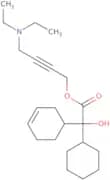
CAS:<p>Oxybutynin impurity C is a metabolite of the drug product Oxybutynin (CAS No. 1199574-70-3). It is an analytical standard for HPLC, and a natural impurity in the synthesis of Oxybutynin. This is a synthetic compound that has been shown to be metabolized through oxidation by cytochrome P450 enzymes, reduction by glutathione reductase, or conjugation with glucuronic acid. Oxybutynin impurity C has been used as an analytical reference material for drug development and research and development.</p>Purity:Min. 95%Oxybutynin EP impurity A
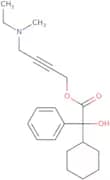
CAS:<p>Oxybutynin EP impurity A is a metabolite of oxybutynin, an antispasmodic drug. It has been shown to have immunomodulatory effects in a rat model of adjuvant arthritis. Oxybutynin EP impurity A is the major metabolite of oxybutynin and has been shown to be pharmacologically active in humans.</p>Purity:Min. 95%2-Methoxy-5-methyl-γ-phenylbenzenepropanol
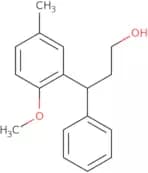
CAS:<p>2-Methoxy-5-methyl-gamma-phenylbenzenepropanol is a synthetic compound that is used as an intermediate in the synthesis of coumarin derivatives. Reaction with sulfonating agents produces sulfones, and reaction with borohydride reagents produces boronates. The synthesis of 2-methoxy-5-methyl-gamma-phenylbenzenepropanol can be accomplished by the reduction of diphenyl ethers with lithium aluminum hydride or borohydride. The reduction can also be carried out using lanthanum oxide and potassium borohydride. The reaction proceeds smoothly at room temperature in nonpolar solvents.<br>2-Methoxy-5-methyl-gamma-phenylbenzenepropanol reacts with chloride to produce the corresponding chlorides, which are useful intermediates for the synthesis of tolterodine tartrate, a drug used to treat urinary inc</p>Formula:C17H20O2Purity:Min. 95%Molecular weight:256.34 g/mol2-[(4-Chloro-3-methyl-2-pyridinyl)methylthio]-1H-benzimidazole
CAS:<p>2-[(4-Chloro-3-methyl-2-pyridinyl)methylthio]-1H-benzimidazole is a drug product. It is an impurity standard for the analytical determination of 2-[(4-chloro-3-methylpyridin)-2yl]thiohydantoin in pharmaceuticals and other chemical products. This compound is also used as a research and development (R&D) metabolite and impurity standard for the synthesis of 4-(4,5,6,7-tetrahydrobenzo[b]thiophen-2-yl)pyridine. The CAS number for this compound is 103312-62-5./END></p>Formula:C14H12ClN3SPurity:Min. 95%Molecular weight:289.78 g/molScopine-2,2-dithienyl glycolate
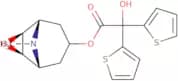
CAS:<p>Scopine-2,2-dithienyl glycolate is a catalyst that belongs to the class of dithienyl glycolates. Scopine-2,2-dithienyl glycolate is used in the pharmaceutical industry as an average catalyst for reactions and can be used to recover dimethylbenzene. The method of detection for scopine-2,2-dithienyl glycolate is based on its ability to absorb light at a wavelength of 360 nm. The reaction solution must be monitored carefully during the synthetic process because it has been shown that it can react with water or air and form hydrogen sulfide gas. If this happens, the reaction solution will become cloudy or turbid. This product is a white crystalline solid that appears as tiny needles and has a melting point of 173 degrees Celsius (340 degrees Fahrenheit).</p>Formula:C18H19NO4S2Purity:Min. 95%Molecular weight:377.48 g/molSolifenacin EP impurity F succinate
CAS:<p>Solifenacin is an anti-cholinergic drug that has been shown to have a potent antagonistic effect on muscarinic receptors. It is used in the treatment of overactive bladder, urinary incontinence, and irritable bowel syndrome. Solifenacin succinate is a metabolite of solifenacin and it has been found to be an antagonist of M3 muscarinic receptors. The presence of solifenacin and its metabolites in wastewater can interfere with treatment processes by inhibiting the removal of other organic chemicals such as tamsulosin hydrochloride. Optimisation studies for solifenacin production have shown that famotidine can be used as a process aid to reduce solifenacin impurities. Famotidine is also an antagonist of M3 muscarinic receptors and can be used to remove solifenacin from wastewater. Analytes detected in wastewater samples include solifenacin, famot</p>Formula:C27H32N2O6Purity:Min. 95%Molecular weight:480.55 g/mol



![1-(1H-Benzo[d]imidazol-2-yl)-3-methyl-4-oxo-1,4-dihydropyridine-2-carboxylic acid Sodium Salt](/_next/image/?url=https%3A%2Fstatic.cymitquimica.com%2Fproducts%2FTR%2Fthumb-webp%2FB203965.webp&w=3840&q=75)
![1-(1H-Benzo[d]imidazol-2-yl)-3-methyl-4-oxo-1,4-dihydropyridine-2-carboxylic acid (>75%)](/_next/image/?url=https%3A%2Fstatic.cymitquimica.com%2Fproducts%2FTR%2Fthumb-webp%2FB203960.webp&w=3840&q=75)
![2,12-Dihydro-1,3-dimethyl-8-methoxy-12-thioxobenzo [4,5] pyrido [1,2-c] imidazo [1,2-a] imidazol-2…](/_next/image/?url=https%3A%2Fstatic.cymitquimica.com%2Fproducts%2F3D%2Fthumb-webp%2FID57924.webp&w=3840&q=75)

![2-[(4-Chloro-3-methyl-2-pyridinyl)methylthio]-1H-benzimidazole](/_next/image/?url=https%3A%2Fstatic.cymitquimica.com%2Fproducts%2F3D%2Fthumb-webp%2FIC21227.webp&w=3840&q=75)