Benzimidazole and Imidazole Derivatives
Benzimidazole is a compound consisting of a benzene ring fused to an imidazole ring, a five-membered structure containing two nitrogen atoms. Benzimidazole derivatives, such as albendazole, are known for their antiparasitic and antifungal activity, used in the treatment of parasitic infections and certain parasitic diseases in animals and humans. Imidazole, on the other hand, is a five-membered structure with two nitrogen atoms found in various biologically active compounds. Imidazole derivatives, such as metronidazole, have antimicrobial and antiparasitic properties. These compounds are also used in the pharmaceutical industry for treating bacterial infections, parasitic diseases, and some fungal infections, as well as in organic chemistry as catalysts.
At CymitQuimica, we offer high-purity benzimidazoles and imidazoles for research in medicinal chemistry, pharmacology, and biotechnology.
Found 10375 products of "Benzimidazole and Imidazole Derivatives"
Sort by
Purity (%)
0
100
|
0
|
50
|
90
|
95
|
100
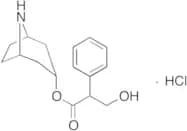
Noratropine Hydrochloride
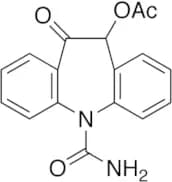
CAS:Controlled Product<p>Stability Hygroscopic<br>Applications A metabolite of Atropine (A794625). Two metabolites of Atropine (apoatropine and noratropine) were found in rat urine.<br>References Xu, A., et al.: J. Pharm. Biomed. Anal., 14, 33 (1995), Cherkaoui, S., et al.: J. Pharm. Biomed. Anal., 17, 1167 (1998),<br></p>Formula:C16H21NO3·HClColor and Shape:BrownMolecular weight:311.8010-Acetyloxy Oxcarbazepine
CAS:Controlled Product<p>Applications An intermediate in the preparation of Carbamazepine metabolites.<br>References Heckendorn, R., et al.: Helv. Chimica Acta, 70, 1955 (1987),<br></p>Formula:C17H14N2O4Color and Shape:NeatMolecular weight:310.30N-[[4-(3-Methoxypropoxy)-3-methyl-2-pyridinyl]methyl] Rabeprazole Sulfide
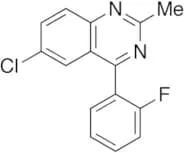
CAS:Controlled Product<p>Applications Rabeprazole (R070500) N-aralkyl impurity.<br>References Fujisaki, H., et al.: Biochem. Pharmacol., 42, 321 (1991), Morri, M., et al.: J. Biol. Chem., 268, 21553 (1993), Pingili, R., et al.: Pharmazie, 60, 814 (2005),<br></p>Formula:C29H36N4O4SColor and Shape:NeatMolecular weight:536.696-Chloro-2-methyl-4-(2-fluorophenyl)quinazoline
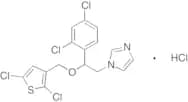
CAS:Controlled Product<p>Applications 6-Chloro-2-methyl-4-(2-fluorophenyl)quinazoline is a photochemical decomposition product of Midazolam (M343000), an anesthetic, anticonvulsant, sedative and hypotic agent.<br>References Anderson, R., et al.: J. Pharma. Biomed. Anal., 13, 667 (1995); Anderson, R., et al: Am. Clin. Lab., 16, 25 (1997);<br></p>Formula:C15H10ClFN2Color and Shape:NeatMolecular weight:272.702,5-Dichlorothiophen-3-yl Tioconazole Hydrochloride
CAS:Controlled ProductFormula:C16H12Cl4N2OS·ClHColor and Shape:NeatMolecular weight:458.62Temazepam
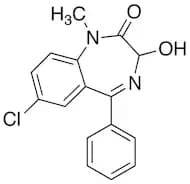
CAS:Controlled Product<p>Applications Temazepam is a pharmacologically active metabolite of Diazepam. It is used as a sedative and hypnotic drug.<br>References Sarteschi, P., et al.: Arzneim.-Forsch., 22, 93 (1972), Schwandt, H.J., et al.: Xenobiotica, 4, 733 (1974), Curry, S.H., et al.: Br. J. Pharmacol., 57, 427 (1976), Heel, R.C., et al.: Drugs, 21, 321 (1981),<br></p>Formula:C16H13ClN2O2Color and Shape:Light YellowMolecular weight:300.74PD 224378
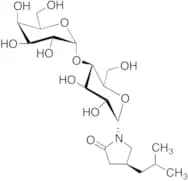
CAS:Controlled Product<p>Stability Very Hygroscopic<br>Applications PD 224378 is a lactose conjugate degradation product of pregabalin (P704800), a GABA analogue used as an anticonvulsant.<br>References Lovdahl, M.J., et al.: J. Pharma. Biomed. Anal., 28, 917 (2002);<br></p>Formula:C20H35NO11Color and Shape:NeatMolecular weight:465.49Scopolamine β-D-Glucuronide
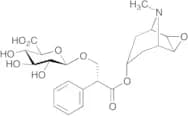
CAS:Controlled Product<p>Stability Hygroscopic<br>Applications A metabolite of Scopolamine.<br>References Shutt, L., et al.: Anaesthesia, 34, 476 (1979), Wada, S., et al.: Xenobiotica, 21, 1289 (1991), Chen, X., et al.: Acta Pharm. Sin., 33, 849(1998),<br></p>Formula:C23H29NO10Purity:>85%Color and Shape:NeatMolecular weight:479.48Lormetazepam
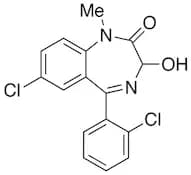
CAS:Controlled Product<p>Applications An analog of Lorazepam (L469850). Sedative, hypnotic.Controlled substance (depressant).<br>References Nudelman, A., et al.: J. Pharma. Sci., 63, 1886 (1974), Humpel, M., et al.: Eur. J. Drug Metab. Pharmacokinet., 4, 237 (1979), Girkin, R., et al.: Xenobiotica, 10, 401 (1980),<br></p>Formula:C16H12Cl2N2O2Color and Shape:Light Yellow To Light GreenMolecular weight:335.18Triazolam-d3
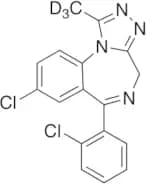
CAS:Controlled Product<p>Applications Labelled Triazolam (T767380(M)). Triazolam in an hypnotic drug used in the short term treatment of insomnia.<br>References Lomen, P., et al.: J. Int. Med. Res., 4, 55 (1976), Allens, G.S., et al.: J. Int. Med. Res., 6, 343 (1978), Pakes, G.E., et al.: Drugs, 22, 81 (1981).<br></p>Formula:C17H9D3Cl2N4Color and Shape:NeatMolecular weight:346.231',4-Dihydroxy Midazolam
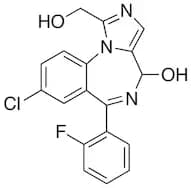
CAS:Controlled Product<p>Applications A metabolite of Midazolam (M343000).<br>References Soucek, P., et al.: Xenobiotica, 22, 83 (1992), Ghosal, A., et al.: Drug Metab. Dispos., 24, 940 (1996), Kobayashi, K., et al.: Biochem. Pharmacol., 63, 889 (2002),<br></p>Formula:C18H13ClFN3O2Color and Shape:NeatMolecular weight:357.77Solifenacin Impurity D
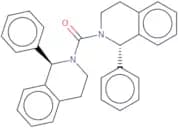
CAS:<p>Solifenacin Impurity D is a synthetic impurity of solifenacin. Solifenacin is an anti-cholinergic drug used to treat overactive bladder and urinary incontinence. The purity of this product is 99%. It is soluble in methanol, ethanol, chloroform, and acetone. Solifenacin Impurity D can be used as a reference material for analytical purposes or as an impurity standard in the development of new drugs.</p>Formula:C31H28N2OPurity:Min. 96 Area-%Color and Shape:White PowderMolecular weight:444.57 g/molTiotropium Bromide EP Impurity G
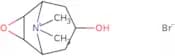
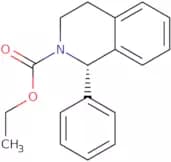
CAS:<p>Tiotropium Bromide EP Impurity G is an anticholinergic bronchodilator that is used in the treatment of asthma. Tiotropium Bromide EP Impurity G has been shown to have long-acting properties, with a half-life of about 20 hours. It has a high affinity for the muscarinic receptor and acts as a competitive antagonist at this site. Tiotropium Bromide EP Impurity G also has a cavity, which may be necessary for its activity.</p>Formula:C9H6BrNO2Purity:Min. 95%Molecular weight:240.05 g/molEthyl (S)-1-phenyl-1,2,3,4-tetrahydro-2-isoquinolinecarboxylate
CAS:<p>Ethyl (S)-1-phenyl-1,2,3,4-tetrahydro-2-isoquinolinecarboxylate is an analytical standard used to identify impurities in drug products. It is a metabolite of the drug product and has been shown to be safe for human consumption. The compound is a synthetic chemical that is not found naturally in the environment. CAS No. 180468-42-2</p>Formula:C18H19NO2Purity:Min. 95%Molecular weight:281.35 g/molAlbendazole impurity F
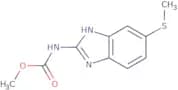
CAS:<p>Albendazole is an anti-helminthic drug that is structurally classified as a benzimidazole. It has been shown to be effective against a variety of helminths, including roundworms, pinworms, hookworms, and tapeworms. Albendazole impurity F is an analytical standard for the determination of albendazole in pharmaceutical products by HPLC. It also serves as a reference substance to establish the purity of drug products containing albendazole and its metabolites. Albendazole impurity F is not considered to be a metabolite of albendazole because it has been shown to be stable under acidic conditions and can be synthesized from other starting materials.</p>Formula:C10H11N3O2SPurity:Min. 95%Molecular weight:237.28 g/mol1-[[4-(3-Methoxypropoxy)-3-methyl-2-pyridinyl]methyl]-2-[[[4-(3-methoxypropoxy)-3-methyl-2-pyridinyl]methyl]thio]-1H-benzimidazole
CAS:<p>1-[[4-(3-Methoxypropoxy)-3-methyl-2-pyridinyl]methyl]-2-[[[4-(3-methoxypropoxy)-3-methyl-2-pyridinyl]methyl]thio]-1H-benzimidazole is a drug product with analytical applications. It has been shown to have natural and synthetic origins, as well as impurities of its own. It is a custom synthesis and research and development compound that is used for HPLC standardization. The compound has been synthesized for the purpose of drug development and it is intended for niche use.</p>Formula:C29H36N4O4SPurity:Min. 95%Molecular weight:536.69 g/mol(R)-1-Phenyl-1,2,3,4-tetrahydroisoquinoline
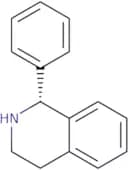
CAS:<p>(R)-1-Phenyl-1,2,3,4-tetrahydroisoquinoline is a chiral molecule with four stereocenters. It is synthesized by the reaction of sulfamic acid and cyclohexene in the presence of p-toluenesulfonic acid. The product formed is then dehydrogenated to produce (R)-1-phenyl-1,2,3,4-tetrahydroisoquinoline. This compound is soluble in organic solvents such as benzene and ethane and can be used as an acceptor for chiral stationary phases.</p>Formula:C15H15NPurity:Min. 95%Color and Shape:PowderMolecular weight:209.29 g/molN-Desalkyl itraconazole
CAS:<p>N-Desalkyl itraconazole is a triazole antifungal drug that belongs to the group of medicines. It is used in the treatment of systemic mycoses, including blastomycosis and histoplasmosis. N-Desalkyl itraconazole has been shown to inhibit the growth of fungi by interfering with their cell membranes and inhibiting their production of ergosterol. Calibration studies have shown that this drug binds to human liver microsomes and plasma proteins, as well as transporters such as P-glycoprotein. These interactions may influence its pharmacokinetics, which can be determined using a bioanalytical method.</p>Formula:C31H30Cl2N8O4Purity:Min. 95%Molecular weight:649.53 g/molOxybutynin impurity C
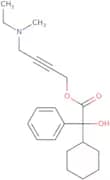
CAS:<p>Oxybutynin impurity C is a metabolite of the drug product Oxybutynin (CAS No. 1199574-70-3). It is an analytical standard for HPLC, and a natural impurity in the synthesis of Oxybutynin. This is a synthetic compound that has been shown to be metabolized through oxidation by cytochrome P450 enzymes, reduction by glutathione reductase, or conjugation with glucuronic acid. Oxybutynin impurity C has been used as an analytical reference material for drug development and research and development.</p>Purity:Min. 95%Scopine-2,2-dithienyl glycolate
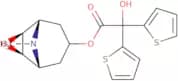
CAS:<p>Scopine-2,2-dithienyl glycolate is a catalyst that belongs to the class of dithienyl glycolates. Scopine-2,2-dithienyl glycolate is used in the pharmaceutical industry as an average catalyst for reactions and can be used to recover dimethylbenzene. The method of detection for scopine-2,2-dithienyl glycolate is based on its ability to absorb light at a wavelength of 360 nm. The reaction solution must be monitored carefully during the synthetic process because it has been shown that it can react with water or air and form hydrogen sulfide gas. If this happens, the reaction solution will become cloudy or turbid. This product is a white crystalline solid that appears as tiny needles and has a melting point of 173 degrees Celsius (340 degrees Fahrenheit).</p>Formula:C18H19NO4S2Purity:Min. 95%Molecular weight:377.48 g/mol

![N-[[4-(3-Methoxypropoxy)-3-methyl-2-pyridinyl]methyl] Rabeprazole Sulfide](/_next/image/?url=https%3A%2Fstatic.cymitquimica.com%2Fproducts%2FTR%2Fthumb-webp%2FM265175.webp&w=3840&q=75)

![1-[[4-(3-Methoxypropoxy)-3-methyl-2-pyridinyl]methyl]-2-[[[4-(3-methoxypropoxy)-3-methyl-2-pyridin…](/_next/image/?url=https%3A%2Fstatic.cymitquimica.com%2Fproducts%2F3D%2Fthumb-webp%2FIM25351.webp&w=3840&q=75)