Peptides and Proteins
Peptides are short chains of amino acids linked by peptide bonds, whereas proteins are longer and more complex amino acid chains that can adopt functional three-dimensional structures. Both types of compounds are essential for various biological functions, such as catalysing reactions (enzymes), immune defence (antibodies), and cellular signalling. Proteins have a hierarchical structure, including the amino acid sequence, secondary, tertiary, and quaternary structures. Peptides are used in pharmaceutical and cosmetic therapies due to their specific biological properties, such as in the treatment of metabolic diseases or enhancing cellular regeneration. Proteins, on the other hand, have applications in biotechnology, nutrition, and regenerative medicine.
At CymitQuimica, we offer high-purity peptides and proteins for research in biotechnology and therapeutic applications.
Found 3121 products of "Peptides and Proteins"
Sort by
Purity (%)
0
100
|
0
|
50
|
90
|
95
|
100
4-(Phenylamino]-1-benzyl-4-piperidinecarboxylic Acid Methyl Ester
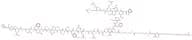
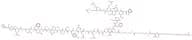
CAS:Controlled Product<p>Applications Remifentanil derivative.<br>References James, M.K., et al.: J. Pharmacol. Exp. Ther., 259, 712 (1991), Hoffman, W.E., et al.: Anesthesiology, 79, 107 (1993), Selinger, K., et al.: J. Pharm. Biomed. Anal., 12, 243 (1994), Richardson, T.D., et al.: Expert Opin. Drug Saf., 4, 643 (2005),<br></p>Formula:C20H24N2O2Color and Shape:NeatMolecular weight:324.4168Liraglutide
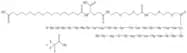
CAS:Controlled ProductFormula:C172H265N43O51Color and Shape:Off-WhiteMolecular weight:3751.2Bivalirudin Plus-Gly Fragment Trifluoroacetic Acid Salt (Impurity)
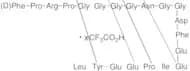
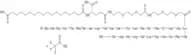
<p>Applications Impurity of Bivalirudin, a direct thrombin inhibitor acting as an anticoagulant through inhibition of the enzyme thrombin.<br>References Bertrand, O. et al.: Am. J. Cardio., 110, 599 (2012); Patti, G. et al.: Am. J. Cardio., 110, 478 (2012);<br></p>Formula:C100H141N25O34•xC2HF3O2Color and Shape:NeatMolecular weight:2237.34 + x(114.02)Thyroxine Sodium Salt
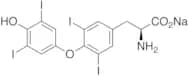
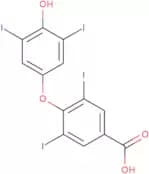
CAS:Controlled Product<p>Stability Hygroscopic<br>Applications One of the thyroid hormones involved in the maintenance of metabolic homeostasis. Synthesized and stored as amino acid residues of thyroglobulin, the major protein component of the thyroid follicular colloid. Synthesis and secretion are regulated by the pituitary hormone (TSH). Deiodinated in peripheral tissues to the active metabolite, liothyronine. The D-form has very little activity as a thyroid hormone, but has been used to treat hyperlipidemia.<br>References Post, A., et al.: Anal. Profiles Drug Subs., 5, 225 (1976), Nelson, J.C., et al.: Clin. Chem., 34, 1737 (1988), Fischer, D.A., et al.: Clin. Chem., 42, 135 (1996), Cavalieri, R.R., et al.: Thyroid, 7, 177 (1997),<br></p>Formula:C15H10I4NO4·NaColor and Shape:NeatMolecular weight:798.85D-Thr(5)-Semaglutide
<p>D-Thr(5)-Semaglutide is a semaglutide impurity. The amino acid at position 5 has been replaced by the D-form of the amino acid D-threonine (D-Thr). Semaglutide impurities are structurally related compounds that arise during synthesis, purification, or storage of semaglutide, a long-acting GLP-1 receptor agonist for managing type 2 diabetes and obesity.</p>Formula:C187H291N45O59Molecular weight:4,113.64 g/molD-Phe(6)-Semaglutide
<p>D-Phe(6)-Semaglutide is a semaglutide impurity. The amino acid at position 6 has been replaced by the D-form of the amino acid D-phenylalanine (D-Phe). Semaglutide impurities are structurally related compounds that arise during synthesis, purification, or storage of semaglutide, a long-acting GLP-1 receptor agonist for managing type 2 diabetes and obesity.</p>Formula:C187H291N45O59Molecular weight:4,113.64 g/mol3,3',5,5'-Tetraiodothyroformic acid
CAS:<p>Cymit Quimicaetic beta-D-glucosiduronic acid</p>Formula:C13H6I4O4Purity:Min. 95 Area-%Color and Shape:Off-White PowderMolecular weight:733.8 g/molD-His(1)-Semaglutide
<p>D-His(1)-Semaglutide is a semaglutide impurity. The amino acid at position 1 has been replaced by the D-form of the amino acid D-histidine (D-His). Semaglutide impurities are structurally related compounds that arise during synthesis, purification, or storage of semaglutide, a long-acting GLP-1 receptor agonist for managing type 2 diabetes and obesity.</p>Formula:C187H291N45O59Molecular weight:4,113.64 g/molSemaglutide Impurity 56 (D-Glu 21)
<p>D-Glu(21)-Semaglutide is a semaglutide impurity. The amino acid at position 21 has been replaced by the D-form of the amino acid D-glutamic acid (D-Glu). Semaglutide impurities are structurally related compounds that arise during synthesis, purification, or storage of semaglutide, a long-acting GLP-1 receptor agonist for managing type 2 diabetes and obesity.</p>Formula:C187H291N45O59Molecular weight:4,113.64 g/molD-Val(10)-Semaglutide
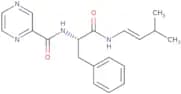
<p>D-Val(10)-Semaglutide is a semaglutide impurity. The amino acid at position 10 has been replaced by the D-form of the amino acid D-valine (D-Val). Semaglutide impurities are structurally related compounds that arise during synthesis, purification, or storage of semaglutide, a long-acting GLP-1 receptor agonist for managing type 2 diabetes and obesity.</p>Formula:C187H291N45O59Molecular weight:4,113.64 g/mol(S,E)-N-(1-(3-Methylbut-1-enylamino)-1-oxo-3-phenylpropan-2-yl)pyrazine-2-carboxamide
CAS:<p>R-N-(1-(3-methylbut-1-enyl)-1-oxo-3-phenylpropan-2-yl) pyrazine-2-carboxamide is a drug product that is used for the treatment of bacterial infections. The compound is an impurity in the synthesis of other compounds and is also used as an analytical standard. It is synthesized from commercially available starting materials and through custom synthesis. R-N-(1-(3-methylbut-1-enyl)-1--oxo--3--phenylpropan--2--yl)pyrazine--2--carboxamide has been shown to be metabolized by CYP450 enzymes, which are responsible for the metabolism of many drugs. R-(1-(3Methylbut 1Enylamino)-1Oxo 3Phenylpropan 2Yl)Pyrazine 2Carboxamide has not been evaluated as a drug product and therefore does not</p>Formula:C19H22N4O2Purity:Min. 95%Molecular weight:338.4 g/molSemaglutide Impurity 60 (D-Arg 30)
<p>D-Arg(30)-Semaglutide is a semaglutide impurity. The amino acid at position 30 has been replaced by the D-form of the amino acid D-arginine (D-Arg). Semaglutide impurities are structurally related compounds that arise during synthesis, purification, or storage of semaglutide, a long-acting GLP-1 receptor agonist for managing type 2 diabetes and obesity.</p>Formula:C187H291N45O59Molecular weight:4,113.64 g/molDes-His(1)-Semaglutide
<p>Des-His(1)-semaglutide is a semaglutide-related impurity. This des-amino acid form has the histidine (His) amino acid from position 1 removed from the peptide chain. Semaglutide impurities are structurally related compounds that arise during synthesis, purification, or storage of semaglutide, a long-acting GLP-1 receptor agonist used for managing type 2 diabetes and obesity.</p>Formula:C181H284N42O58Molecular weight:3,976.5 g/molLinear Semaglutide
<p>Linear semaglutide, or simply L-Sema, is the semaglutide compound without the lipid side chain modification. It is essentially a linear version of the peptide.</p>Formula:C152H230N42O47Molecular weight:3,397.76 g/molD-Ser(11)-Semaglutide
<p>D-Ser(11)-Semaglutide is a semaglutide impurity. The amino acid at position 11 has been replaced by the D-form of the amino acid D-serine (D-Ser). Semaglutide impurities are structurally related compounds that arise during synthesis, purification, or storage of semaglutide, a long-acting GLP-1 receptor agonist for managing type 2 diabetes and obesity.</p>Formula:C187H291N45O59Molecular weight:4,113.64 g/molD-Ala-(19)-Semaglutide
<p>D-Ala(19)-Semaglutide is a semaglutide impurity. The amino acid at position 19 has been replaced by the D-form of the amino acid D-alanine (D-Ala). Semaglutide impurities are structurally related compounds that arise during synthesis, purification, or storage of semaglutide, a long-acting GLP-1 receptor agonist for managing type 2 diabetes and obesity.</p>Formula:C187H291N45O59Molecular weight:4,113.64 g/molSemaglutide Impurity 101 (D-Glu 3)
<p>D-Glu(3)-Semaglutide is a semaglutide impurity. The amino acid at position 3 has been replaced by the D-form of the amino acid D-glutamic acid (D-Glu). Semaglutide impurities are structurally related compounds that arise during synthesis, purification, or storage of semaglutide, a long-acting GLP-1 receptor agonist for managing type 2 diabetes and obesity.</p>Formula:C187H291N45O59Molecular weight:4,113.64 g/molDes-Glu(3)-Semaglutide
<p>Des-Glu(3)-semaglutide is a semaglutide-related impurity. This des-amino acid form has got the glutamic acid or glutamate (Glu) amino acid from position 3 removed from the peptide chain. Semaglutide impurities are structurally related compounds that arise during synthesis, purification, or storage of semaglutide, a long-acting GLP-1 receptor agonist used for managing type 2 diabetes and obesity.</p>Formula:C182H284N44O56Molecular weight:3,984.53 g/molBortezomib intermediate I
CAS:<p>Bortezomib intermediate I is a metabolite of bortezomib, which is a research and development drug product. Bortezomib intermediate I is an impurity standard for bortezomib. Bortezomib intermediate I can be synthesized from the corresponding compound. It is an analytical standard used in pharmacopoeia and can be used as an API impurity or synthetic material in drug development. Bortezomib intermediate I has a high purity, natural origin, and a niche application. CAS No. 1248339-44-7</p>Formula:C25H36BN5O4Purity:Min. 95%Color and Shape:White PowderMolecular weight:481.4 g/molSemaglutide Impurity 54 (D-Ala 18)
<p>D-Ala(18)-Semaglutide is a semaglutide impurity. The amino acid at position 18 has been replaced by the D-form of the amino acid D-alanine (D-Ala). Semaglutide impurities are structurally related compounds that arise during synthesis, purification, or storage of semaglutide, a long-acting GLP-1 receptor agonist for managing type 2 diabetes and obesity.</p>Formula:C187H291N45O59Molecular weight:4,113.64 g/mol
![4-(Phenylamino]-1-benzyl-4-piperidinecarboxylic Acid Methyl Ester](/_next/image/?url=https%3A%2Fstatic.cymitquimica.com%2Fproducts%2FTR%2Fthumb-webp%2FP307500.webp&w=3840&q=75)