Amino Acids (AA)
Subcategories of "Amino Acids (AA)"
- Amino Acid Derivatives(4,012 products)
- Amino Acid and Amino Acid Related Compounds(3,490 products)
- Amino Acids with Oxygen or Sulphur(168 products)
- Boc- Amino Acids(351 products)
- Fmoc Amino Acids(1,710 products)
Found 38366 products of "Amino Acids (AA)"
Boc-Val-PAM resin (200-400 mesh)
Please enquire for more information about Boc-Val-PAM resin (200-400 mesh) including the price, delivery time and more detailed product information at the technical inquiry form on this pagePurity:Min. 95%N-Boc-(3S)-3-phenyl-3-aminopropionaldehyde
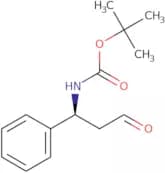
CAS:N-Boc-(3S)-3-phenyl-3-aminopropionaldehyde is a synthetic chiral ligand that can be used as a building block in the synthesis of other compounds. It has been used to optimize the synthetic process, and it can be used in buffers, ammonium formate, metal chelate, and other additives to synthesize new compounds. N-Boc-(3S)-3-phenyl-3-aminopropionaldehyde is an optical isomer that can be used for supercritical fluid chromatography (SCFC) or liquid chromatography (LC). This compound has been shown to have a high affinity for ligands with a phenol group.Formula:C14H19NO3Purity:Min. 95%Molecular weight:249.31 g/molLHRH (1-2) (free acid) acetate salt
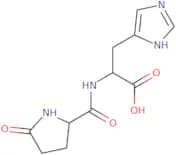
CAS:LHRH (1-2) (free acid) acetate salt Pyr-His-OH acetate salt is an analog of the natural hormone LHRH. It is a member of the amide category and has been shown to have a constant level in human serum. LHRH (1-2) (free acid) acetate salt Pyr-His-OH acetate salt is resistant to renal proximal tubule uptake and has an acidic pH optimum, which inhibits its uptake into cells. This drug also has an inhibitory effect on the reaction products of hydrogen chloride and proximal tubules.Formula:C11H14N4O4Purity:Min. 95%Molecular weight:266.25 g/molEntero-Kassinin
CAS:Please enquire for more information about Entero-Kassinin including the price, delivery time and more detailed product information at the technical inquiry form on this pageFormula:C58H89N15O21SPurity:Min. 95%Molecular weight:1,364.48 g/molH-Gly-Glu-pNA
CAS:H-Gly-Glu-pNA is a reactive atypical synthetic peptide. It is a serine protease inhibitor that has been shown to inhibit the activity of chymotrypsin, trypsin and elastase. H-Gly-Glu-pNA binds to the active site of these enzymes and inactivates them by binding to their catalytic residue. The maximal inhibition of H-Gly-Glu-pNA occurs at neutral pH and its activity can be inhibited by carboxylic acids such as lactic acid, which have a high affinity for the hydroxyl group on the pNA side chain.
Formula:C13H16N4O6Purity:Min. 95%Molecular weight:324.29 g/molpTH-Related Protein (1-16) (human, mouse, rat)
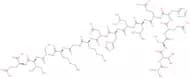
CAS:Please enquire for more information about pTH-Related Protein (1-16) (human, mouse, rat) including the price, delivery time and more detailed product information at the technical inquiry form on this pageFormula:C77H128N24O25Purity:Min. 95%Molecular weight:1,789.99 g/molAcetyl-Cholecystokinin Octapeptide (2-8) (sulfated)
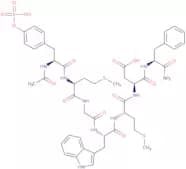
CAS:Please enquire for more information about Acetyl-Cholecystokinin Octapeptide (2-8) (sulfated) including the price, delivery time and more detailed product information at the technical inquiry form on this pageFormula:C47H59N9O14S3Purity:Min. 95%Molecular weight:1,070.22 g/molFmoc-[ring-D5]Phe-OH
CAS:Controlled ProductPlease enquire for more information about Fmoc-[ring-D5]Phe-OH including the price, delivery time and more detailed product information at the technical inquiry form on this pageFormula:C24H16D5NO4Purity:Min. 95%Molecular weight:392.46 g/molBiotinyl-Neuromedin S (human) trifluoroacetate salt
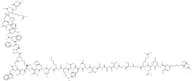
CAS:Please enquire for more information about Biotinyl-Neuromedin S (human) trifluoroacetate salt including the price, delivery time and more detailed product information at the technical inquiry form on this page
Formula:C183H279N55O46SPurity:Min. 95%Molecular weight:4,017.58 g/molEthyl 2-(4-hydroxyphenyl)-4-methylthiazole-5-carboxylate
CAS:Ethyl 2-(4-hydroxyphenyl)-4-methylthiazole-5-carboxylate is an anticancer agent that belongs to the class of formamidines. It is synthesized by refluxing ethyl 4-hydroxyphenylacetic acid with hexamethylenetetramine and acetic acid in ethanol. After purification, it is converted to its active form by reacting with hydrochloric acid. Ethyl 2-(4-hydroxyphenyl)-4-methylthiazole-5-carboxylate prevents the growth of cancer cells in culture by preventing DNA synthesis, which prevents RNA and protein synthesis. This agent has also been found to suppress paclitaxel production in cultured human breast cancer cells.Formula:C13H13NO3SPurity:Min. 95%Molecular weight:263.31 g/molLeu-Enkephalin amide acetate salt
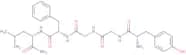
CAS:Leu-Enkephalin amide acetate salt H-Tyr-Gly-Gly-Phe-Leu-NH2 acetate salt is a peptide that is used as an analgesic and antipyretic drug. It is a synthetic form of endogenous enkephalins, which are natural pain relievers. The chemical stability of Leu-Enkephalin amide acetate salt H-Tyr-Gly-Gly-Phe-Leu-NH2 acetate salt makes it an effective drug for chronic use, and it has been shown to have a low side effect profile. This compound also has been shown to block the synthesis of histamine in vivo, but its bioavailability in vivo is not high due to its rapid degradation by proteases.Formula:C28H38N6O6Purity:Min. 95%Color and Shape:PowderMolecular weight:554.64 g/mol4-Fluoromethyl-alpha-methylbenzyl alcohol
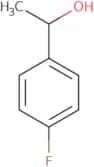
CAS:4-Fluoromethyl-alpha-methylbenzyl alcohol is a nonclassical molecule that has been synthesized. This molecule has been modeled computationally and the results indicate that it exhibits a planar geometry with a diastereomeric ratio of 1:1. The theoretical calculations show that the reaction of 4-fluoromethyl-alpha-methylbenzyl alcohol with water is exothermic, which would result in the formation of an intermediate hydroxide ion. Kinetic studies have shown that this molecule can undergo transfer reactions and dehydrogenation reactions, both of which are possible mechanisms for its reactivity.
Formula:C8H9FOPurity:Min. 95%Molecular weight:140.15 g/molTos-Gly-Pro-OH
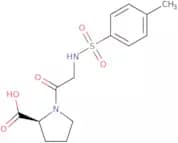
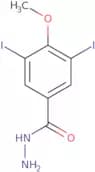
CAS:Tos-Gly-Pro-OH is a fluorescent histone deacetylase (HDAC) inhibitor. It has been validated as a competitive inhibitor of HDACs by using a fluorescence assay to detect the deacetylated form of 7-amino-4-methylcoumarin. Tos-Gly-Pro-OH is used in the treatment of malignant tumors, such as leukemia and lymphoma, by inhibiting HDACs that are responsible for cellular proliferation. In addition, Tos-Gly-Pro-OH may be useful in the treatment of diseases caused by bacterial infection because it inhibits bacterial HDACs that are responsible for protein synthesis and chemotaxis. This drug also inhibits trypsin activity and can be used as an alternative to nonisotopic solvents for peptide synthesis.Formula:C14H18N2O5SPurity:Min. 95%Molecular weight:326.37 g/mol3,5-Diiodo-4-methoxybenzhydrazide
CAS:3,5-Diiodo-4-methoxybenzhydrazide is a high quality chemical that is useful in the preparation of complex compounds. This compound has been shown to be an excellent reagent and useful intermediate for the synthesis of various fine chemicals. It has been used as a precursor for the production of the antiviral drug Tamiflu, among other pharmaceuticals. 3,5-Diiodo-4-methoxybenzhydrazide is also a versatile building block that can be used in research or as a reaction component in organic synthesis.
Formula:C8H8I2N2O2Purity:Min. 95%Color and Shape:PowderMolecular weight:417.97 g/molH-Ala-Pro-pNA hydrochloride salt
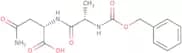
CAS:H-Ala-Pro-pNA hydrochloride salt is a protease inhibitor that is used as a therapeutic agent for the treatment of hepatitis C. It has been shown to inhibit the activity of serine proteases, such as trypsin and chymotrypsin, by binding to their active site. H-Ala-Pro-pNA hydrochloride salt also inhibits the activity of DPPIV (dipeptidyl peptidase IV), which is an enzyme that cleaves the third amino acid from peptides in some blood cells. H-Ala-Pro-pNA hydrochloride salt has been shown to be effective in preventing diabetic nephropathy in animal models by inhibiting DPPIV activity. H-Ala-Pro-pNA hydrochloride salt can be used to treat chronic hepatitis B and C infections. It binds to virus particles and prevents them from attaching themselves to host cells, thus preventing viral replication.Formula:C14H18N4O4Purity:Min. 95%Molecular weight:306.32 g/molZ-Ala-Asn-OH
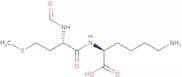
CAS:Z-Ala-Asn-OH is a hydrophobic amino acid that is used in industrial applications, such as paints and coatings. It can be synthesized from L-alanine and D-asparagine by the enzyme carboxypeptidase Y. Z-Ala-Asn-OH has been shown to have relevance for biochemically screening hyperthermophilic microorganisms, such as E. coli or other bacteria from the family Enterobacteriaceae. This amino acid has also been shown to be an essential component of a consortium of gram negative bacteria that produce an enzyme called xylanase and are used in the production of xylitol.Formula:C15H19N3O6Purity:Min. 95%Molecular weight:337.33 g/molFor-Met-Lys-OH
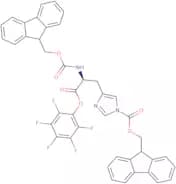
CAS:Please enquire for more information about For-Met-Lys-OH including the price, delivery time and more detailed product information at the technical inquiry form on this pageFormula:C12H23N3O4SPurity:Min. 95%Molecular weight:305.39 g/molFmoc-His(Fmoc)-OPfp
CAS:Please enquire for more information about Fmoc-His(Fmoc)-OPfp including the price, delivery time and more detailed product information at the technical inquiry form on this page
Formula:C42H28N3O6F5Purity:Min. 95%Molecular weight:765.68 g/molVEGFR-KDR/Flk-1 Antagonist Peptide trifluoroacetate salt
CAS:Please enquire for more information about VEGFR-KDR/Flk-1 Antagonist Peptide trifluoroacetate salt including the price, delivery time and more detailed product information at the technical inquiry form on this pageFormula:C77H99N23O18SPurity:Min. 95%Molecular weight:1,666.82 g/molH-Leu-NHOH·TFA
CAS:H-Leu-NHOH·TFA is a histidine analogue that is used as a catalyst. It has been shown to be an effective inhibitor of corynebacteria, and can be used in the synthesis of fatty acids, which are important for cell membrane production. H-Leu-NHOH·TFA also binds to the enzyme synthetase and inhibits its activity, which blocks the conversion of ammonia and amino acids into polypeptides. This inhibition prevents bacterial growth. H-Leu-NHOH·TFA is active at acidic pH levels, with a maximum activity at pH 4.0. The optimum temperature for this compound is 50°C, but it will still work at temperatures up to 60°C.Formula:C6H14N2O2·C2HF3O2Purity:Min. 95%Color and Shape:PowderMolecular weight:260.21 g/mol



![Fmoc-[ring-D5]Phe-OH](/_next/image/?url=https%3A%2Fstatic.cymitquimica.com%2Fproducts%2F3D%2Fthumb-webp%2FFF111391.webp&w=3840&q=75)