Amino Acids (AA)
Amino acids (AAs) are the fundamental building blocks of proteins, playing a crucial role in various biological processes. These organic compounds are essential for protein synthesis, metabolic pathways, and cell signaling. In this category, you will find a comprehensive range of amino acids, including essential, non-essential, and modified forms, which are vital for research in biochemistry, molecular biology, and nutritional sciences. At CymitQuimica, we provide high-quality amino acids to support your research and development needs, ensuring accuracy and reliability in your experimental outcomes.
Subcategories of "Amino Acids (AA)"
- Amino Acid Derivatives(4,012 products)
- Amino Acid and Amino Acid Related Compounds(3,490 products)
- Amino Acids with Oxygen or Sulphur(168 products)
- Boc- Amino Acids(351 products)
- Fmoc Amino Acids(1,710 products)
Found 38366 products of "Amino Acids (AA)"
Sort by
Purity (%)
0
100
|
0
|
50
|
90
|
95
|
100
(Tyr0)-Stresscopin-Related Peptide (human)
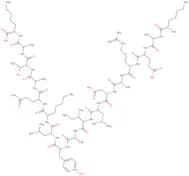
CAS:Please enquire for more information about (Tyr0)-Stresscopin-Related Peptide (human) including the price, delivery time and more detailed product information at the technical inquiry form on this pageFormula:C214H367N69O59Purity:Min. 95%Molecular weight:4,850.63 g/molAc-Lys-Gln-Leu-Arg-AFC trifluoroacetate salt
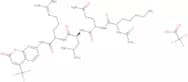
CAS:Please enquire for more information about Ac-Lys-Gln-Leu-Arg-AFC trifluoroacetate salt including the price, delivery time and more detailed product information at the technical inquiry form on this pageFormula:C35H51F3N10O8Purity:Min. 95%Molecular weight:796.84 g/mol(D-Leu7)-LHRH trifluoroacetate salt
CAS:Please enquire for more information about (D-Leu7)-LHRH trifluoroacetate salt including the price, delivery time and more detailed product information at the technical inquiry form on this pageFormula:C55H75N17O13Purity:Min. 95%Molecular weight:1,182.29 g/mol1,3,5-Tri(1-phenyl-1H-benzo[d]imidazol-2-yl)phenyl
CAS:1,3,5-Tri(1-phenyl-1H-benzo[d]imidazol-2-yl)phenyl is a diphenyl ether derivative that has been synthesized from the reaction of methanol with a solution of benzimidazole. The compound is soluble in organic solvents such as chloroform and dichloromethane. The molecule absorbs UV light and emits visible light, which can be detected by photomultiplier tubes. It has chemical structures similar to other benzimidazole derivatives.Formula:C45H30N6Purity:Min. 95%Molecular weight:654.76 g/molBoc 8-Lys4-Lys2-Lys-b-Ala-PAM resin (200-400 mesh)
CAS:Boc 8-Lys4-Lys2-Lys-b-Ala-PAM resin (200-400 mesh) is a versatile research chemical used in various applications. It contains aminooxyacetic acid, which is commonly used in the synthesis of fatty acids and other organic compounds. This resin is often employed in the purification and separation of target molecules, such as ochratoxin, collagen, synthetic cannabinoids, naphthalene derivatives, fatty acids, steroids, and more. Additionally, it can be utilized as an inhibitor for various enzymes or complexes like arp2/3 complex. The Boc 8-Lys4-Lys2-Lys-b-Ala-PAM resin has also been used in the synthesis of cefazolin sodium, an antibiotic widely used in medical settings. With its high-quality composition and fine particle size (200-400 mesh), this resin offers excellent performance and efficiency for biomass-related studies and other research endeavors.Formula:C45H91N15O9·xC2HF3O2Purity:Min. 95%H-Ser-Glu-Gly-OH
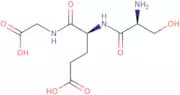
CAS:H-Ser-Glu-Gly-OH is an atypical compound that has shown anti-cancer activity in vitro. It is a member of the family of compounds known as glycine receptor antagonists. H-Ser-Glu-Gly-OH has been shown to inhibit the proliferation of A549 lung cancer cells and to induce cell cycle arrest and apoptosis. The compound also inhibits the activation of signal regulated kinase (ERK) in A549 lung cancer cells, which may be due to its ability to inhibit the production of cytokines such as IL6, IL8, and TNFα. H-Ser-Glu-Gly-OH also has mitogenic and antiproliferative activities for a variety of nonmalignant cell lines including human umbilical vein endothelial cells (HUVEC), human embryonic kidney cells (HEK293), and mouse erythroleukemia cells (MEL).Formula:C10H17N3O7Purity:Min. 95%Molecular weight:291.26 g/molH-Asn-Arg-Cys-Ser-Gln-Gly-Ser-Cys-Trp-Asn-OH (Disulfide bond)
CAS:Please enquire for more information about H-Asn-Arg-Cys-Ser-Gln-Gly-Ser-Cys-Trp-Asn-OH (Disulfide bond) including the price, delivery time and more detailed product information at the technical inquiry form on this pageFormula:C44H65N17O16S2Purity:Min. 95%Molecular weight:1,152.22 g/molLeucokinin II
CAS:Leucokinin II is a fatty acid. It is a diagnostic agent that can be used to identify bacteria, such as Stenotrophomonas maltophilia, which produce β-amino acids. Leucokinin II can also be used for the diagnosis of cancer and inflammatory diseases. Its analogs are being studied for their potential use in diagnosing infectious diseases. Leucokinin II binds to the receptor and activates it, resulting in the production of biochemical or electrochemical signals that can be detected by a detector.Formula:C39H50N10O12Purity:Min. 95%Molecular weight:850.87 g/molC-Peptide (human) acetate salt
CAS:C-Peptide (human) acetate salt H-Glu-Ala-Glu-Asp-Leu-Gln-Val-Gly-Gln-Val-Glu-Leu-Gly-Gly-Gly-Pro-Gly-Ala -Gly Ser Leu Gln Pro Leu Ala Leu Glu Gly Ser Leu Gln Pro Leu Ala is a peptide that has been purified from the pancreas of human and bovine sources. It is used in blood sampling and rate constant experiments to measure the response element on a signal peptide. This experiment can be used to study insulin production, as well as other biological samples. C Peptide (human) acetate salt H Glu Ala Glu Asp Leu Gln Val Gly Gln Val Glu Leu Gly Gly Gly Pro Gly Ala Gly Ser Leu Gln Pro Leu Ala has inhibitory properties againstFormula:C129H211N35O48Purity:Min. 95%Molecular weight:3,020.26 g/molH-Lys-Lys-bNA acetate salt
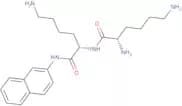
CAS:Please enquire for more information about H-Lys-Lys-bNA acetate salt including the price, delivery time and more detailed product information at the technical inquiry form on this pageFormula:C22H33N5O2Purity:Min. 95%Molecular weight:399.53 g/molLHRH (1-2) (free acid) acetate salt
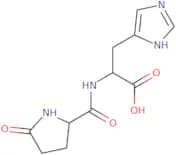
CAS:LHRH (1-2) (free acid) acetate salt Pyr-His-OH acetate salt is an analog of the natural hormone LHRH. It is a member of the amide category and has been shown to have a constant level in human serum. LHRH (1-2) (free acid) acetate salt Pyr-His-OH acetate salt is resistant to renal proximal tubule uptake and has an acidic pH optimum, which inhibits its uptake into cells. This drug also has an inhibitory effect on the reaction products of hydrogen chloride and proximal tubules.Formula:C11H14N4O4Purity:Min. 95%Molecular weight:266.25 g/mol(D-Phe12)-Bombesin
CAS:Please enquire for more information about (D-Phe12)-Bombesin including the price, delivery time and more detailed product information at the technical inquiry form on this pageFormula:C74H112N22O18SPurity:Min. 95%Molecular weight:1,629.88 g/mol2-[(4-Chloro-2-nitrophenyl)azo]-N-(2-methoxyphenyl)-3-oxobutanamide
CAS:2-[(4-Chloro-2-nitrophenyl)azo]-N-(2-methoxyphenyl)-3-oxobutanamide is a chelating agent that has been used as a control agent in the manufacture of dyes, plastics, and rubber. It is also used as an additive in paints, textiles, and paper. 2-[(4-Chloro-2-nitrophenyl)azo]-N-(2-methoxyphenyl)-3-oxobutanamide is nonvolatile, nonflammable, and does not produce toxic byproducts when heated. This compound has low molecular weight with a molecular formula of C12H13NO5Cl. The structure of this compound includes two hydroxy groups (OH), one aliphatic hydrocarbon group (CH3), one carboxylic acid group (COOH), and three chlorine atoms (Cl). This product is soluble in waterFormula:C17H15ClN4O5Color and Shape:Yellow Clear LiquidMolecular weight:390.78 g/molZ-Gly-Pro-Leu-Gly-Pro-OH
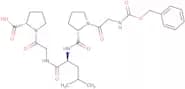
CAS:Z-Gly-Pro-Leu-Gly-Pro-OH is a synthetic peptide that is hydrophobic and has a sequence of amino acids. It can be used as a substrate for proteolytic enzymes. Z-Gly-Pro-Leu-Gly-Pro-OH has been shown to have collagenase activity in human liver and porcine tissues, but not in the presence of chloromethyl ketone. The neutral pH is important for this reaction because it increases the solubility of the substrate. This product is also soluble in water, making it easier to use in experiments.Formula:C28H39N5O8Purity:Min. 95%Molecular weight:573.64 g/molZ-Ala-Ile-OH
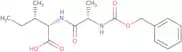
CAS:Z-Ala-Ile-OH is a hydroxamic acid that is used in peptide synthesis. It is a monomer that is hydrophobic and has an affinity for peptidyl acceptors. The synthetic method for Z-Ala-Ile-OH involves the use of aspartic acid and aspartate semialdehyde, which are used to synthesize the hydroxamic acid via an amidation reaction. The nomenclature of Z-Ala-Ile-OH is based on its structure and the order of amino acids found in it. Aspartic acid and asparagine are both amino acids found in Z-Ala-Ile-OH, with the -NH2 group being replaced by -OH in this particular molecule. This substitution results in a more hydrophobic compound than aspartate semialdehyde.
Formula:C17H24N2O5Purity:Min. 95%Molecular weight:336.38 g/molCytochrome C (88-104) (domestic pigeon) trifluoroacetate salt
CAS:Please enquire for more information about Cytochrome C (88-104) (domestic pigeon) trifluoroacetate salt including the price, delivery time and more detailed product information at the technical inquiry form on this pageFormula:C84H144N24O25Purity:Min. 95%Molecular weight:1,890.19 g/molFmoc-Lys(Adpoc)-OH
CAS:Please enquire for more information about Fmoc-Lys(Adpoc)-OH including the price, delivery time and more detailed product information at the technical inquiry form on this pageFormula:C35H44N2O6Purity:Min. 95%Molecular weight:588.73 g/molH-Phe-Ala-Arg-Lys-Gly-Ala-Leu-Arg-Gln-OH
CAS:Please enquire for more information about H-Phe-Ala-Arg-Lys-Gly-Ala-Leu-Arg-Gln-OH including the price, delivery time and more detailed product information at the technical inquiry form on this pageFormula:C46H79N17O11Purity:Min. 95%Molecular weight:1,046.23 g/molH-Ser-Phe-NH2·HCl
CAS:Please enquire for more information about H-Ser-Phe-NH2·HCl including the price, delivery time and more detailed product information at the technical inquiry form on this pageFormula:C12H17N3O3·HClPurity:Min. 95%Molecular weight:287.74 g/mol(S)-(+)-Glycidyl-4-nitrobenzoate
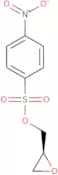
CAS:Glycidyl-4-nitrobenzoate (GLYNB) is an opioid receptor ligand, which binds to the κ opioid receptor. It has been used in biological testing and has been shown to have affinity for the κ opioid receptor. GLYNB may be a useful tool for investigating the molecular diversity of this receptor and its function in both normal and pathological conditions.Formula:C9H9NO6SPurity:Min. 95%Molecular weight:259.24 g/mol


![1,3,5-Tri(1-phenyl-1H-benzo[d]imidazol-2-yl)phenyl](/_next/image/?url=https%3A%2Fstatic.cymitquimica.com%2Fproducts%2F3D%2Fthumb-webp%2FFT37776.webp&w=3840&q=75)



![2-[(4-Chloro-2-nitrophenyl)azo]-N-(2-methoxyphenyl)-3-oxobutanamide](/_next/image/?url=https%3A%2Fstatic.cymitquimica.com%2Fproducts%2F3D%2Fthumb-webp%2FFC149929.webp&w=3840&q=75)