


Enzyme Substrates
Subcategories of "Enzyme Substrates"
Found 1526 products of "Enzyme Substrates"
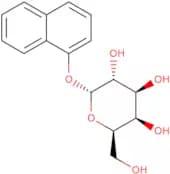
1-Naphthyl a-D-galactopyranoside
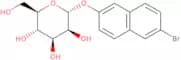
CAS:1-Naphthyl a-D-galactopyranoside is a chromogenic substrate use to detect alpha-galactosidase activity.Formula:C16H18O6Purity:Min. 95%Color and Shape:PowderMolecular weight:306.31 g/mol6-Bromo-2-naphthyl α-D-mannopyranoside
CAS:Chromogenic substrate to visualize the activity of alpha-D-mannopyranoside; red color producedFormula:C16H17BrO6Purity:Min. 95%Color and Shape:PowderMolecular weight:385.21 g/mol4-Nitrocatechol sulfate dipotassium salt
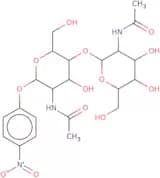
CAS:Chromogenic sulfatase substrateFormula:C6H3NO7SK2Purity:Min. 98 Area-%Color and Shape:PowderMolecular weight:311.35 g/mol4-Nitrophenyl 2-acetamido-4-O-(2-acetamido-2-deoxy-b-D-glucopyranosyl)-2-deoxy-a-D-galactopyranoside
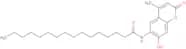
4-Nitrophenyl 2-acetamido-4-O-(2-acetamido-2-deoxy-b-D-glucopyranosyl)-2-deoxy-a-D-galactopyranoside is an enzyme substrate that is used in the detection of phenylalanine, tyrosine, and tryptophan. It is also used for environmental testing, bioluminescence, culture media, chemiluminescence, fluorogenic substrate, food testing, diagnostics and other applications.Purity:Min. 95%Color and Shape:Off-White PowderMolecular weight:545.49 g/mol6-Hexadecanoylamino-4-methylumbelliferone
CAS:Fluorochrome for calibration of fluorimeters. Used with corresponding fluorogenic substrates for the diagnosis of Krabbe - and Niemann-Pick A/B disease.Formula:C26H39NO4Purity:Min. 95%Color and Shape:White PowderMolecular weight:429.59 g/mol4-Nitrophenyl-alpha-D-galactopyranoside
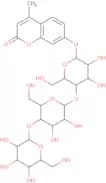
CAS:Chromogenic substrate yielding a soluble chromophore for the colorimetric assay of α-D-galactosidase upon cleavage. Used for the detection of hydrolases in tissues and membranes.Formula:C12H15NO8Purity:Min. 99.0 Area-%Molecular weight:301.26 g/mol4-Methylumbelliferyl b-D-cellotrioside
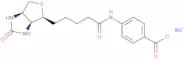
CAS:Fluorogenic cellulose analogueFormula:C28H38O18Purity:Min. 95%Color and Shape:PowderMolecular weight:662.6 g/mol(+)-Biotin 4-amidobenzoic acid sodium salt
CAS:(+)-Biotin 4-amidobenzoic acid sodium salt, often referred as (+)-biotin PABA, is a fluorogenic substrate used to measure biotinidase activity, especially in newborn screening programs.
Formula:C17H20N3NaO4SPurity:Min. 95%Color and Shape:White Slightly Yellow PowderMolecular weight:385.41 g/mol4-Methylumbelliferyl a-L-idopyranosiduronic acid sodium salt
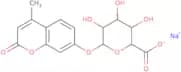
CAS:PAIRED PRODUCT AVAILABLE: alpha-L-iduronidase Enzyme, FI179383.
4MU-alpha-L-idopyranosiduronic acid is a fluorogenic substrate for alpha-L-iduronidase. Active alpha-L-iduronidase cleaves the MU moiety from the synthetic substrate, which results in release of a fluorescent signal (Ex 360 nm / Em 455 nm). The reaction is stopped by the addition of sodium carbonate. 4MU-alpha-L-idopyranosiduronic acid is used in alpha-L-iduronidase assays in the context of biochemical characterisation of samples from patients affected by lysosomal storage disease mucopolysaccharidosis I (MPS I).Formula:C16H15NaO9Purity:Min. 98 Area-%Color and Shape:White PowderMolecular weight:374.27 g/mol4-Methylumbelliferyl oleate
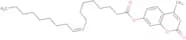
CAS:Methylumbelliferyl oleate is a MOSCERDAM® substrate targeting the lipase enzymeFormula:C28H40O4Purity:Min. 90 Area-%Color and Shape:White PowderMolecular weight:440.61 g/mol4-Nitrophenyl O-(N-acetyl-a-neuraminosyl)-(2,3)-O-b-D-galactopyranosyl-(1,3)-2-acetamido-2-deoxy-a-D-galactopyran oxide
CAS:4-Nitrophenyl O-(N-acetyl-a-neuraminosyl)-(2,3)-O-b-D-galactopyranosyl-(1,3)-2-acetamido-2-deoxy-a-D-galactopyran oxide is a fluorogenic substrate that is used in the detection of glycosidases. It has been shown to be an excellent ligand for the enzyme beta galactosidase, which cleaves the glycan substrate 4NPOBGPA into 4NP and O-(N acetyl) neuraminic acid. 4NPOBGPA can be used as a chromogenic substrate for detecting beta galactosidase activity and can also be conjugated to other fluorescent molecules. This product is high purity and high quality.Purity:Min. 95%Molecular weight:795.7 g/mol5-Bromo-4-chloro-3-indoxyl butyrate
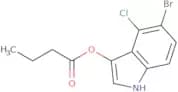
CAS:5-Bromo-4-chloro-3-indoxyl butyrate is a colorimetric substrate used to detect and quantify esterase activity. Upon hydrolysis by esterases, it yields a blue-green dye, allowing the detection and quantification of enzyme activity. It is commonly used in assays for the screening of esterase-producing microorganisms and in research aimed at understanding the role of esterases in various cellular processes.
Formula:C12H11BrClNO2Purity:Min. 95%Color and Shape:PowderMolecular weight:316.58 g/mol4-Methylumbelliferyl 4-O-(α-L-fucopyranosyl)-β-D-galactopyranoside
CAS:4-Methylumbelliferyl 4-O-(alpha-L-fucopyranosyl)-beta-D-galactopyranoside is a fluorogenic substrate for alpha-L-fucosidase. After enzymatic cleaveage, free 4-methylumbelliferone (also known as hymecromone) is released, exhibiting blue fluorescence upon excitation with UV light. The strongest fluorescence of 4-methylumbelliferone requires deprotonation of the hydroxyl group (thus requires alkaline pH), with a maximal fluorescence intensity obtained with excitation at 350 to 370 nm and emission at 440 to 470 nm. The use of 4-methylumbelliferyl 4-O-(alpha-L-fucopyranosyl)-beta-D-galactopyranosideas a substrate for measuring the alpha-L-fucosidase activity is used for fucosidosis diagnosis and in screening studies of glycoprotein metabolism disorders.Formula:C22H28O12Purity:Min. 95 Area-%Color and Shape:PowderMolecular weight:484.45 g/mol5-Cyano-3-indoxyl-β-D-galactopyranoside
For detection of beta-galactosidase activity. The colors of the chromogen can be adjusted by incorporating different functional groups, e.g. cyano or nitro group, which yields purple or black green colonies with beta-galactosidase positive strain.Formula:C15H16N2O6Molecular weight:320.3 g/molNaphthol AS-D chloroacetate
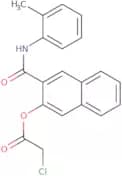
CAS:Histochemical substrate for esteraseFormula:C20H16ClNO3Purity:Min. 98 Area-%Color and Shape:PowderMolecular weight:353.8 g/mol5-Bromo-4-chloro-3-indoxyl phosphate p-toluidine, micronized
CAS:A substrate for alkaline phosphatase yielding a blue insoluble product upon cleavage. Colour can be further enhanced when used together with Nitroblue tetrazolium. The substrate system is versatile and has functions in a variety of applications, including Northern, Southern, and Western blotting, in situ hybridization, ELISAs, microarray and immunohistochemistry. The micronized structure enhances solubility.Formula:C8H6BrClNO4P•C7H9NPurity:Min. 95%Color and Shape:PowderMolecular weight:433.63 g/molLuc-phosphate Na enhanced
Luc-phosphate Na enhanced is a bioluminescent substrate used to detect phosphatase activity in bacterial assays.
Formula:C18H12N2Na3O7PS2Purity:Min. 97 Area-%Molecular weight:531.95 g/mol4-Trifluoromethylumbelliferyl-β-D-galactopyranoside
CAS:4-Trifluoromethylumbelliferyl-beta-D-galactopyranoside is a fluorogenic substrate for beta-galactosidase. It is used in the detection of beta-galactosidase activity in cell lysates and culture media, as well as in food testing. This compound has been shown to be highly pure, with a purity greater than 98%. 4-Trifluoromethylumbelliferyl-beta-D-galactopyranoside has also been shown to have high chemiluminescence, making it an ideal candidate for use in diagnostics.Formula:C16H15F3O8Molecular weight:392.29 g/mol4-Methylumbelliferyl phosphate, disodium salt trihydrate
CAS:Sensitive fluorogenic substrate for fluorometric and UV-spectrophotometric assays of phosphatases.Formula:C10H13Na2O9PMolecular weight:354.16 g/mol2,5-dioxabicyclo[2.2.1]heptan-7-one
Please enquire for more information about 2,5-dioxabicyclo[2.2.1]heptan-7-one including the price, delivery time and more detailed product information at the technical inquiry form on this page
Formula:C5H6O3Purity:Min. 95%Molecular weight:114.10 g/mol







![2,5-dioxabicyclo[2.2.1]heptan-7-one](/_next/image/?url=https%3A%2Fstatic.cymitquimica.com%2Fproducts%2F3D%2Fthumb-webp%2FKAA21803.webp&w=3840&q=75)