Enzyme Substrates
Subcategories of "Enzyme Substrates"
Found 1526 products of "Enzyme Substrates"
4-Methylumbelliferyl beta-D-apiofuranoside
4-Methylumbelliferyl beta-D-apiofuranoside is a fluorescent substrate that is used in the detection of enzyme activity. It is a yellow crystalline powder with a melting point of 132°C and an optical rotation of +27°. 4-Methylumbelliferyl beta-D-apiofuranoside can be used as a conjugate for fluorescence, chemiluminescence, or bioluminescence detection of enzymes such as β-galactosidase, phosphatases, esterases, and peroxidases. It is also used to stain cells and tissues for microscopic analysis. This product has been tested for its effects on the environment and found to have little potential for harm to the environment. 4-Methylumbelliferyl beta-D-apiofuranoside has been shown to be high purity with no significant impurities detected in testing. The chemical has shown high quality characteristics inFormula:C15H16O7Purity:Min. 95 Area-%Molecular weight:308.29 g/molAldol® 470 butyrate, Biosynth Patent: EP 2427431 and US 8940909
CAS:Controlled ProductAldol® 470 butyrate, a chromogenic substrate manufactured by Cymit Quimica and used for enzymatic assays that produces a yellow-orange color upon enzymatic cleavage.Formula:C27H25NO5Purity:Min. 95%Color and Shape:PowderMolecular weight:443.5 g/mol6-Chloro-4-(trifluoromethyl)umbelliferyl β-D-cellotrioside
6-Chloro-4-(trifluoromethyl)umbelliferyl b-D-cellotrioside is a fluorogenic substrate for cellulases and beta-glucosidases. After hydrolisis, the fluorophore TFMU is released generating a blue fluorescence.Formula:C28H34ClF3O18Purity:Min. 95%Color and Shape:White to off-white powder.Molecular weight:751.01 g/molN-Methylindoxyl-beta-D-galactopyranoside monohydrate
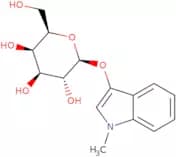
CAS:N-Methylindoxyl-beta-D-galactopyranoside monohydrate (MG) is a chromogenic probe that interacts with galactose residues found on glycoproteins, which are found on cell surfaces, leading to activation of cells. MG also binds specifically to the surface of lung cells and can inhibit the development of certain types of infections..Formula:C15H21NO7Purity:Min. 98 Area-%Color and Shape:PowderMolecular weight:327.33 g/mol4-Methylumbelliferyl 2-deoxy-2-sulfamino-a-D-glucopyranoside sodium salt - Moscerdam™ biochemical purity
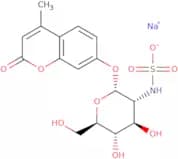
CAS:4-Methylumbelliferyl 2-deoxy-2-sulfamino-a-D-glucopyranoside sodium salt (M3A or MU-GlcNS) is a fluorogenic substrate of heparin sulfamidase, used in the diagnosis of Mucopolysaccharidosis III type A (MPS III A). MPS III A, also known as Sanfilippo syndrome type A, is caused by the deficiency of heparan N-sulfatase. Heparin sulfamidase in the assay desulfates MU-GlcNS to 4-methylumbelliferyl 2-amino-2-deoxy-α-D-glucopyranoside (MU-GlcNH2). To release fluorometrically measurable 4-methylumbelliferone (MU) and by-product glucosamine, MU-GlcNH2 is further hydrolysed by an enzyme such as yeast α-glucosidase during a second incubation.Formula:C16H18NO10SNaPurity:Min. 95 Area-%Color and Shape:White PowderMolecular weight:439.37 g/mol5-Bromo-4-chloro-3-indoxyl phosphate, dilithium salt hydrate
5-Bromo-4-chloro-3-indoxyl phosphate, dilithium salt hydrate is a chromogenic substrate used to detect the specific enzymatic activity of alkaline phosphatase. After cleavage, 5-bromo-4-chloro-indoxyl is released, resulting in a blue to blue-green color change in bacterial colonies or media. 5-Bromo-4-chloro-3-indoxyl phosphate, dilithium salt hydrate is used in ELISA and molecular biology assays such as lacZ reporter systems.
Formula:C8H4BrClLi2NO4P(anhydrousbasis)Purity:Min. 98 Area-%Color and Shape:PowderMolecular weight:338.34 g/mol4-Nitrophenyl sulfate potassium salt
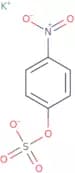
CAS:4-Nitrophenyl sulfate potassium salt is a chromogenic substrate for arylsulfatase. Upon hydrolysis, para-nitrophenol is released yielding a yellowish colour. 4-Nitrophenyl sulfate potassium salt is used in different applications such as the Metachromatic leukodystrophy diagnosis, sulfatase activity assaysFormula:C6H4KNO6SPurity:Min. 95%Color and Shape:PowderMolecular weight:257.26 g/mol2-Naphthyl butyrate
CAS:2-Naphthyl butyrate is used as a chromogenic substrate in hematological studies via measuring esterase activity. This type of assays are important as it can help in distinguishing acute leukemias with monocytic or granulocytic differentiation. After hydrolysis of 2-naphthyl butyrate by the esterase (for example acylase), b-napthol is released that can be quantified spectrophotometrically (Exc 320 nm; Em 410 nm).Formula:C14H14O2Purity:Min. 98 Area-%Color and Shape:Colorless Clear LiquidMolecular weight:214.26 g/mol5-Bromo-4-chloro-3-indolyl b-D-glucuronide sodium salt
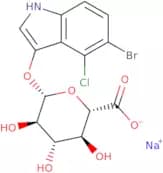
CAS:Chromogenic substrate for beta-glucuronidase
Formula:C14H12BrClNNaO7Purity:Min. 98 Area-%Color and Shape:White Off-White PowderMolecular weight:444.59 g/mol4-Methylumbelliferyl-α-L-rhamnopyranoside
CAS:4-Methylumbelliferyl-alpha-L-rhamnopyranoside is a fluorogenic substrate used in enzyme assays. It is a substrate of the enzyme beta-galactosidase, which catalyzes the hydrolysis of terminal galactose residues from polysaccharides and glycoproteins. The fluorescent product 4-methylumbelliferone (4MU) is formed by cleavage of the terminal galactose residue and can be measured spectrophotometrically at 360 nm. 4-Methylumbelliferone has been used for chemiluminescent detection in immunoassays and as a substrate for bioluminescence reactions.
Formula:C16H18O7Purity:Min. 98.0 Area-%Molecular weight:322.32 g/molRef: 3D-M-6185
1gTo inquire5gTo inquire10gTo inquire500mgTo inquire2500mgTo inquire-Unit-ggTo inquire4-Methylumbelliferyl-beta-D-glucopyranoside
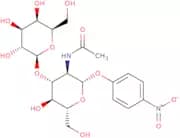
CAS:Fluorogenic substrate for beta-glucosidase yielding a blue fluorescent solution. Used for the detection of beta-glucosidase as an indicator of Enterococci.Formula:C16H18O8Purity:Min. 99 Area-%Molecular weight:338.32 g/mol4-Nitrophenyl 2-acetamido-2-deoxy-3-O-(b-D-galactopyranosyl)-b-D-glucopyranoside
CAS:Chromogenic substrate for fucosyltransferasesFormula:C20H28N2O13Purity:Min. 98 Area-%Color and Shape:White PowderMolecular weight:504.44 g/mol4-Methylumbelliferyl phosphate, free acid
CAS:A sensitive fluorogenic substrate for fluorometric and UV-spectrophotometric assays of phosphatases. It is used for the detection of C. perfringens because acid phosphatase is a highly specific indicator for C. perfringens.Formula:C10H9O6PMolecular weight:256.15 g/molAquaSpark® beta-D-glucuronide, 10 mM in DMSO, Ramot at Tel-Aviv University Ltd. Patent family WO 2017/130191
CAS:For use in bacterial detection
Formula:C34H37ClO13Purity:Min. 95%Color and Shape:Clear LiquidMolecular weight:688.19 g/mol4-Methylumbelliferyl phosphate, bis(cyclohexylammonium) salt, trihydrate
CAS:Sensitive fluorogenic substrate for fluorometric and UV-spectrophotometric assays of phosphatases. This may also be used for in-gel assaysFormula:C22H41N2O9PMolecular weight:508.55 g/mol4-Methylumbelliferyl-β-L-fucopyranoside
CAS:4-Methylumbelliferyl-beta-L-fucopyranoside is a fluorogenic substrate that is used in food testing. It also has uses as a chromogenic substrate and a ligand for biological studies. 4-Methylumbelliferyl-beta-L-fucopyranoside is a conjugate of 4-methylumbelliferone and beta-D-fucopyranosyl ester, which is an enzyme substrate for the detection of phosphatases. This product can be used to detect the activity of phosphatase enzymes in various media, including culture media, environmental testing, and staining. 4MUFBPY also has chemiluminescent properties that can be used for bioluminescence assays.Formula:C16H18O7Molecular weight:322.31 g/molRef: 3D-M-5541
1gTo inquire5gTo inquire250mgTo inquire500mgTo inquire2500mgTo inquire-Unit-ggTo inquire3-(4,4-Difluoro-5,7-dimethyl-4-bora-3a,4a-diaza-s-indacene-3-propionamido)propyl b-D-lactoside
3-(4,4-Difluoro-5,7-dimethyl-4-bora-3a,4a-diaza-s-indacene-3-propionamido)propyl b -D -lactoside (FDPBP) is a substrate for alkaline phosphatase. It reacts with the enzyme to produce a blue color. FDPBP is used in diagnostic applications such as food testing and bioluminescence.Purity:Min. 95%Color and Shape:PowderMolecular weight:675.48 g/molLuc-S.aureus K
Luc-S.aureus K is a fluoro-ligand that is used as a diagnostic to detect and quantify the activity of S.aureus in any given sample. It is a detection substrate for the enzyme β-galactosidase, which catalyzes the hydrolysis of the luciferin. When luciferin is cleaved by β-galactosidase, it emits light that can be detected using a luminometer to measure the amount of light produced and calculate the quantity of bacteria present in the sample. Luc-S.aureus K has been approved for use as a detector for bioluminescence in food testing, environmental testing, and other diagnostic applications.Purity:Min. 95%4-Nitrophenyl laurate
CAS:4-Nitrophenyl laurate is a chromogenic substrate for lipase. Upon hydrolysis, para-nitrophenol is released yielding a yellowish colour. 4-Nitrophenyl laurate is used in different applications such as the Lipase activity screening, clinical diagnosticsFormula:C18H27NO4Purity:Min. 95%Color and Shape:White PowderMolecular weight:321.41 g/molalpha-N-Bz-L-Arg-aminoluciferin
alpha-N-Bz-L-Arg-aminoluciferin is a modified form of D-luciferin used as a luminescent enzyme substrate for protease.
Formula:C24H25N7O4S2Purity:Min. 95 Area-%Molecular weight:539.63 g/mol