Enzyme Substrates
Enzyme substrates are molecules upon which enzymes act to catalyze chemical reactions. The substrate binds to the active site of the enzyme, where it undergoes a specific transformation to form the product of the reaction. Enzyme substrates are essential tools in research for studying enzyme kinetics, specificity, and mechanism of action. They are also used in diagnostic assays and biochemical studies. At CymitQuimica, we provide a diverse selection of high-quality enzyme substrates to support your research in enzymology and biochemistry.
Subcategories of "Enzyme Substrates"
Found 1527 products of "Enzyme Substrates"
Sort by
Purity (%)
0
100
|
0
|
50
|
90
|
95
|
100
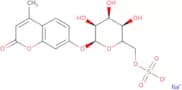
4-Methylumbelliferyl b-D-galactopyranoside-6-sulphate sodium salt - Moscerdam™ biochemical purity
CAS:<p>4-MU-Gal-6S (M4A) is a fluorogenic substrate of galactose-6-sulfate sulfatase (GALNS), used for the diagnosis of Mucopolysaccharidosis IV type A (MPS IV A). MPS IV, also known as Morquio syndrome, is a rare metabolic disorder in which the human body cannot process glycosaminoglycans (GAGs). MPS IV A is caused by the deficiency of the enzyme N-acetyl-galactosamine-6-sulfatase resulting in accumulation of keratan and chondroitin sulfate in tissues. M4A is used as the GALNS substrate in the anti-lysosomal enzyme antibody assay for the treatments of lysosomal storage disorders (LSDs) with enzyme replacement therapies (ERTs).</p>Formula:C16H17NaO11SPurity:Min. 97 Area-%Color and Shape:White PowderMolecular weight:440.36 g/mol4-Nitrophenyl a-D-mannopyranoside
CAS:<p>4-Nitrophenyl a-D-mannopyranoside is a chromogenic pNP enzyme substrate that enables the detection and quantification of a-D-mannosidase activity in various biological samples through a colorimetric assay. The hydrolysis of the substrate by the enzyme releases 4-nitrophenol, a yellow compound whose absorption can be measured spectrophotometrically. Applications for this substrate span biomedical research, disease diagnostics, and industrial enzyme production.</p>Formula:C12H15NO8Purity:Min. 98.0 Area-%Color and Shape:Off-White PowderMolecular weight:301.25 g/mol3,4-Cyclohexenoesculetin β-D-glucuronide
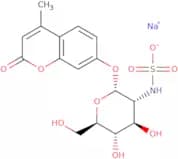
<p>Chromogenic substrate for beta-glucuronidase</p>Purity:Min. 95%4-Methylumbelliferyl 2-deoxy-2-sulfamino-a-D-glucopyranoside sodium salt - Moscerdam™ biochemical purity
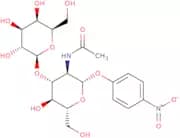
CAS:<p>4-Methylumbelliferyl 2-deoxy-2-sulfamino-a-D-glucopyranoside sodium salt (M3A or MU-GlcNS) is a fluorogenic substrate of heparin sulfamidase, used in the diagnosis of Mucopolysaccharidosis III type A (MPS III A). MPS III A, also known as Sanfilippo syndrome type A, is caused by the deficiency of heparan N-sulfatase. Heparin sulfamidase in the assay desulfates MU-GlcNS to 4-methylumbelliferyl 2-amino-2-deoxy-α-D-glucopyranoside (MU-GlcNH2). To release fluorometrically measurable 4-methylumbelliferone (MU) and by-product glucosamine, MU-GlcNH2 is further hydrolysed by an enzyme such as yeast α-glucosidase during a second incubation.</p>Formula:C16H18NO10SNaPurity:Min. 95 Area-%Color and Shape:White PowderMolecular weight:439.37 g/mol4-Nitrophenyl 2-acetamido-2-deoxy-3-O-(b-D-galactopyranosyl)-b-D-glucopyranoside
CAS:<p>Chromogenic substrate for fucosyltransferases</p>Formula:C20H28N2O13Purity:Min. 98 Area-%Color and Shape:White PowderMolecular weight:504.44 g/mol6-Bromo-2-naphthyl 2-acetamido-2-deoxy-b-D-glucopyranoside
CAS:<p>6-Bromo-2-naphthyl 2-acetamido-2-deoxy-b-D-glucopyranoside is a chromogenic substrate used for the detection of chitinase activity. Upon hydrolysis by chitinase, it releases a yellow-brown color, which is easily detected by spectrophotometry. This substrate has been used to study chitinases in various organisms, including bacteria, fungi, and insects. It can also be used to quantitate chitinase activity in various biological samples.</p>Formula:C18H20BrNO6Purity:Min 97%Color and Shape:White PowderMolecular weight:426.26 g/mol4-Methylumbelliferyl-α-D-mannopyranoside
CAS:<p>4-Methylumbelliferyl alpha-D-mannopyranoside (4-MU-a-D-Man) is a fluorogenic substrate used in activity assays for alpha-mannosidase. When it is hydrolyzed by alpha-mannosidase, it produces a fluorescent compound, 4-methylumbelliferone (4-MU). 4-MU-a-D-Man is often used in medical research to monitor the activity of alpha-mannosidase, which is important in lysosomal storage diseases. In addition, 4-Methylumbelliferyl alpha-D-mannopyranoside has been used to study the the activity of concanavalin A, a lectin that specifically binds to alpha-D-mannopyranosyl and alpha-D-glucopyranosyl residues on various glycoproteins. The use of this fluorogenic enzyme substrate permits study the degree of alpha-D-mannosidic linkage cleavage by the enzyme.</p>Formula:C16H18O8Purity:Min. 98 Area-%Molecular weight:338.32 g/molRef: 3D-M-5730
1gTo inquire5gTo inquire10gTo inquire500mgTo inquire2500mgTo inquire-Unit-ggTo inquire6-Chloro-3-indoxyl-α-D-galactopyranoside
CAS:<p>Chromogenic substrate for α-galactosidase yielding a salmon-colored precipitate.</p>Formula:C14H16ClNO6Molecular weight:329.74 g/mol4-Methylumbelliferyl palmitate
CAS:<p>Fluorogenic substrate for esterase yielding a blue fluorescent solution upon cleavage.</p>Formula:C26H38O4Purity:Min. 99 Area-%Molecular weight:414.59 g/molRef: 3D-M-5750
1gTo inquire5gTo inquire250mgTo inquire500mgTo inquire2500mgTo inquire-Unit-ggTo inquireAldol® 458 nonanoate, Biosynth Patent: EP 2427431 and US 8940909
CAS:Controlled Product<p>Aldol 458 nonanoate is a high quality, chromogenic and fluorogenic substrate for use in enzymatic, chemiluminescent, and immunochemical reactions. Aldol 458 nonanoate is used as a chromogenic substrate for the detection of glucose oxidase activity in culture media and as a fluorogenic substrate for the detection of glucose oxidase activity in environmental testing. This product has CAS number 2484872-52-6.</p>Formula:C25H29NO4Purity:Min. 98.0 Area-%Molecular weight:407.5 g/molβ-Naphthyl stearate
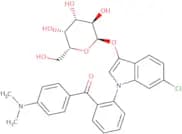
CAS:<p>Beta-naphthyl stearate is a chromogenic substrate for measuring enzymatic activity.</p>Purity:Min. 95%Color and Shape:PowderMolecular weight:410.63 g/molAldol® 518 α-D-galactopyranoside, Biosynth Patent: EP 2427431 and US 8940909
CAS:<p>Aldol® 518 alpha-D-galactopyranoside is a chromogenic and fluorogenic enzyme substrate used for detection of alpha-galactosidase activity. The enzyme substrate is cleaved by alpha-galactosidase positive bacteria and yeasts in liquid or solid media, yielding red color and red fluorescence signal. Aldol® 518 alpha-D-galactopyranoside can also be used to detect alpha-galactosidase (encoded by the Mel1 gene) in yeast gene reporter assays or for identification of alpha-gal positive transformants on agar plates. Aldol® 518 alpha-D-galactopyranoside can be used under aerobic and anaerobic conditions.</p>Formula:C29H29ClN2O7Purity:Min. 95.0 Area-%Molecular weight:553.01 g/mol2-Chloro-4-nitrophenyl a-D-maltotrioside
CAS:<p>2-Chloro-4-nitrophenyl a-D-maltotrioside (2CNP) is a potent hypoglycemic agent that has been shown to decrease postprandial blood glucose levels in humans. 2CNP is a white crystalline solid that is soluble in water and ethanol. The transfer reactions of 2CNP are enhanced by benzalkonium chloride, which forms an organic complex with the drug. The optimum concentration for the hypoglycemic effect of 2CNP is determined to be 10 μM, which can be detected using an optical sensor. This compound also inhibits α-amylase and other enzymes involved in carbohydrate metabolism, leading to the accumulation of glycogen and lowering the blood glucose level.</p>Formula:C24H34CiNO18Purity:Min. 95%Color and Shape:Off-White Yellow PowderMolecular weight:659.98 g/mol6-Chloro-3-indolyl β-D-cellobioside
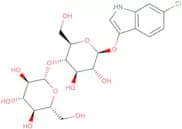
CAS:<p>6-Chloro-3-indolyl b-D-cellobioside is a chromogenic substrate that produces a salmon-pink color after enzymatic cleavage. It is used for detecting the activity of beta-D-cellobiosidase in enzyme assays.</p>Purity:Min. 95%Color and Shape:White To Off-White SolidMolecular weight:491.87 g/mol4-Chloro-3-indolyl β-D-galactopyranoside
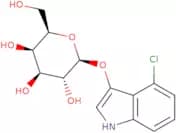
CAS:<p>2-Chloro-4-nitrophenyl b-D-lactoside is a chromogenic enzyme substrate used to study the activity of enzymes. It produces a color when hydrolyzed, which makes it a valuable tool in screening for enzyme activity and studying enzyme kinetics.</p>Formula:C14H16ClNO6Purity:Min. 95%Color and Shape:SolidMolecular weight:329.73 g/mol2-(N-Hexadecanoylamino)-4-nitrophenylphosphocholine hydroxide
CAS:<p>2-(N-Hexadecanoylamino)-4-nitrophenylphosphocholine hydroxide, often abbreviated as HDA-PC, is a chromogenic substrate for acid sphingomyelinase enzyme. HDA-PC is used as a key substrate for measuring the activity of this enzyme, responsible for catalyzing the hydrolysis of sphingomyelin to ceramide. The activity assay for this measuring this enzyme's acitivy is to detect a deficiency (or lack) of the enzyme which is directly related to the Niemann-Pick disease.</p>Formula:C27H50N3O8PPurity:Min. 95%Color and Shape:Off-White PowderMolecular weight:575.68 g/molLuc-S.aureus K
<p>Luc-S.aureus K is a fluoro-ligand that is used as a diagnostic to detect and quantify the activity of S.aureus in any given sample. It is a detection substrate for the enzyme β-galactosidase, which catalyzes the hydrolysis of the luciferin. When luciferin is cleaved by β-galactosidase, it emits light that can be detected using a luminometer to measure the amount of light produced and calculate the quantity of bacteria present in the sample. Luc-S.aureus K has been approved for use as a detector for bioluminescence in food testing, environmental testing, and other diagnostic applications.</p>Purity:Min. 95%Luc-Salmonella
<p>Luc-Salmonella is a conjugate of the enzyme luciferase and the substrate 5-bromo-4-chloro-3-indolyl phosphate. Luc-Salmonella has been used for diagnostic purposes in the detection of bacteria in culture media, as well as in environmental and food testing. Luc-Salmonella can be used to detect Salmonella, which is a bacterium that can cause gastrointestinal disease. Luminescence is measured using a luminometer or fluorimeter with an excitation wavelength of 485 nm and emission wavelengths at 510 nm. Luminescence from Luc-Salmonella is typically measured after 1 hour incubation with bacterial cells.<br>Luc-Salmonella has been shown to have high purity and quality due to its unique composition of enzyme substrate. This product has been tested for contamination by sensitive assays such as chemiluminescence, bioluminescence, or fluorescence. The purity level of Luc-Sal</p>Purity:Min. 96 Area-%Ref: 3D-L-8281
5mgTo inquire10mgTo inquire25mgTo inquire50mgTo inquire100mgTo inquire-Unit-mgmgTo inquireAldol® 458 nonanoate, Biosynth Patent: EP 2427431 and US 8940909
CAS:Controlled Product<p>Aldol 458 nonanoate is a fluorogenic substrate that can be used in the detection of enzyme activity particularly C8/C9-esterases, lipases activity producing a yellow/green-orange color. Aldol 458 nonanoate reacts with enzymes, such as oxidoreductases and hydrolases, to produce light. This product is a conjugate of aldol 458 nonanoate and an enzyme substrate for the detection of these enzymes. It has been shown to be useful in food testing, staining, fluorogenic substrate, environmental testing, chromogenic substrate, conjugate, high purity, enzyme substrate for diagnostics and ligand.</p>Formula:C25H29NO4Purity:Min. 95%Molecular weight:407.5 g/mol2-Naphthyl caprylate
CAS:<p>2-Naphthyl caprylate is a substrate that is employed in an assays for carboxylesterase and lipase and when hydrolyzed, produces 2-naphthol, a compound that can also be identified via fluorescence analysis. By combining it with a diazonium salt, the formation of the corresponding azo dye occurs. In particular, this substrate is used to detect the extracellular lipase of Pseudomonas fluorescens B52.</p>Formula:C18H22O2Purity:Min. 95%Color and Shape:White PowderMolecular weight:270.37 g/mol