Enzyme Substrates
Subcategories of "Enzyme Substrates"
Found 1526 products of "Enzyme Substrates"
4-Methylumbelliferyl-beta-D-mannopyranoside
CAS:Fluorogenic substrate for detection of β-D-mannosidase.Formula:C16H18O8Purity:Min. 99.0 Area-%Molecular weight:338.31 g/mol5-Bromo-4-chloro-3-indolyl a-D-mannopyranoside
CAS:5-Bromo-4-chloro-3-indolyl a-D-mannopyranoside is a chromogenic substrate used to detect the specific enzymatic activity of alpha-mannosidase. After cleavage, 5-bromo-4-chloro-indoxyl is released, resulting in a blue to blue-green color change in bacterial colonies or media. 5-Bromo-4-chloro-3-indolyl a-D-mannopyranoside is used in alpha-mannosidosis diagnosis and other lysosomal storage disorder.Formula:C14H15BrClNO6Purity:Min. 95 Area-%Color and Shape:PowderMolecular weight:408.63 g/mol4-Methylumbelliferyl lignocerate
CAS:This botanical is a download for the Floral Database.
Formula:C34H54O4Purity:Min. 95 Area-%Molecular weight:526.81 g/molRef: 3D-M-5720
1gTo inquire5gTo inquire250mgTo inquire500mgTo inquire2500mgTo inquire-Unit-ggTo inquire5-Bromo-4-chloro-3-indoxyl-alpha-D-N-acetylneuraminic acid, cyclohexylammonium salt
5-Bromo-4-chloro-3-indoxyl-alpha-D-N-acetylneuraminic acid, cyclohexylammonium salt is a chemiluminescent substrate that provides a significant increase in light emission. It has a CAS number of 59820-92-0 and is supplied in high purity and high quality. This product is used for the detection of various biological reactions, including diagnostics, enzyme substrates, food testing, and more.Purity:Min. 95%Resorufin β-D-cellobioside
CAS:Resorufin beta-D-cellobioside is a fluorogenic substrate for the enzyme beta-glucosidase. It is soluble in water and can be used as a chromogenic substrate for beta-galactosidase. Resorufin beta-D-cellobioside is also used as a ligand to study protein interactions, such as those between lectins and glycoproteins. This product is of high purity and quality, with CAS No. 1000404-48-7.Formula:C24H27NO13Purity:Min. 95 Area-%Molecular weight:537.47 g/molRef: 3D-R-2056
10mgTo inquire25mgTo inquire50mgTo inquire100mgTo inquire250mgTo inquire-Unit-ggTo inquireAldol® 458 phosphate, disodium salt, Biosynth Patent: EP 2427431 and US 8940909
CAS:Aldol® 458 phosphate is a chromogenic and fluorogenic enzyme substrate used for detection of phosphatase activity. The colorless enzyme substrate is cleaved by phosphatases secreted by bacteria grown in liquid media, yielding yellow color and green fluorescence. Aldol® 458 phosphate can also be used in assays involving phosphatase-coupled antibodies in immunoassay applications (ELISA). Aldol® 458 phosphate can be used under aerobic and anaerobic conditions.Formula:C16H12NNa2O6PPurity:Min. 95%Color and Shape:PowderMolecular weight:391.22 g/mol4-Methylumbelliferyl b-D-cellopentoside
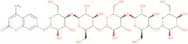
CAS:A fluorogenic MOSCERDAM® substrate targeting cellulasesFormula:C40H58O28Purity:Min. 95%Color and Shape:White To Off-White SolidMolecular weight:986.89 g/molGlycyl-glycine 7-amido-4-methylcoumarin hydrochloride
CAS:Glycyl-glycine 7-amido-4-methylcoumarin hydrochloride (Gly-Gly-AMC) is a fluorescent compound that can be used as a probe for the transfer of glycine in the brain. Gly-Gly-AMC binds to Langerhans cells and is transferred by an anterograde axonal transport mechanism from the peripheral nervous system to the central nervous system. The binding of Gly-Gly-AMC to Langerhans cells has been shown to activate them, which induces the release of inflammatory mediators into the surrounding tissue. This activity may be due to increased levels of calcium ions, which are known to induce exocytosis in these cells. Glycine is also involved in depression and other mental disorders, as well as muscle and brain activity.Formula:C14H16ClN3O4Molecular weight:325.75 g/molRef: 3D-G-6100
1gTo inquire5gTo inquire10gTo inquire500mgTo inquire2500mgTo inquire-Unit-ggTo inquire4-Nitrophenyl 2-acetamido-6-O-(2-acetamido-2-deoxy-b-D-glucopyranosyl)-3-O-(b-D-galactopyranosyl)-2-deoxy-a-D-galactopyranoside
CAS:4-Nitrophenyl 2-acetamido-6-O-(2-acetamido-2-deoxy-b-D-glucopyranosyl)-3-O-(b-D-galactopyranosyl)-2-deoxy-a-D-galactopyranoside is a specific chromogenic substrate designed for the highly sensitive and accurate detection of glycosidase enzyme activity. Glycosidases are responsible for the cleavage of glycosidic bonds between saccharide units in various carbohydrates. The hydrolysis of this substrate by glycosidase enzymes produces 4-nitrophenol, a yellow-colored compound that can be easily monitored through spectrophotometric measurements due to its strong absorbance at 405 nm. This chromogenic substrate is widely used in the analysis of glycosidase activity in various biological samples, including bacterial, fungal, and plant tissues, as well as in environmental samples and biotechnological applications.Formula:C28H41N3O18Purity:Min. 95 Area-%Color and Shape:White PowderMolecular weight:707.63 g/molAldol® 515 choline phosphate, Biosynth Patent: EP 2427431 and US 8940909
A useful substrate for the study of enzyme activitiesFormula:C28H32N3O5PPurity:Min. 95 Area-%Molecular weight:521.55 g/mol4-Nitrophenyl-beta-D-lactopyranoside
CAS:Chromogenic substrate for cellobiohydrolase and endoglucanase.Formula:C18H25NO13Purity:Min. 99.0 Area-%Molecular weight:463.40 g/molHippurate hydrolase from Campylobacter jejuni, aqueous solution with glycerol
Hippurate hydrolase is an enzyme that catalyzes the hydrolysis of hippurate to glycine and taurine. It is a fluorogenic substrate with high purity, ligand, and high quality. Hippurate hydrolase is used as a diagnostic enzyme for detecting the presence of hippuric acid in urine. This enzyme can be conjugated to a variety of molecules, including fluorophores, biotin or haptens, for use in immunoassay or other applications.Formula:C1944H3000N516O573S18Purity:Min. 95%Molecular weight:24,542 g/molAquaSpark® 510 Calibration Probe, Ramot at Tel-Aviv University Ltd. Patent family WO 2017/130191
CAS:AquaSpark® Calibration Probe is a water-soluble dioxetane-based chemiluminescent probe. Deprotonation of the free phenol group of the calibration probe under mild basic conditions results in an emissive decomposition process. No addition of enhancer or sensitizing agent is required to produce the bright green light emission in aqueous solutions.
AquaSpark® Calibration Probe is used for:
Demonstration experiment susing only the probe and an aqueous solution or water;
Evaluation of the AquaSpark® maximum light emission;
Functional tests of luminometers, plate readers and cameras;
Comparison with other probes bearing an enzyme labile group in order to build concentration/response curves;
Validation and comparison between different AquaSpark® probes.Formula:C21H23ClO6Purity:Min. 95%Color and Shape:PowderMolecular weight:406.12 g/mol5-Bromo-4-chloro-3-indolyl a-L-arabinofuranoside
5-Bromo-4-chloro-3-indolyl a-L-arabinofuranoside is a chromogenic substrate used to detect the specific enzymatic activity of alpha-L-arabinofuranosidase. After cleavage, 5-bromo-4-chloro-indoxyl is released, resulting in a blue to blue-green color change in bacterial colonies or media. 5-Bromo-4-chloro-3-indolyl a-L-arabinofuranoside is used in bacterial arabinan degradation assays (e.g. Bacillus spp.).Formula:C13H13BrClNO5Purity:Min. 98.0 Area-%Color and Shape:PowderMolecular weight:378.6 g/molAldol® 455 alpha-D-glucopyranoside - Biosynth Patent: EP 2427431 and US 8940909
Aldol® 455 alpha-D-glucopyranoside is a high quality, environmentally tested, staining, and ligand for bioluminescent assays. It has been shown to be a chromogenic substrate for diagnostics and a fluorogenic substrate for enzymes such as alpha-glucosidase, producing a yellow/green-orange color. Aldol® 455 alpha-D-glucopyranoside is also used in culture media and food testing.
Formula:C27H24ClNO7Purity:Min. 95 Area-%Color and Shape:PowderMolecular weight:509.93 g/mol4-Nitrophenyl phosphate mono(2-amino-2-ethyl-1,3-propanediol) salt monohydrate
CAS:4-Nitrophenyl phosphate mono(2-amino-2-ethyl-1,3-propanediol) salt monohydrate is a chromogenic substrate that can be used to detect the presence of alkaline phosphatase. It is also used in food testing and diagnostics. 4NPPMD is a substrate for the enzyme alkaline phosphatase, which has been shown to play a role in the inflammatory response. The production of 4NPPMD by bacteria in the environment can be detected with chemiluminescence or bioluminescence. This product has been shown to react with both horseradish peroxidase and alkaline phosphatase, as well as other enzymes that are involved in metabolic pathways. This substrate also has high purity and fluorescence properties.Formula:C11H21N2O9PPurity:Min. 95 Area-%Molecular weight:356.26 g/molIsopropyl-β-D-thiogalactopyranoside - non-animal origin
CAS:A non-metabolizable allolactose analogue, widely used in molecular biology for overexpression of recombinant proteins from inducible systems under the control of lac promoter. IPTG binds to the LacI repressor and causes its release from the lac operator, allowing gene expression to take place. Present in vectors of pGEX, pGEM-T, pET, pRSET, pMAL class and others.Formula:C9H18O5SPurity:Min. 99.0 Area-%Molecular weight:238.3 g/mol4-Methylumbelliferyl 6-deoxy-2,3,4,6-tetra-O-acetyl-6-thio-β-D-glucopyranoside
4-Methylumbelliferyl 6-deoxy-2,3,4,6-tetra-O-acetyl-6-thio-beta-D-glucopyranoside is a fluorogenic substrate for beta-glucosidase. After enzymatic cleaveage, free 4-methylumbelliferone (also known as hymecromone) is released, exhibiting blue fluorescence upon excitation with UV light. The strongest fluorescence of 4-methylumbelliferone requires deprotonation of the hydroxyl group (thus requires alkaline pH), with a maximal fluorescence intensity obtained with excitation at 350 to 370 nm and emission at 440 to 470 nm. The use of 4-methylumbelliferyl 6-deoxy-2,3,4,6-tetra-O-acetyl-6-thio-beta-D-glucopyranosideas a substrate for measuring the beta-glucosidase activity is used for Gaucher disease diagnosis.Formula:C24H26O11SPurity:Min. 95%Color and Shape:White to off-white solid.Molecular weight:522.52 g/mol4-Methylumbelliferyl caprylate
CAS:Fluorogenic substrate for esterase with C8 activity yielding a blue fluorescent solution upon cleavage. Used for the identification of Salmonella spp. based on the detection of caprylate esterase.Formula:C18H22O4Purity:Min. 98 Area-%Molecular weight:302.37 g/mol3-Nitrophenyl b-D-galactopyranoside
CAS:Chromogenic substrate targeting beta-galactosidaseFormula:C12H15NO8Color and Shape:PowderMolecular weight:301.25 g/mol