Enzyme Substrates
Enzyme substrates are molecules upon which enzymes act to catalyze chemical reactions. The substrate binds to the active site of the enzyme, where it undergoes a specific transformation to form the product of the reaction. Enzyme substrates are essential tools in research for studying enzyme kinetics, specificity, and mechanism of action. They are also used in diagnostic assays and biochemical studies. At CymitQuimica, we provide a diverse selection of high-quality enzyme substrates to support your research in enzymology and biochemistry.
Subcategories of "Enzyme Substrates"
Found 1527 products of "Enzyme Substrates"
Sort by
Purity (%)
0
100
|
0
|
50
|
90
|
95
|
100
Coelenterazine e
CAS:<p>Coelenterazine and its derivatives spontaneously complex with aequorin to develop a Ca2+-dependent fluorescent signal.</p>Formula:C28H23N3O3Purity:Min. 95%Color and Shape:PowderMolecular weight:449.5 g/mol5-Bromo-4-chloro-3-indoxyl-N-acetyl-beta-D-galactosaminide
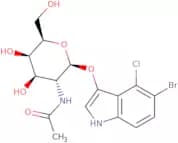
CAS:<p>5-Bromo-4-Chloro-3-Indoxyl-N-Acetyl-Beta-D-Galactosaminide is a chromogenic substrate for detecting beta-galactosidase and GalNAc-transferase enzymes. Upon hydrolysis by the enzyme, it produces a blue-green colored compound that can be detected visually or measured spectrophotometrically. This substrate is useful in characterizing the activity of Beta-Galactosidase and GalNAc-transferase enzymes involved in glycobiology research and diagnostic applications.</p>Formula:C16H18BrClN2O6Purity:Min. 98 Area-%Color and Shape:Crystalline PowderMolecular weight:449.68 g/molD-Luciferin Firefly, sodium salt monohydrate
CAS:<p>Water soluble substrate for firefly luciferase.</p>Formula:C11H9N2NaO4S2Purity:Min. 99.0 Area-%Molecular weight:320.32 g/molAquaSpark® 515 Singlet Oxygen Probe, Ramot at Tel-Aviv University Ltd. Patent family WO 2017/130191
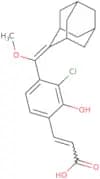
CAS:Singlet Oxygen Chemiluminescence Probe, SOCLFormula:C21H23ClO4Purity:Min. 95 Area-%Color and Shape:PowderMolecular weight:374.13 g/mol5-Bromo-4-chloro-3-indolyl a-L-rhamnoside
<p>5-Bromo-4-chloro-3-indolyl a-L-rhamnoside is a chromogenic substrate used to detect the specific enzymatic activity of alpha-L-rhamnosidase. After cleavage, 5-bromo-4-chloro-indoxyl is released, resulting in a blue to blue-green color change in bacterial colonies or media. 5-Bromo-4-chloro-3-indolyl a-L-rhamnoside is used in bacterial rhamnose metabolism studies (e.g. E. coli).</p>Formula:C14H15BrClNO5Purity:Min. 95%Color and Shape:SolidMolecular weight:392.63 g/mol4-Methylumbelliferyl-beta-D-glucuronic acid dihydrate
CAS:<p>4-Methylumbelliferyl beta-D-glucuronide (MUG) is commonly used as a substrate for detecting beta-glucuronidase. MUG is used for identifying E. coli contamination in food, drinking water, clinical samples and for rapid bacterial identification in blood cultures. It is recommended in international normatives (ISO, DIN) as a fluorogenic substrate for detection of E. coli. MUG is also a tool assaying the glucuronidase gene in plants.</p>Formula:C16H20O11Purity:Min. 99 Area-%Molecular weight:388.33 g/mol2-Chloro-4-nitrophenyl-β-D-cellotetraoside
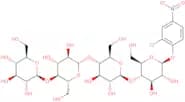
CAS:<p>2-chloro-4-nitrophenyl-beta-D-cellotetraoside is a chromogenic substrate for measuring cellulase activity and other glycosyl hydrolases. The release of 2-chloro-4-nitrophenol can be detected at 405 nm.</p>Formula:C30H44ClNO23Purity:Min. 95%Color and Shape:PowderMolecular weight:822.12 g/mol4-Methylumbelliferyl b-D-glucosaminide - Moscerdam™ biochemical purity
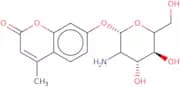
CAS:<p>A substrate used for the diagnosis of Sanfilippo disease C (MPS III C).</p>Formula:C16H19NO7Purity:Min. 98 Area-%Color and Shape:White PowderMolecular weight:337.32 g/mol5-Bromo-4-chloro-3-indolyl b-D-galactofuranoside
<p>5-Bromo-4-chloro-3-indolyl b-D-galactofuranoside is a chromogenic substrate used to detect the specific enzymatic activity of beta-D-galactofuranosidase. After cleavage, 5-bromo-4-chloro-indoxyl is released, resulting in a blue to blue-green color change in bacterial colonies or media. 5-Bromo-4-chloro-3-indolyl b-D-galactofuranoside is used in assays for detecting bacterial pathogens (e.g., Mycobacterium tuberculosis).</p>Formula:C14H15BrClNO6Purity:Min. 95%Color and Shape:PowderMolecular weight:408.63 g/mol4-Nitrophenyl myristate
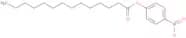
CAS:<p>4-Nitrophenyl myristate (NphOMy) is a chromogenic enzyme substrate used as a diagnosis tool for detection of β-lactamase hydrolysis activities. In the presence of certain drugs, 4-nitrophenyl myristate HSA-Tyr411-catalyzed hydrolysis seems to be inhibited.</p>Formula:C20H31NO4Purity:Min. 95 Area-%Color and Shape:White PowderMolecular weight:349.46 g/molLuciferin-alpha-D-glucoside, potassium salt
<p>Luciferin-alpha-D-glucoside, potassium salt is a fluorogenic substrate that is used in diagnostics as a ligand. It can be conjugated to various substances, including proteins and antibodies. It is also used as an enzyme substrate in the detection of glucose oxidase in bacterial culture media and chemiluminescence in food testing, environmental testing, and staining.</p>Purity:Min. 95%N-(6-Hydroxyhexyl)trifluoroacetamide
CAS:<p>Please enquire for more information about N-(6-Hydroxyhexyl)trifluoroacetamide including the price, delivery time and more detailed product information at the technical inquiry form on this page</p>Formula:C8H14F3NO2Molecular weight:213.2 g/molL-Lysyl-L-alanine 7-amido-4-methylcoumarin dihydrochloride
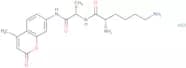
CAS:<p>L-Lysyl-L-alanine 7-amido-4-methylcoumarin dihydrochloride is a fluorogenic peptide substrate for aminopeptidase. This AMC peptide substrate is normally used to rapidly profile the N-terminal specificity of proteases.</p>Purity:Min. 98.0 Area-%Color and Shape:Powder2-Chloro-4-nitrophenyl α-D-mannopyranoside
CAS:<p>2-Chloro-4-nitrophenyl alpha-D-mannopyranoside is a substrate used to measure the alpha-mannosidase activity. This enzyme plays a crucial role in the lysosomal degradation of asparagine-linked carbohydrate cores of glycoproteinsis. The use of 2-Chloro-4-nitrophenyl alpha-D-mannopyranoside in diagnostic assays is important as a deficiency in alpha-mannosidase leads to the accumulation of mannose-rich oligosaccharides in lysosomes, causing a range of health problems collectively known as alpha-mannosidosis.</p>Formula:C12H14ClNO8Purity:Min. 98 Area-%Color and Shape:White PowderMolecular weight:335.69 g/molHippurate hydrolase from Campylobacter jejuni, aqueous solution with glycerol
<p>Hippurate hydrolase is an enzyme that catalyzes the hydrolysis of hippurate to glycine and taurine. It is a fluorogenic substrate with high purity, ligand, and high quality. Hippurate hydrolase is used as a diagnostic enzyme for detecting the presence of hippuric acid in urine. This enzyme can be conjugated to a variety of molecules, including fluorophores, biotin or haptens, for use in immunoassay or other applications.</p>Formula:C1944H3000N516O573S18Purity:Min. 95%Molecular weight:24,542 g/mol4-Nitrophenyl 2,3,4,6-tetra-O-acetyl-a-D-thiomannopyranoside
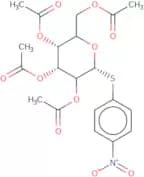
CAS:<p>4-Nitrophenyl 2,3,4,6-tetra-O-acetyl-a-D-thiomannopyranoside is a pNP substrate that serves as a chromogenic substrate for enzyme assays. It has been tested for the detection of a-D-mannosidase activity in a variety of biological samples, including cell lysates, body fluids, and tissue homogenates.</p>Purity:Min. 95%Molecular weight:485.47 g/mol6-Nitro-3-indolyl-b-D-galactopyranoside
<p>6-Nitro-3-indolyl-b-D-galactopyranoside is a chemiluminescent substrate that reacts with horseradish peroxidase to produce light. 6NIGP is used in the diagnostic field as a fluorogenic or chromogenic substrate for enzymes such as alkaline phosphatase, and as a staining agent for cells, tissues, and other biological materials. 6NIGP has been used in the detection of bacteria, fungi, parasites, and viruses. It is also used in food testing as an enzyme substrate. 6NIGP is purified by recrystallization from water or acetone and can be stored at −20°C.</p>Purity:Min. 95%Chlorophenol red-β-D-cellotrioside
CAS:<p>Chromogenic substrate for cellulases; red color</p>Formula:C37H42Cl2O20SPurity:Min. 95%Color and Shape:Orange to red solid.Molecular weight:909.69 g/mol5-Bromo-6-chloro-3-indolyl α-D-glucopyranoside
CAS:<p>5-Bromo-6-chloro-3-indolyl α-D-glucopyranoside is a chromogenic substrate that yields a magenta-colored product after cleavage. The chromophore 5-bromo-6-chloro-indoxyl is released, generating the observable color. It is used in Pompe disease diagnostics, a glycogen storage disorder, that measures the deffiency of alpha-glucosidase (GAA) that could lead to the accumulation of glycogen in lysosomes.</p>Formula:C14H15BrClNO6Purity:Min. 95%Color and Shape:PowderMolecular weight:408.63 g/molAldol® 515 nonanoate hydrochloride, Biosynth Patent: EP 2427431 and US 8940909
CAS:Aldol® 515 nonanoate hydrochloride is a chromogenic and fluorogenic enzyme substrate for detection of lipase activity. The colorless product is cleaved by C9 esterases produced by bacteria in liquid or solid media, yielding a red color and red fluorescence when Aldol® 355 fluorescence enhancer or a suitable matrix is present. Aldol® 515 nonanoate can be used under aerobic and anaerobic conditions. Well detectable color/fluorescence of bacterial colonies or liquid cultures is obtained within 24-48 h. In the presence of a purified lipase, color and fluorescence develops within minutes to few hours.Formula:C32H36ClN2O3Purity:Min. 95 Area-%Molecular weight:533.1 g/mol