Enzyme Substrates
Subcategories of "Enzyme Substrates"
Found 1528 products of "Enzyme Substrates"
Galβ(1-3)[neu5acα(2-6)]GlcNAc-β-PNP
CAS:Galβ(1-3)[neu5acα(2-6)]GlcNAc-β-PNP is a glycosylation product of the complex carbohydrate GlcNAc. It is synthesized by the enzyme β-1,3-galactosyltransferase and N-acetylneuraminic acid transferase. This product has been modified using click chemistry to introduce a fluorine atom at the 6 position of Neu5Acα2-6. Galβ(1-3)[neu5acα(2-6)]GlcNAc-β-PNP is available in high purity and custom synthesis.Formula:C31H45N3O21Purity:Min. 95%Molecular weight:795.7 g/molThymidine 5′-monophosphate p-nitrophenyl ester sodium
CAS:Thymidine 5′-monophosphate p-nitrophenyl ester sodium is a fluorogenic substrate that is used in food testing and environmental testing. It is an important component of the Ligand Assay, a diagnostic test for the detection of antibodies to HIV. Thymidine 5′-monophosphate p-nitrophenyl ester sodium has been shown to be a good substrate for use in enzyme assays, such as DNA polymerase, DNA ligase, and RNA polymerase. This product is also used in bioluminescence and chemiluminescence reactions.Formula:C16H18N3O10P•NaPurity:Min. 95%Molecular weight:466.29 g/mol4-Methylumbelliferyl-a-D-mannopyranoside-2-phosphoethanolamine
4-Methylumbelliferyl-a-D-mannopyranoside-2-phosphoethanolamine is a fluorescent substrate used in enzyme assays. It is an analog of the natural substrate, 4-methylumbelliferyl-alpha-D-mannopyranoside, which is a phosphoethanolamine linked to alpha-D-mannose. This product can be used as a chromogenic or fluorogenic substrate for various enzymes, including beta glucosidase, beta galactosidase, and beta lactonase. 4MUMPE can also be used for bioluminescent studies and has been shown to have high purity and quality.Purity:Min. 95%4-Nitrophenyl 4,6-benzylidene-2-O-(2,3,4,6-tetra-O-[4-methoxybenzyl]-a-D-glucopyranosyl)-a-D-glucopyranoside
4-Nitrophenyl 4,6-benzylidene-2-O-(2,3,4,6-tetra-O-[4-methoxybenzyl]-a-D-glucopyranosyl)-a-D-glucopyranoside is a fluorogenic substrate that is used in diagnostic assays to measure the activity of enzymes such as β–galactosidase and β–glucuronidase. It is also an enzyme substrate for culture media and chemiluminescence. This product has a CAS number of 57316-92-8.Purity:Min. 95%Molecular weight:1,088.02 g/molAquaSpark® Alkaline Phosphatase Substrate, Ramot at Tel-Aviv University Ltd. Patent family WO 2017/130191
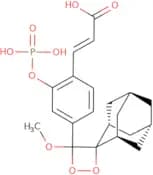
AquaSpark® Alkaline Phosphatase Substrate is a stand-alone reagent - no additives such as enhancers or detergents are required to start a strong light reaction. AquaSpark® Alkaline Phosphatase Substrate is superior to other luminogenic alkaline phosphatase substrates as it shows significantly higher signal intensities and very low background.Application Examples:
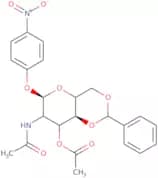
Formula:C21H24NaO9PPurity:Min. 80.0 Area-%Molecular weight:474.38 g/mol4-Nitrophenyl 2-acetamido-3-O-acetyl-4,6-O-benzylidene-2-deoxy-a-D-glucopyranoside
CAS:4-Nitrophenyl 2-acetamido-3-O-acetyl-4,6-O-benzylidene-2-deoxy-aDglucopyranoside is a fluorogenic substrate that can be used for the detection of β-glucosidase activity. It is a water soluble substrate with an extinction coefficient of approximately 10,000 M−1 cm−1 at 420 nm. 4NPAABGDG is a chromogenic substrate that can be used to detect β-galactosidase activity. It has an extinction coefficient of approximately 1,700 M−1 cm−1 at 420 nm. The CAS number for 4NPAABGDG is 23262–56–8 and it is sold by Sigma Aldrich under catalog number L4959.Purity:Min. 95%Molecular weight:472.44 g/mol6-Bromo-2-naphthyl-α-D-mannopyranoside
CAS:6-Bromo-2-naphthyl-alpha-D-mannopyranoside is a strong inhibitor of alpha-mannosidase. It has been shown to inhibit the growth of Mycobacterium tuberculosis and Streptococcus pneumoniae, which are both known to cause bacterial infections in humans. 6BNA inhibits the enzyme alpha-mannosidase, which hydrolyzes terminal α-(1,4)-linked mannose residues from oligosaccharides and glycoproteins. This drug has a high affinity for the active site of alpha-mannosidase and an IC50 value of 0.2 mM, making it an effective inhibitor.
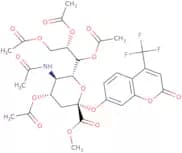
Formula:C16H17BrO6Purity:Min. 98.0 Area-%Molecular weight:385.22 g/mol4-Trifluoromethylumbelliferyl Tetra-O-acetylated alpha-D-N-Acetylneuraminate Methyl Ester
CAS:4-Trifluoromethylumbelliferyl Tetra-O-acetylated alpha-D-N-Acetylneuraminate Methyl Ester is a chemiluminescent substrate that is often used in enzyme and immunoassays. It is a high purity, high quality chemical with a CAS number of 195210-09-4. The 4-Trifluoromethylumbelliferyl Tetra-O-acetylated alpha-D-N-Acetylneuraminate Methyl Ester is used in the detection of bacterial infections and can be used to measure the activity of enzymes such as lysozyme and peroxidase. This product has been tested for its ability to induce bioluminescence in bacteria grown in culture media, as well as for its ability to cause fluorescence or staining in cells or tissues. The 4TUMBTM Tetra O AcetylatedFormula:C30H32F3NO15Purity:Min. 95%Molecular weight:703.57 g/mol6-Chloro-3-indolyl phosphate disodium salt
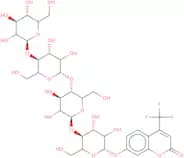
CAS:6-Chloro-3-indolyl phosphate disodium salt is a substrate for visualising alkaline phosphatase activity. It produces a red colored insoluble end product that is detected visually, when used together with nitroblue tetrazolium. The substrate system is versatile and functions in a variety of applications, including Northern, Southern, and Western blotting, in situ hybridization, ELISAs and immunohistochemistry. DMF soluble.Formula:C8H5ClNNa2O4PPurity:Min. 98 Area-%Color and Shape:PowderMolecular weight:291.54 g/mol4-(Trifluoromethyl)umbelliferyl-b-D-cellotetraoside
CAS:4-(Trifluoromethyl)umbelliferyl-b-D-cellotetraoside is a chemiluminescent substrate that can be used in the detection of peroxidase, horseradish peroxidase, and other enzymes. It is a fluorescent product that emits light upon reaction with hydrogen peroxide. This product has been tested for purity and quality and has shown to have no detectable levels of heavy metals or other contaminants. 4-(Trifluoromethyl)umbelliferyl-b-D-cellotetraoside is not cytotoxic and can be used for the detection of enzyme activity in living cells. 4-(Trifluoromethyl)umbelliferyl-b-D-cellotetraoside is also known as TMBECFDA, which stands for Trifluoromethyl)umbelliferone (Cellobiose) (BiotPurity:Min. 95%Molecular weight:878.7 g/mol2-Nitrophenyl 2,3,4-tri-O-acetyl-b-D-galactopyranoside
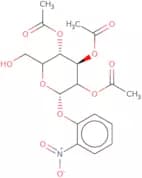
CAS:2-Nitrophenyl 2,3,4-tri-O-acetyl-b-D-galactopyranoside is a fluorogenic substrate that can be used to detect β-galactosidase activity. This specific substrate is one of the most commonly used substrates for detecting β-galactosidase activity in diagnostic assays. It reacts with the enzyme to produce a blue color and has a fluorescence emission maximum at about 480 nm. The product is available in high purity and high quality and it is also an enzyme substrate.Purity:Min. 95%Molecular weight:427.36 g/mol6-Chloro-7-hydroxy-4-(trifluoromethyl)coumarin
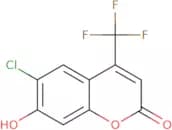
CAS:6-Chloro-7-hydroxy-4-(trifluoromethyl)coumarin is a fungicide that inhibits the growth of fungi by interfering with their DNA synthesis. It does this by inhibiting the activity of two enzymes: the fungal enzyme oxime and the enzyme cinerea, which is found in many fungi. 6-Chloro-7-hydroxy-4-(trifluoromethyl)coumarin has been shown to be effective against Alternaria and Botrytis cinerea. The compound also has an antifungal effect against other types of fungi, such as Penicillium roqueforti, when used in combination with a solvent such as ether.
Purity:Min. 95%Molecular weight:264.58 g/mol5-Bromo-4-chloro-3-indolyl 5-O-feruloyl a-L-arabinofuranoside
5-Bromo-4-chloro-3-indolyl 5-O-feruloyl a-L-arabinofuranoside is a chemiluminescent ligand that is used in the detection of DNA, RNA, and proteins. It has been shown to be an efficient fluorescence substrate for DNA and RNA polymerases. 5-Bromo-4-chloro-3-indolyl 5-O-feruloyl a-L-arabinofuranoside is suitable for use in diagnostic tests for bacteria, fungi, viruses, parasites, and toxins. This compound has been extensively tested for toxicity and carcinogenicity.Purity:Min. 95%4-Nitrophenyl 6'-deoxy-6'-(2-pyridylamino)-a-D-penta-(1-4)-glucopyranoside
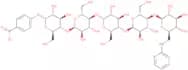
CAS:4-Nitrophenyl 6'-deoxy-6'-(2-pyridylamino)-a-D-penta-(1-4)-glucopyranoside is a fluorescent substrate for the enzyme beta glucosidase. It is a chemiluminescent reagent that can be used to measure beta glucosidase activity. The substrate is an excellent high quality chemical and has been tested for environmental safety, heavy metal content and staining. 4-Nitrophenyl 6'-deoxy-6'-(2-pyridylamino)-a-D-penta-(1-4)-glucopyranoside is a chromogenic substrate that can be used in diagnostic testing, such as bioluminescence or fluorogenic assay. This product can also be used as a culture media additive or food testing agent.Purity:Min. 95%Molecular weight:1,025.91 g/mol6-Chloro-4-methylumbelliferyl b-D glucuronide
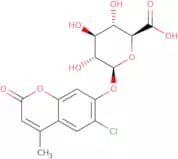
CAS:6-Chloro-4-methylumbelliferyl b-D glucuronide is a fluorogenic substrate for beta-glucuronidase that exhibits longer absorption/emission maxima (~385/500 nm) than typical 4MU-derived substrates.Formula:C16H15ClO9Purity:Min. 97 Area-%Color and Shape:White PowderMolecular weight:386.74 g/molN-Succinyl-Ala-Phe-Lys 7-amido-4-methylcumarin acetate (salt)
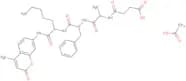
CAS:Controlled ProductFluorogenic substrate targeting plasminFormula:C34H43N5O10Purity:Min. 95%Molecular weight:681.7 g/mol3-Carboxyumbelliferyl b-D-galactopyranoside
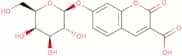
CAS:3-Carboxyumbelliferyl b-D-galactopyranoside is a fluorescent probe that can be used to study protein synthesis in live cells. It binds to the active site of the enzyme peptidyl transferase, which catalyzes the covalent linkage of amino acids to form a polypeptide chain. 3CMBG is specific for the amino acid proline and is a substrate for peptidyl transferase. The fluorescence of 3CMBG increases when it is bound to peptidyl transferase, making it useful as a marker for protein synthesis.
Purity:Min. 95%Molecular weight:368.28 g/mol4-Methylumbelliferyl 2-acetamido-3,4,6-tri-O-acetyl-2-deoxy-b-D-glucopyranoside
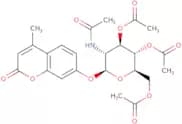
CAS:4-Methylumbelliferyl 2-acetamido-3,4,6-tri-O-acetyl-2-deoxy--bDglucopyranoside is a compound that has been shown to interact with glutamicum and casein kinase. It is also a test compound for corynebacterium glutamicum and interacts with it by functional theory. The compound has been shown to inhibit inflammatory diseases and may be used as a potential treatment for these diseases.Purity:Min. 95%Molecular weight:505.47 g/mol4-Nitrophenyl b-D-celloheptaoside
CAS:Chromogenic substrate targeting cellulasePurity:Min. 95%Molecular weight:1,274.09 g/mol4-Trifluoromethylumbelliferyl a-D-N-acetylneuraminic acid
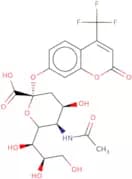
CAS:4-Trifluoromethylumbelliferyl a-D-N-acetylneuraminic acid is a fluorescent chemiluminescent substrate that is used in the detection of beta-galactosidase activity. Beta-galactosidase catalyzes the hydrolysis of 4-trifluoromethylumbelliferyl a-D-N-acetylneuraminic acid to form 4-trifluoromethylumbelliferone and D-galactose, which emits light at approximately 480 nm. This reaction can be detected by fluorescence spectrophotometry using a fluorometer or photometer. 4TFUNA is not toxic, does not inhibit enzymes, and has been tested for toxicity and mutagenicity using bacteria and mammalian cells.
Purity:Min. 95%Molecular weight:521.39 g/mol
![Galβ(1-3)[neu5acα(2-6)]GlcNAc-β-PNP](/_next/image/?url=https%3A%2Fstatic.cymitquimica.com%2Fproducts%2F3D%2Fthumb-webp%2FEFB95471.webp&w=3840&q=75)


![4-Nitrophenyl 4,6-benzylidene-2-O-(2,3,4,6-tetra-O-[4-methoxybenzyl]-a-D-glucopyranosyl)-a-D-gluco…](/_next/image/?url=https%3A%2Fstatic.cymitquimica.com%2Fproducts%2F3D%2Fthumb-webp%2FEN04828.webp&w=3840&q=75)