Enzyme Substrates
Subcategories of "Enzyme Substrates"
Found 1526 products of "Enzyme Substrates"
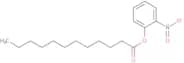
2-Nitrophenyl laurate
CAS:2-Nitrophenyl laurate is a fatty acid that is not able to be degraded and has a high affinity for magnetic particles. It can be used in the immobilization of bacteria, such as Stenotrophomonas maltophilia, which are resistant to many antibiotics. 2-Nitrophenyl laurate also inhibits the enzyme lipolytic enzymes, which are responsible for the degradation of phospholipids in the cell membrane. This inhibition may lead to an increase in bacterial susceptibility to antibiotics. 2-Nitrophenyl laurate is a synthetic substrate that can be used to study the regulation of lipolytic enzymes by regulatory proteins.
Purity:Min. 95%Color and Shape:Pale yellow to yellow solid.Molecular weight:321.41 g/molRef: 3D-EN15506
Discontinued productLuciferin-beta-D-glucoside, potassium salt
Luciferin-beta-D-glucoside, potassium salt is a fluorogenic substrate that can be used as a ligand in enzyme assays. It is also used in the manufacture of diagnostic reagents, such as conjugates and culture media. It is often used to test for the presence of bacteria or fungi.
Purity:Min. 95%Phenytoin sodium
CAS:Controlled ProductPlease enquire for more information about Phenytoin sodium including the price, delivery time and more detailed product information at the technical inquiry form on this page
Formula:C15H11N2O2NaMolecular weight:274.25 g/molRef: 3D-Q-201564
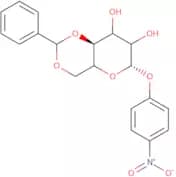
Discontinued product4-Nitrophenyl 4,6-O-benzylidene-b-D-glucopyranoside
CAS:4-Nitrophenyl 4,6-O-benzylidene-b-D-glucopyranoside is a fluorescent compound that is used in diagnostics and research. The compound is an enzyme substrate, a ligand for metal ions, and a chromogenic substrate. It can be used to test cultures of bacteria in culture media, as well as for food testing and environmental testing. 4-Nitrophenyl 4,6-O-benzylidene-b-D-glucopyranoside has high purity and quality due to its high fluorescence intensity. This product has been shown to be highly stable in various conditions and may be used in conjugates with other compounds.
Purity:Min. 95%Molecular weight:389.36 g/molLuciferin-choline phosphate, sodium salt
Luciferin-choline phosphate, sodium salt is a chemical compound used for the detection of phosphatases and esterases. This compound is also used for the detection of bacteria and fungi in food testing and environmental testing. Luciferin-choline phosphate, sodium salt is a chromogenic substrate that can be detected using bioluminescence or fluorogenic substrates. It has an absorbance maximum at around 420 nm.
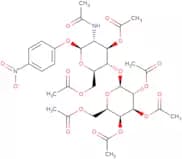
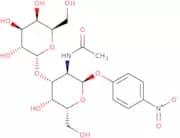
Formula:C16H17N3NaO6PS2Purity:Min. 95 Area-%Molecular weight:465.41 g/mol4-Nitrophenyl 2-acetamido-3,6-di-O-acetyl-4-O-(2,3,4,6-tetra-O-acetyl-b-D-galactopyranosyl)-2-deoxy-b-D-glucopyranoside
CAS:4-Nitrophenyl 2-acetamido-3,6-di-O-acetyl-4-O-(2,3,4,6-tetra-O-acetyl-b-D-galactopyranosyl)-2-deoxy-b-D-glucopyranoside is modified acetylated chromogenic substrate designed for the detection and quantification of enzyme activity. This highly specific substrate is cleaved by enzymes, releasing a yellow 4-nitrophenol product that can be easily measured spectrophotometrically. This allows for accurate and sensitive analysis of enzyme kinetics, inhibition studies, and substrate specificity determination.
Purity:Min. 95%Molecular weight:756.66 g/molRef: 3D-EN06441
Discontinued product4-Nitrophenyl D-maltopentaoside
CAS:Chromogenic substrate targeting amylase and maltase
Formula:C36H55NO28Purity:Min. 95%Molecular weight:949.81 g/mol2,4-Dinitrophenyl 2-deoxy-2-fluoro-b-D-xylopyranoside
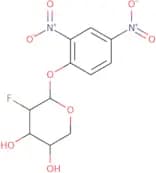
CAS:2,4-Dinitrophenyl 2-deoxy-2-fluoro-b-D-xylopyranoside (DNFX) is a transglycosylation reagent that can be used to inactivate enzymes that catalyze the synthesis of xylosides. DNFX undergoes a covalent reaction with these enzymes and inhibits them by binding to the active site. DNFX catalyses the reaction between xylose and nucleophiles such as hydroxide ions, thiols, or amines. DNFX also has a catalytic effect on electrospray ionization and can be used for the detection of nucleophile activity.Purity:Min. 95%Color and Shape:White PowderMolecular weight:318.21 g/molD-Luciferin-6-O b-D-glucopyranoside
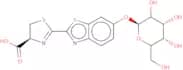
Chemiluminescent substrate for beta-D-glucosidase
Purity:Min. 95%Molecular weight:442.47 g/molAldol® 467 N-acetyl-beta-D-glucosaminide, Biosynth Patent: EP 2427431 and US 8940909
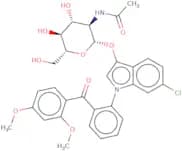
CAS:Aldol® 467 N-acetyl-beta-D-glucosaminide is a chromogenic and fluorogenic enzyme substrate used for detection of beta-N-acetyl-glucosaminidase activity. The colorless enzyme substrate is cleaved in the presence of beta-N-acetyl-glucosaminidase yielding development of a yellow product. In addition, green fluorescence is generated when a suitable matrix or Aldol® 355 fluorescence enhancer is present. Aldol® 467 N-acetyl-beta-D-glucosaminide amide can be used in enzymatic assays or in live bacterial cultures. Aldol® 467 N-acetyl-beta-D-glucosaminide is suitable for use in liquid and solid media, under aerobic as well as anaerobic conditions.
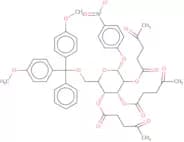
Formula:C31H31ClN2O9Purity:Min. 95%Color and Shape:PowderMolecular weight:611.04 g/mol4-Nitrophenyl 6-O-DMT-2,3,4-tri-O-levulinoyl-a-D-mannopyranoside
4-Nitrophenyl 6-O-DMT-2,3,4-tri-O-levulinoyl-a-D-mannopyranoside is a fluorogenic substrate that can be used for the detection of DMT (dihydroxyacetone) in food products. It has been shown to be an excellent alternative to the more commonly used 4,5′,6,7,8,-Tetrabromoindoxyl 3′,5′,6′,-tetraacetic acid (TBA). This product is also used as a chromogenic substrate for the determination of phenols in environmental testing and as a ligand conjugate for immunohistochemistry staining. The purity of this product is guaranteed and it has been tested extensively.
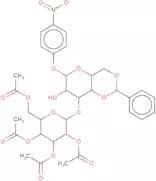
Purity:Min. 95%Molecular weight:897.92 g/mol4-Nitrophenyl 4,6-O-benzylidene-3-O-(2,3,4,6-tetra-O-acetyl-b-D-glucopyranosyl)-b-D-glucopyranoside
4-Nitrophenyl 4,6-O-benzylidene-3-O-(2,3,4,6-tetra-O-acetyl-b-D-glucopyranosyl)-b-D-glucopyranoside is a high purity fluorescent reagent that can be used as a substrate for many enzymes. It is also used in environmental testing and to detect the presence of nitrophenols in food. This product has CAS number 545414.
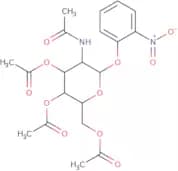
Purity:Min. 95%Molecular weight:719.64 g/mol2-Nitrophenyl 2-acetamido-3,4,6-tri-O-acetyl-2-deoxy-b-D-galactopyranoside
CAS:2-Nitrophenyl 2-acetamido-3,4,6-tri-O-acetyl-2-deoxy-b-D-galactopyranoside is a chemiluminescent substrate for the detection of beta galactosidase. It is a white to light yellow powder with a molecular weight of 564.87 and an assay of ≥ 98% by HPLC. This product has been shown to be stable when stored at 4°C for up to three months.Purity:Min. 95%Molecular weight:468.41 g/mol5-Bromo-3-indoxyl-β-D-galactopyranoside-6-sulfate sodium salt
CAS:5-Bromo-3-indoxyl-beta-D-galactopyranoside (5BIG) is a fluorogenic substrate that has been shown to be an effective enzyme substrate. It is used in the chemiluminescence, bioluminescence, and fluorescence detection of enzymes. 5BIG is also a chromogenic substrate for nucleic acid staining and can be used in food testing as well as diagnostics. 5BIG is highly pure and high quality with a CAS number of 1301706-59-1.
Formula:C14H15BrNNaO9SPurity:Min. 98 Area-%Molecular weight:476.24 g/mol4-Nitrophenyl 2-acetamido-4-O-(2-acetamido-3,4,6-tri-O-acetyl-2-deoxy-b-D-glucopyranosyl)-3,6-di-O-acetyl-2-deoxy-b-D-glucopyranosid e
CAS:4-Nitrophenyl 2-acetamido-4-O-(2-acetamido-3,4,6-tri-O-acetyl-2-deoxy-b-D-glucopyranosyl)-3,6-di-O -acetyl2 deoxy b D glucopyranosid e is a chemiluminescence substrate that reacts with hydrogen peroxide to produce light. It is used in diagnostics for the detection of bacterial and fungal cultures. The reaction between 4NPAA and hydrogen peroxide generates light at 540 nm. This product has been tested for purity and quality using various methods including culture media, environmental testing, bioluminescence, staining, fluorogenic substrate, enzyme substrate, food testing and conjugate.Purity:Min. 95%Molecular weight:755.68 g/molPhenylethyl 2-acetamido-2-deoxy-b-D-glucopyranoside
CAS:Phenylethyl 2-acetamido-2-deoxy-b-D-glucopyranoside can be used to inhibit the growth of bacteria, yeast, and fungi. It is a yellow powder that has been shown to cause regression in tumor xenografts in mice. Phenylethyl 2-acetamido-2-deoxy-b-D-glucopyranoside inhibits cellular proliferation by blocking the synthesis of proteins and nucleic acids. This compound also has been shown to have an effect on the environment because it inhibits the growth of phytoplankton. Phenylethyl 2-acetamido-2-deoxy-b-D-glucopyranoside was found to disrupt bacterial gene expression profiles, which may be due to its ability to inhibit protein synthesis at the ribosome level.Purity:Min. 95%Molecular weight:325.36 g/mol2-Nitrophenyl 2-acetamido-2-deoxy-b-D-galactopyranoside
CAS:2-Nitrophenyl 2-acetamido-2-deoxy-b-D-galactopyranoside is a carboxymethyl derivative of the natural substrate of β-galactosidase, which is used as a substrate for the production of recombinant proteins in the corynebacterium glutamicum. The enzyme β-galactosidase hydrolyzes this substrate to produce an acid molecule and a sugar molecule. This product can be used in biotechnological processes for the production of recombinant proteins or other bioactive molecules. It can also be used in the isolation of nucleic acid from bacteria or fungi, or to study bacterial membrane transport systems. 2NPGAG can be expressed as a recombinant protein with expression vectors such as pET21a and pET24a. It has been shown that this product inhibits transport through membranes by binding to cellulose, which may be useful for studies on cellulose biosynthesis
Purity:Min. 95%Molecular weight:342.3 g/mol4-Nitrophenyl 2-O-(a-D-glucopyranosyl)-a-D-glucopyranoside
CAS:4-Nitrophenyl 2-O-(α-D-glucopyranosyl)-α-D-glucopyranoside is a specialized chromogenic pNP substrate featuring dual glucose-linked moieties, designed for accurate detection and quantification of specific glycosidase enzymes. Upon cleavage by target enzymes, this substrate releases 4-Nitrophenol, which can be easily monitored spectrophotometrically as a yellow color change. This advanced substrate offers enhanced specificity and sensitivity in enzyme assays, facilitating cutting-edge research in biochemistry, enzymology, and other related fields.
Purity:Min. 95%Molecular weight:463.39 g/molRef: 3D-EN04809
Discontinued product5-Bromo-4-chloro-3-indolyl b-D-galactopyranoside-6-sulphate
CAS:5-Bromo-4-chloro-3-indolyl b-D-galactopyranoside 6-sulphate (BCIGS) is a chemiluminescent substrate that reacts with an enzyme to produce light. It has been used for the detection of various substances, including 5'-nucleotidase, 5'-adenosine monophosphate phosphohydrolases, and alkaline phosphatase. BCIGS can be used as a chromogenic substrate in the fluorometric assay of glucose oxidase and galactose oxidase. BCIGS is also used as a ligand in immunological reactions such as immunodiffusion, immunoelectrophoresis, and radioimmunoassay.Formula:C14H15BrClNO9SPurity:Min. 95%Molecular weight:488.69 g/molRef: 3D-EB03191
Discontinued product4-Nitrophenyl 2-acetamido-2-deoxy-3-O-(a-D-galactopyranosyl)-a-D-galactopyranoside
CAS:4-Nitrophenyl 2-acetamido-2-deoxy-3-O-(a-D-galactopyranosyl)-a-D-galactopyranoside is a fluorescent substrate that can be used in chemiluminescent assays. It is a high purity, high quality chemical that has been tested for culture media, environmental testing and bioluminescence. This product is an excellent choice for use in diagnostics, chromogenic substrates, enzyme substrates and food testing.
Purity:Min. 95%Molecular weight:504.44 g/mol