Enzyme Substrates
Enzyme substrates are molecules upon which enzymes act to catalyze chemical reactions. The substrate binds to the active site of the enzyme, where it undergoes a specific transformation to form the product of the reaction. Enzyme substrates are essential tools in research for studying enzyme kinetics, specificity, and mechanism of action. They are also used in diagnostic assays and biochemical studies. At CymitQuimica, we provide a diverse selection of high-quality enzyme substrates to support your research in enzymology and biochemistry.
Subcategories of "Enzyme Substrates"
Found 1527 products of "Enzyme Substrates"
Sort by
Purity (%)
0
100
|
0
|
50
|
90
|
95
|
100
Aldol® 515 acetate, Biosynth Patent: EP 2427431 and US 8940909
CAS:<p>Aldol® 515 acetate is a chromogenic and fluorogenic substrate, used for detection of esterase activity. The colorless product is cleaved by purified esterase, or esterase secreted by microorganisms in liquid or solid media, yielding a red color and red fluorescence signal when Aldol® 355 fluorescence enhancer or a suitable matrix is present. Aldol® 515 acetate can be used under aerobic and anaerobic conditions. Well detectable color/fluorescence of bacterial colonies or liquid cultures is obtained within 16-48 h. In the presence of a purified esterase, color and fluorescence develops within minutes to few hours.</p>Formula:C25H22N2O3Purity:Min. 95.0 Area-%Molecular weight:398.45 g/molAcetyl-L-alanine 7-amido-4-methylcoumarin
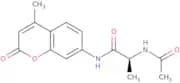
CAS:<p>Acetyl-L-alanine 7-amido-4-methylcoumarin is a fluorogenic substrate for aminopeptidase. The enzyme cleaves the N-terminal amino acids, yielding a blue fluorescent solution.</p>Formula:C15H16N2O4Purity:Min. 98 Area-%Color and Shape:PowderMolecular weight:288.3 g/molLuc-coliforms Na
CAS:<p>Luc-coliforms Na is a fluorogenic substrate that is used in the diagnosis of bacterial contamination. It is a conjugate of the enzyme luciferase and the substrate coelenterazine, which are combined in a buffer solution. Luc-coliforms Na is used to detect bacteria by adding it to a culture broth or other growth media. The bacteria will emit light as they break down the luc-coliforms Na and produce ATP, which can then be measured with an appropriate detector. Luc-coliforms Na can also be used as a stain for gram-negative rods, such as coliforms, e.g., Escherichia coli, Enterobacter aerogenes, Klebsiella pneumoniae, Proteus mirabilis.</p>Formula:C17H17NaN2O8S2Purity:Min. 95 Area-%Molecular weight:464.44 g/molRef: 3D-L-8263
5mgTo inquire10mgTo inquire25mgTo inquire50mgTo inquire100mgTo inquire-Unit-mgmgTo inquire5-Bromo-6-chloro-3-indoxyl sulfate, potassium salt
CAS:5-Bromo-6-chloro-3-indoxyl sulfate, potassium salt is a fluorogenic substrate for the enzyme alkaline phosphatase. This compound is used in the detection of alkaline phosphatase activity as well as in many other applications such as diagnostic tests and environmental testing. 5-Bromo-6-chloro-3-indoxyl sulfate, potassium salt is available at high purity and quality.Formula:C8H4BrClKNO4SPurity:Min. 98 Area-%Molecular weight:364.65 g/mol5-Bromo-4-chloro-3-indoxyl-α-D-N-acetylneuraminic acid, cyclohexylammonium salt
<p>5-Bromo-4-chloro-3-indoxyl-alpha-D-N-acetylneuraminic acid, cyclohexylammonium salt is a Fluorogenic substrate used for the detection of an enzyme that converts sialic acid to fluorescein. This product has a high quality and purity with a CAS number. It is used in Culture media as a conjugate, Enzyme substrate, Food testing, High purity, Diagnostics, ligand, Chromogenic substrate, Environmental testing. The product has been tested and found to be safe for use with animals and humans.</p>Formula:C25H35BrClN3O9Purity:Min. 99.5 Area-%Molecular weight:636.92 g/mol6-Chloro-3-indoxyl-N-acetyl-β-D-galactosaminide
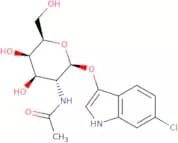
CAS:<p>Chromogenic substrate for N-Acetyl-β-D-galactosaminidase yielding a salmon-colored precipitate.</p>Formula:C16H19ClN2O6Purity:Min. 98.0 Area-%Molecular weight:370.79 g/mol2-O-(4-Nitrophenyl)-a-D-N-acetylneuraminic acid
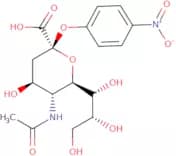
CAS:<p>2-O-(4-Nitrophenyl)-a-D-N-acetylneuraminic acid, also known as p-nitrophenyl N-acetylneuraminic acid, is a chromogenic substrate specifically designed for the detection and quantification of neuraminidase (sialidase) activity. Upon cleavage by neuraminidase, it releases a yellow-colored product, 4-nitrophenol, which can be easily monitored spectrophotometrically at 405 nm. This substrate is widely used in various applications, including enzyme kinetics studies, inhibitor screening, and the determination of neuraminidase activity in biological samples such as viruses, bacteria, and cell lysates. It is particularly useful for studying the enzymatic properties of neuraminidases from different sources and for the development of novel antiviral and antibacterial agents targeting neuraminidase activity.</p>Formula:C17H22N2O11Purity:Min. 90 Area-%Color and Shape:White PowderMolecular weight:430.36 g/mol4-Methylumbelliferyl-2-O-(α-L-fucopyranosyl)-β-L-fucopyranoside
<p>4-Methylumbelliferyl-2-O-(alpha-L-fucopyranosyl)-beta-L-fucopyranoside is a fluorogenic substrate for alpha-L-fucosidase. After enzymatic cleaveage, free 4-methylumbelliferone (also known as hymecromone) is released, exhibiting blue fluorescence upon excitation with UV light. The strongest fluorescence of 4-methylumbelliferone requires deprotonation of the hydroxyl group (thus requires alkaline pH), with a maximal fluorescence intensity obtained with excitation at 350 to 370 nm and emission at 440 to 470 nm. The use of 4-methylumbelliferyl-2-O-(alpha-L-fucopyranosyl)-beta-L-fucopyranosideas a substrate for measuring the alpha-L-fucosidase activity is used for diagnosis of fucosidosis (defficiency of L-fucosidase).</p>Purity:Min. 95%Color and Shape:White/Off-White SolidMolecular weight:468.45 g/mol4-Methylumbelliferyl 2-O-(a-L-fucopyranosyl)-b-D-galactopyranoside
CAS:<p>4-Methylumbelliferyl 2-O-(a-L-fucopyranosyl)-b-D-galactopyranoside is an enzyme substrate used in chromogenic assays of alpha-fucosidases. It is also used for glycoprocessing enzymes in synthesis.</p>Purity:Min. 95%Molecular weight:484.45 g/molIsopropyl-β-D-thiogalactopyranoside
CAS:<p>A non-metabolizable allolactose analogue, widely used in molecular biology for overexpression of recombinant proteins from inducible systems under the control of lac promoter. IPTG binds to the LacI repressor and causes its release from the lac operator, allowing gene expression to take place. Present in vectors of pGEX, pGEM-T, pET, pRSET, pMAL class and others.</p>Formula:C9H18O5SPurity:Min. 99 Area-%Molecular weight:238.3 g/molRef: 3D-I-8020
25gTo inquire50gTo inquire100gTo inquire250gTo inquire500gTo inquire-Unit-ggTo inquire6-Bromo-2-naphthyl b-D-glucuronide
CAS:6-Bromo-2-naphthyl beta-D-glucuronide is a substrate for beta-glucuronidase, an enzyme involved in detoxification and bacterial metabolism. Upon enzymatic hydrolysis, it releases 6-bromo-2-naphthol, which forms a detectable dye when reacted with diazonium salts. This compound is widely used in microbiology to detecting E. coli in water testing and histochemical staining. 6-Bromo-2-naphthyl beta-D-glucuronide is also been used in cancer research studies. It has been found that some tumors are related to a high activity of beta-glucuronidase, responsible to reactivate the carcinogens and promote tumor progression, developing a drug resistance to chemotherapy.Formula:C16H15BrO7Purity:Min 97%Color and Shape:White Off-White PowderMolecular weight:399.2 g/mol4-Nitrophenyl b-L-arabinopyranoside
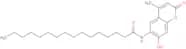
CAS:<p>4-Nitrophenyl beta-L-arabinopyranoside is a chromogenic substrate for beta-L-arabinosidase. Upon hydrolysis, para-nitrophenol is released yielding a yellowish colour. 4-Nitrophenyl beta-L-arabinopyranoside is used in different applications such as the Bacterial arabinan degradation assays, gut microbiome analysis</p>Formula:C11H13NO7Purity:Min. 98 Area-%Color and Shape:White PowderMolecular weight:271.22 g/mol6-Hexadecanoylamino-4-methylumbelliferone
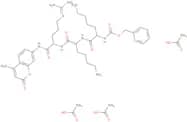
CAS:<p>Fluorochrome for calibration of fluorimeters. Used with corresponding fluorogenic substrates for the diagnosis of Krabbe - and Niemann-Pick A/B disease.</p>Formula:C26H39NO4Purity:Min. 95%Color and Shape:White PowderMolecular weight:429.59 g/molN-CBZ-L-Lysyl-L-lysyl-L-arginine 7-amido-4-methylcoumarin triacetate
CAS:Controlled Product<p>N-CBZ-L-Lysyl-L-lysyl-L-arginine 7-amido-4-methylcoumarin triacetate is a synthetic peptide substrate used as a fluorogenic substrate for aminopeptidase.</p>Formula:C35H51N9O7•(C2H4O2)3Purity:Min. 95%Color and Shape:PowderMolecular weight:903.03 g/mol3-(7-Hydroxycoumarin-3-carboxamido)propyl 4-O-(b-D-galactopyranosyl)-b-D-glucopyranoside
<p>3-(7-Hydroxycoumarin-3-carboxamido)propyl 4-O-(b-D-galactopyranosyl)-b-D-glucopyranoside is a fluorogenic substrate that is used for the detection of beta-galactosidase. It has been shown to be an efficient substrate for the enzyme beta galactosidase and can be used to detect this enzyme in cell culture media and other diagnostic applications. 3-(7-Hydroxycoumarin-3-carboxamido)propyl 4-O-(b-D-galactopyranosyl)-b-D-glucopyranoside can also be used as a chromogenic substrate, which is added to a reaction mixture containing beta galactosidase, where it is hydrolyzed by the enzyme to produce a blue color. This product also has food testing and environmental testing applications.</p>Purity:Min. 95%4-Methylumbelliferyl-β-D-ribofuranoside
CAS:<p>4-Methylumbelliferyl-beta-D-ribofuranoside is a chemical compound that belongs to the class of phenols. It has been found in Australian plants and animals. 4-Methylumbelliferyl-beta-D-ribofuranoside is used as a corrosion inhibitor. This chemical has been shown to be effective against corrosion in mammals.br>br><br>4-Methylumbelliferyl-beta-D-ribofuranoside can also be used as a fluorescent probe for studying cell membrane activity.</p>Formula:C15H16O7Purity:Min. 99 Area-%Molecular weight:308.29 g/molRef: 3D-M-6190
1gTo inquire5gTo inquire250mgTo inquire500mgTo inquire2500mgTo inquire-Unit-ggTo inquire4-Methylumbelliferyl-N-acetyl-β-D-glucosaminide
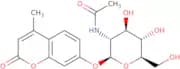
CAS:<p>Fluorogenic substrate for N-Acetyl-β-D-glucosaminidase yielding a blue fluorescent solution. Used for rapid identification of Salmonella species.</p>Formula:C18H21NO8Purity:Min. 99 Area-%Molecular weight:379.37 g/mol3,4-Cyclohexenoesculetine β-D-glucopyranoside
CAS:<p>Chromogenic substrate for beta-glucosidase</p>Formula:C19H22O9Purity:Min. 95%Color and Shape:PowderMolecular weight:394.37 g/mol6-Chloro-3-indoxyl choline phosphate
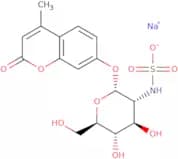
CAS:<p>6-Chloro-3-indoxyl choline phosphate is a chromogenic substrate for phosphatidylcholine-specific phospholipase C (PC-PLC) for the detection of mibrobial metabolites. The use of this specific substrate permits monitoring the activity of PC-PLC. This an important enzyme for the regulation of steady-state levels of phosphatidylcholine (PC) and diacylglycerol (DAG). Abnormally high levels of PC-PLC activity in various tissues have been linked to many disease progressions.</p>Formula:C13H18ClN2O4PPurity:Min. 99 Area-%Color and Shape:PowderMolecular weight:332.72 g/mol4-Methylumbelliferyl 2-deoxy-2-sulfamino-a-D-glucopyranoside sodium salt - Moscerdam™ biochemical purity
CAS:<p>4-Methylumbelliferyl 2-deoxy-2-sulfamino-a-D-glucopyranoside sodium salt (M3A or MU-GlcNS) is a fluorogenic substrate of heparin sulfamidase, used in the diagnosis of Mucopolysaccharidosis III type A (MPS III A). MPS III A, also known as Sanfilippo syndrome type A, is caused by the deficiency of heparan N-sulfatase. Heparin sulfamidase in the assay desulfates MU-GlcNS to 4-methylumbelliferyl 2-amino-2-deoxy-α-D-glucopyranoside (MU-GlcNH2). To release fluorometrically measurable 4-methylumbelliferone (MU) and by-product glucosamine, MU-GlcNH2 is further hydrolysed by an enzyme such as yeast α-glucosidase during a second incubation.</p>Formula:C16H18NO10SNaPurity:Min. 95 Area-%Color and Shape:White PowderMolecular weight:439.37 g/mol