Enzyme Substrates
Subcategories of "Enzyme Substrates"
Found 1526 products of "Enzyme Substrates"
3-Indolyl 2-acetamido-2-deoxy-b-D-galactopyranoside
3-Indolyl 2-acetamido-2-deoxy-b-D-galactopyranoside is a fluorogenic substrate that reacts with the enzyme β-galactosidase to produce a blue product. This product can be used to diagnose the presence of β-galactosidase in culture media, as well as in food and environmental testing. 3IAG is also a chromogenic substrate that can be used for detection of β-galactosidase activity.
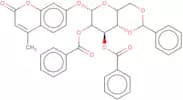
Purity:Min. 95%Molecular weight:336.34 g/mol4-Methylumbelliferyl 2,3-di-O-benzoyl-4,6-O-benzylidene-b-D-galactopyranoside
4-Methylumbelliferyl 2,3-di-O-benzoyl-4,6-O-benzylidene-b-D-galactopyranoside is a fluorogenic substrate that is used in the detection of β-galactosidase activity. This product is a white to off white powder that has a purity of 99.2%. It has been given CAS number 53654–95–1 and it can be found in the Diagnostics section of Acros Organics.
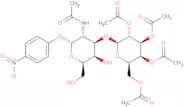
Purity:Min. 95%Molecular weight:634.63 g/mol4-Nitrophenyl 2-acetamido-3-O-(2,3,4,6-tetra-O-acetyl-b-D-galactopyranosyl)-2-deoxy-a-D-galactopyranoside
CAS:4-Nitrophenyl 2-acetamido-3-O-(2,3,4,6-tetra-O-acetyl-b-D-galactopyranosyl)-2-deoxy-a-D-galactopyranoside is a chromogenic substrate designed for the detection and quantification of enzyme activity. This tetra-acetylated compound is specifically designed to be cleaved by enzymes, releasing a yellow 4-nitrophenol product that can be easily measured spectrophotometrically, allowing for accurate and sensitive analysis of enzyme kinetics and inhibition studies.
Purity:Min. 95%Molecular weight:672.59 g/mol5-Bromo-4-chloro-3-indoxyl-α-D-xylopyranoside
CAS:5-Bromo-4-chloro-3-indoxyl-alpha-D-xylopyranoside is an enzyme substrate that can be used in the detection of β-galactosidase activity. This product has been shown to be a good ligand for various xanthine oxidoreductases, including xanthine dehydrogenase and uricase. 5BBIX is also a chromogenic substrate for horseradish peroxidase and can be used to detect hydrogen peroxide in the presence of osmium tetroxide or potassium permanganate. 5BBIX has been extensively tested for use in diagnostics, food, and environmental testing.
Formula:C13H13BrClNO5Purity:Min. 98.0 Area-%Molecular weight:378.61 g/molMethyl 4-nitrophenyl hexyl phosphonate
CAS:Methyl 4-nitrophenyl hexyl phosphonate is a lipase suicide inhibitor that is a chromogenic substrate for lipases which upon enzymatic action, binds irreversibly to the lipase and inactivates it. The substrate can be used for the determination of active sites in lipases.
Purity:Min. 95%Molecular weight:301.28Luciferin-β-D-glucoside, potassium salt
Luciferin-beta-D-glucoside, potassium salt is a conjugate of luciferin and beta-D-glucose. This compound is a substrate for enzymes that catalyze the oxidation of luciferin to generate light. It can be used in diagnostic tests as a chromogenic or fluorogenic substrate to detect specific substances, such as metals and microbes.
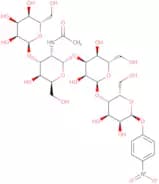
Formula:C17H17KN2O8S2Purity:Min. 94 Area-%Molecular weight:464.47 g/mol4-Nitrophenyl lacto-N-tetraoside
CAS:4-Nitrophenyl lacto-N-tetraoside is a chromogenic substrate for enzymes that cleave lactose-specific linkages, such as beta-galactosidases. Upon enzyme cleavage, the pNP group is released, resulting in a yellow-colored solution that can be spectrophotometrically quantified at 405 nm. This substrate is commonly used in detecting lactose hydrolysis activity, such as in dairy industry for production optimization studies, or in microbiology for bacterial lactose fermentation assays. Its tetrasaccharide structure resembles that of lactose and makes it a specific substrate for lactose-utilizing enzymes. The properties of 4-nitrophenyl lacto-N-tetraoside make it a useful tool in enzyme kinetics studies and screening of new lactose-utilizing microorganisms.
Purity:Min. 95%Molecular weight:828.72 g/molRef: 3D-EN44927
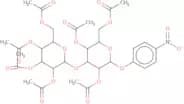
Discontinued product4-Nitrophenyl 2,4,6-tri-O-acetyl-3-O (2,3,4,6-tetra-O-acetyl-b-D-glucopyranosyl)-a-D-glucopyranoside
4-Nitrophenyl 2,4,6-tri-O-acetyl-3-O (2,3,4,6-tetra-O-acetyl-b-D-glucopyranosyl)-a-D-glucopyranoside is a chemiluminescent substrate that can be used for the detection of aminoglycosides in biological fluids. It is a high purity and high quality product with CAS No. 482743. The product has been tested for safety and purity using culture media and environmental testing. This product may be used as a bioluminescence substrate to detect the presence of aminoglycosides in samples such as urine, serum or plasma. 4NTPAGDG is also useful as a fluorogenic substrate for diagnostics and enzyme substrates for food testing.
Purity:Min. 95%Molecular weight:757.65 g/molJalapeno green-Gal
Jalapeno green-Gal (Jalapeno green-beta-D-galactopyranoside) is a chromogenic indicator for beta-galactosidase activity. The colorless product is cleaved by lactose-utilizing bacteria in liquid media or on agar plates and yields a Jalapeno green colored precipitate. Jalapeno green-Gal can also be used as detecting agent for beta-galactosidase activity in reporter gene assays or for identification of positive transformants on agar plates when using the α-complementation approach.
Molecular weight:472.1 g/molLuc-B.cereus Na
Luc-B.cereus Na is a chemiluminescent substrate that is used for diagnostic purposes. This substrate emits light in the presence of peroxide and can be detected by a luminometer or photomultiplier tube. Luc-B.cereus Na is a high purity, high quality, and chemically stable product that can be stored at room temperature for up to one year. It has been tested for use with a wide variety of organisms such as bacteria, fungi, parasites, and viruses. Luc-B.cereus Na reacts with peroxide to produce light and is an excellent choice for use in diagnostics because it does not require any additional chemicals.
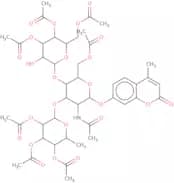
Purity:Min. 95%4-Methylumbelliferyl 2-acetamido-3-O-(2,3,4-tri-O-acetyl-a-L-fucopyranosyl)-4-O-(2,3,4,6-tetra-O-acetyl-b-D-galactopyranosyl)-6-O-ac etyl-2-deoxy-b-D-glucopyranoside
4-Methylumbelliferyl 2-acetamido-3-O-(2,3,4-tri-O-acetyl-a-L-fucopyranosyl)-4-O-(2,3,4,6 -tetra-O-acetylbDgalactopyranosyl)-6-O-acetyldEoxybDglucopyranoside is a chemiluminescent substrate that has been used in the detection of beta galactosidase activity. It is a ligand for beta galactosidases and can be used for the study of enzyme kinetics. This compound also exhibits high purity and is available in CAS number: 916071. 4MUFAGAALF is suitable for use in culture media and environmental testing as well as diagnostics (e.g., bioluminescence), staining (fluorogenic substrate), and chromogenic substrates
Purity:Min. 95%Molecular weight:1,023.94 g/mol4-Nitrophenyl 2-O-(2,3,4,6-tetra-O-acetyl-a-D-mannopyranosyl)-a-D-mannopyranoside
4-Nitrophenyl 2-O-(2,3,4,6-tetra-O-acetyl-a-D-mannopyranosyl)-a-D-mannopyranoside is a fluorogenic substrate that is used as a diagnostic tool and can be used to detect the presence of β--glucosidase in the gut. It is also used as a conjugate with enzymes such as peroxidase or alkaline phosphatase for use in enzyme catalyzed reactions. The product has been shown to be active against a variety of bacteria, including Staphylococcus aureus and Escherichia coli. This product has been shown to produce chemiluminescence when incubated with horseradish peroxidase and hydrogen peroxide. This product is light sensitive and should be stored at room temperature away from direct sunlight.
Purity:Min. 95%Molecular weight:631.54 g/mol4-Nitrophenyl b-D-cellohexaoside
CAS:4-Nitrophenyl b-D-cellohexaoside is a substrate for many enzymes and can be used to detect the presence of these enzymes in biological samples. It can also be used to detect the presence of bacteria, fungi, parasites, and viruses. 4-Nitrophenyl b-D-cellohexaoside is an excellent substrate for enzyme reactions that produce a chromogenic or fluorogenic product. This product is often conjugated with other compounds such as antibodies or antigens to form an immunoassay. 4-Nitrophenyl b-D-cellohexaoside is made from a high purity chemical by a process called nitration with sodium nitrate and sulfuric acid.
Purity:Min. 95%Molecular weight:1,111.95 g/mol4-Nitrophenyl 2,3,4,6-tetra-O-acetyl-b-D-glucopyranoside
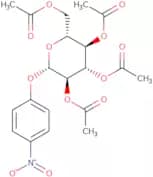
CAS:4-Nitrophenyl 2,3,4,6-tetra-O-acetyl-β-D-glucopyranoside is a versatile chromogenic substrate designed for the detection and quantification of various glycosidase enzymes. This substrate is widely used in enzyme assays, producing a yellow color upon cleavage by target enzymes. The 4-Nitrophenol released in this reaction can be easily monitored spectrophotometrically, allowing for rapid and accurate enzyme analysis. This high-quality substrate provides a convenient and reliable tool for researchers in biochemistry, enzymology, and related fields.
Formula:C20H23NO12Purity:Min. 95 Area-%Color and Shape:PowderMolecular weight:469.4 g/molS-(4-Nitrophenyl)mercapturic acid
CAS:S-(4-Nitrophenyl)mercapturic acid (S-NPMA) is the major metabolite of 4-nitrophenol, which is a precursor to dyes and pharmaceuticals. S-NPMA has been detected in urine samples from humans, rats, and mice. The main metabolic pathway for S-NPMA is an oxidative conversion by cytochrome P450 enzymes. S-NPMA has been found to be a useful biomarker for the presence of polycyclic aromatic hydrocarbons in wastewater and human urine. The levels of this compound have also been shown to increase with age in humans.
Purity:Min. 95%Molecular weight:284.29 g/molRef: 3D-EN26334
Discontinued product4-Methylumbelliferyl 2-acetamido-2-deoxy-3-O-(a-L-fucopyranosyl)-b-D-glucopyranoside
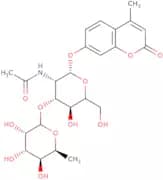
CAS:4-Methylumbelliferyl 2-acetamido-2-deoxy-3-O-(alpha-L-fucopyranosyl)-beta-D-glucopyranoside is a fluorogenic substrate for alpha-L-fucosidase. After enzymatic cleaveage, free 4-methylumbelliferone (also known as hymecromone) is released, exhibiting blue fluorescence upon excitation with UV light. The strongest fluorescence of 4-methylumbelliferone requires deprotonation of the hydroxyl group (thus requires alkaline pH), with a maximal fluorescence intensity obtained with excitation at 350 to 370 nm and emission at 440 to 470 nm. The use of 4-methylumbelliferyl 2-acetamido-2-deoxy-3-O-(alpha-L-fucopyranosyl)-beta-D-glucopyranosideas a substrate for measuring the alpha-L-fucosidase activity is used for fucosidosis diagnosis (deficiency of the enzyme alpha-L-fucosidase) and lysosomal storage disorder screening.Formula:C24H31NO12Purity:Min. 95 Area-%Color and Shape:White PowderMolecular weight:525.5 g/molRef: 3D-EM04792
Discontinued product4-Nitrophenyl 6-O-DMT-a-D-mannopyranoside
4-nitrophenyl 6-O-DMT-a-D-mannopyranoside is a fluorescent substrate for the enzyme beta-glucosidase. It reacts with an acyl group at the C2 position of the glycoside moiety, producing an aldehyde group at the C1 position and a hydroxymethylene group at the C4 position. This reaction is catalyzed by beta-glucosidase, which cleaves the glycosidic linkage in sucrose and other disaccharides. The product can be detected using luminescence methods, such as chemiluminescence or bioluminescence.
4-nitrophenyl 6-O-DMT-a-D-mannopyranoside is used to detect β glucosidase activity in bacteria. This substrate has been shown to be sensitive and specific for β glucosidase activity when combined with fluorescence detection technologyPurity:Min. 95%Molecular weight:603.62 g/mol4-Nitrophenyl 4,6-benzylidene-3-O-(2,3,4,6-tetra-O-[4-methoxybenzyl]-a-D-glucopyranosyl)-a-D-glucopyranoside
4-Nitrophenyl 4,6-benzylidene-3-O-(2,3,4,6-tetra-O-[4-methoxybenzyl]-a-D-glucopyranosyl)-a-D-glucopyranoside is a chemiluminescent substrate used for the detection of various enzymes. This substrate is commonly used in enzyme assays to measure the activity of β-galactosidase, α-amylase, and β-lactamase. The product can be used in diagnostic applications such as food testing and bacterial identification.Purity:Min. 95%Molecular weight:1,088.02 g/molRef: 3D-EN04840
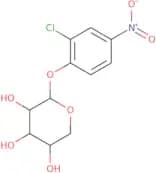
Discontinued product2-Chloro-4-nitrophenyl β-D-xylopyranoside
CAS:2-Chloro-4-nitrophenyl β-D-xylopyranoside is a fluorogenic substrate that can be used for the detection of β-glucuronidase activity in food testing, environmental testing, and diagnostics. It has been shown to be an effective substrate for detecting β-glucuronidase activity with a high degree of sensitivity and specificity. 2CNPX can also be used as a chromogenic substrate for the detection of β-glucuronidase activity in food testing and environmental testing. The conjugate form of this substrate is useful for immunochemical assays, such as enzyme linked immunosorbent assay (ELISA) or radioimmunoassay (RIA). This product is also used as a ligand in fluorescence resonance energy transfer (FRET) assays.
2CNPX can be used to detect β-glucuronidase activity by chemiluminescenceFormula:C11H12ClNO7Purity:Min. 95%Molecular weight:305.67 g/molRef: 3D-EC182588
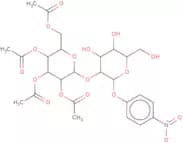
Discontinued product4-Nitrophenyl 2-O-(a-D-mannopyranosyl)-a-D-mannopyranoside
CAS:4-Nitrophenyl 2-O-(a-D-mannopyranosyl)-a-D-mannopyranoside is a chromogenic substrate for the enzyme, beta-glucosidase. It is used as a food additive to test for the presence of alpha and beta glucosidases in foods. This product is also commonly used as an enzyme substrate and conjugate in biochemical research and diagnostic applications.
Purity:Min. 95%Color and Shape:White To Off-White SolidMolecular weight:463.39 g/molRef: 3D-EN06460
Discontinued product








![4-Nitrophenyl 4,6-benzylidene-3-O-(2,3,4,6-tetra-O-[4-methoxybenzyl]-a-D-glucopyranosyl)-a-D-gluco…](/_next/image/?url=https%3A%2Fstatic.cymitquimica.com%2Fproducts%2F3D%2Fthumb-webp%2FEN04840.webp&w=3840&q=75)