Chromogenic Substrates
Found 712 products of "Chromogenic Substrates"
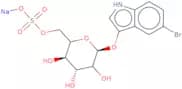
5-Bromo-3-indolyl-β-D-galactopyranoside-6-sulfate sodium salt
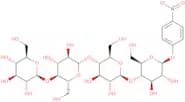
CAS:5-Bromo-3-indolyl-beta-D-galactopyranoside-6-sulfate sodium salt is a lapis substrate, a chromogenic substrate that yields a deep blue color after cleavage. It is used in sulfatase activity assays and for the diagnosis of Mucopolysaccharidosis IVA (Morquio A).Formula:C14H15BrNNaO9SPurity:Min. 95%Color and Shape:PowderMolecular weight:476.23 g/mol4-Nitrophenyl b-D-cellotetraoside
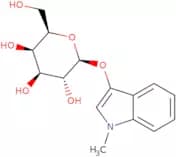
CAS:4-Nitrophenyl b-D-cellotetraoside is a chromogenic substrate utilized for the detection and quantification of cellulase enzyme activity. Cellulase enzymes hydrolyze the beta-1,4-glycosidic bonds of cellulose, a major component of plant cell walls. Upon cleavage by cellulase, it releases 4-nitrophenol, a compound that exhibits a yellow color and absorbs strongly at 405 nm, allowing for easy spectrophotometric measurements of cellulase activity levels in various sample types, including bacterial and fungal cultures, environmental samples, and industrial applications.Formula:C30H45NO23Purity:Min. 95%Color and Shape:PowderMolecular weight:787.67 g/molN-Methylindoxyl-beta-D-galactopyranoside monohydrate
CAS:N-Methylindoxyl-beta-D-galactopyranoside monohydrate (MG) is a chromogenic probe that interacts with galactose residues found on glycoproteins, which are found on cell surfaces, leading to activation of cells. MG also binds specifically to the surface of lung cells and can inhibit the development of certain types of infections..Formula:C15H21NO7Purity:Min. 98 Area-%Color and Shape:PowderMolecular weight:327.33 g/mol2-Nitrophenyl-beta-D-cellobioside
CAS:Chromogenic substrate for β-D-Cellobiosidase yielding a yellow solution upon cleavage.
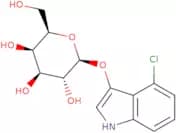
Formula:C18H25NO13Purity:Min. 98.0 Area-%Molecular weight:463.4 g/mol4-Chloro-3-indolyl β-D-galactopyranoside
CAS:2-Chloro-4-nitrophenyl b-D-lactoside is a chromogenic enzyme substrate used to study the activity of enzymes. It produces a color when hydrolyzed, which makes it a valuable tool in screening for enzyme activity and studying enzyme kinetics.Formula:C14H16ClNO6Purity:Min. 95%Color and Shape:SolidMolecular weight:329.73 g/mol5-Bromo-4-chloro-3-indolyl b-D-fucopyranoside
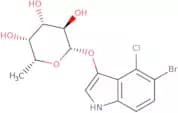
CAS:5-Bromo-4-chloro-3-indolyl b-D-fucopyranoside is a chromogenic substrate used is for the enzyme beta-fucosidase.
Formula:C14H15BrClNO5Purity:Min. 98 Area-%Color and Shape:PowderMolecular weight:392.63 g/mol6-Chloro-3-indoxyl-β-D-glucuronic acid methyl ester, Biosynth Patent: EP 2718458 and US 9127303
6-Chloro-3-indoxyl-beta-D-glucuronic acid methyl ester is a chemiluminescent substrate that is used to measure the activity of enzymes in the beta-galactosidase family. This product is a white crystalline solid that dissolves in water and ethanol. 6-Chloro-3-indoxyl-beta-D-glucuronic acid methyl ester has been shown to be stable for at least two years when stored at -20°C. It can be used for diagnostic purposes, such as the detection of bacterial infections, or as an enzyme substrate in biochemistry studies.Purity:Min. 95%6-Chloro-3-indoxyl-beta-D-galactopyranoside
CAS:6-Chloro-3-indoxyl-beta-D-galactopyranoside is a chromogenic substrate for beta-galactosidase that yields a salmon or rose-coloured precipitate and hence is also known as Salmon-Gal. It can be used in conjunction with isopropyl-beta-D-thiogalactopyranoside (IPTG) as an alternative to the chromogenic substrate 5-bromo-4-chloro-3-indolyl beta-D-galactopyranoside (X-Gal) for detection of beta-galactosidase activity in bacterial colonies in colorimetric assays. Where beta-galactosidase expressed from a reporter gene in molecular biology experiments, recombinant colonies on growth plates are salmon-coloured while non-recombinants appear as white. Use of nitroblue tetrazolium salt (NBT) with Salmon-Gal may provide faster results, yielding a clear, purple precipitate, than for Salmon-Gal alone. In conjunction with 5-bromo-4-chloro-3-indolyl-beta-D-glucoside (X-Glc), Salmon-Gal is useful for simultaneous detection of GUS and Lac activities in the same medium.Formula:C14H16ClNO6Purity:Min. 98.0 Area-%Molecular weight:329.74 g/molAldol® 458 beta-D-galactopyranoside, Biosynth Patent: EP 2427431 and US 8940909
CAS:Aldol® 458 beta-D-galactopyranoside is a chromogenic and fluorogenic enzyme substrate used for detection of beta-galactosidase activity. The colorless enzyme substrate is cleaved by lactose utilizing bacteria grown in liquid or solid media, yielding yellow coloration and green fluorescence. Aldol® 458 beta-D-galactopyranoside can also be used in beta-galactosidase gene reporter assays or immunoassay applications (ELISA). Aldol® 458 beta-D-galactopyranoside can be used under aerobic and anaerobic conditions.Formula:C22H23NO8Purity:Min. 95 Area-%Color and Shape:PowderMolecular weight:429.42 g/mol5-Bromo-3-indolyl 2-acetamido-2-deoxy-b-D-glucopyranoside
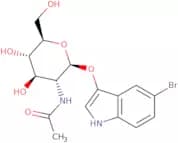
CAS:5-Bromo-3-indolyl 2-acetamido-2-deoxy-b-D-glucopyranoside is a lapis substrate, a chromogenic substrate that yields a deep blue color after cleavage. It is used in lysosomal storage disorder screening such as for Sanfilippo syndrome.Formula:C16H19BrN2O6Purity:Min. 98 Area-%Color and Shape:White Off-White PowderMolecular weight:415.24 g/mol2-Nitrophenyl b-D-galactopyranoside-6-phosphate cyclohexylammonium salt
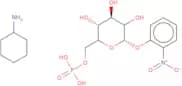
CAS:2-Nitrophenyl beta-D-galactopyranoside-6-phosphate cyclohexylammonium salt is a chromogenic substrate used to detect the enzymatic activity of beta-galactosidase-6-phosphatase. After cleavage, the nitrophenyl moiety is released exhibiting a light yellowish color. 2-Nitrophenyl beta-D-galactopyranoside-6-phosphate cyclohexylammonium salt is used in diagnostic assays such as lysosomal storage disorder.Purity:Min. 95%Color and Shape:PowderMolecular weight:480.4 g/mol2-Chloro-4-nitrophenyl b-D-galactopyranoside
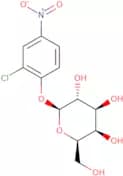
CAS:2-Chloro-4-nitrophenyl-beta-D-galactopyranoside is a chromogenic substrate used to test enzyme activities. It is commonly used in molecular biology research for the detection and measurement of beta-galactosidase activity.Formula:C12H14ClNO8Purity:Min. 95%Color and Shape:White PowderMolecular weight:335.69 g/mol6-Chloro-3-indoxyl-3-acetate
CAS:Chromogenic substrate for carboxylesterase yielding a salmon colored precipitate upon cleavage. Mainly used in histochemistry.Formula:C10H8ClNO2Molecular weight:209.63 g/molRef: 3D-C-4758
1gTo inquire5gTo inquire250mgTo inquire500mgTo inquire2500mgTo inquire-Unit-ggTo inquire3-Nitrophenyl β-D-glucopyranoside
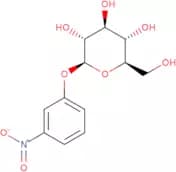
CAS:3-Nitrophenyl beta-D-glucopyranoside is a chromogenic enzyme substrate commonly used to assay for beta-glucosidase activity. Upon hydrolysis by the enzyme, it produces a yellow product that can be easily detected by spectrophotometry. This substrate is often used in the field of carbohydrate chemistry and biochemistry to study enzyme kinetics and inhibition in both in vitro and in vivo systems.Formula:C12H15NO8Purity:Min. 95%Color and Shape:White Yellow PowderMolecular weight:301.25 g/mol4-Nitrophenyl b-L-arabinopyranoside
CAS:4-Nitrophenyl beta-L-arabinopyranoside is a chromogenic substrate for beta-L-arabinosidase. Upon hydrolysis, para-nitrophenol is released yielding a yellowish colour. 4-Nitrophenyl beta-L-arabinopyranoside is used in different applications such as the Bacterial arabinan degradation assays, gut microbiome analysis
Formula:C11H13NO7Purity:Min. 98 Area-%Color and Shape:White PowderMolecular weight:271.22 g/mol5-Bromo-4-chloro-3-indolyl-D-thymidine-3'-phosphate cyclohexylammonium salt
CAS:5-Bromo-4-chloro-3-indolyl-D-thymidine-3'-phosphate cyclohexylammonium salt is a chromogenic substrate used to detect the specific enzymatic activity of alkaline phosphatase. After cleavage, 5-bromo-4-chloro-indoxyl is released, resulting in a blue to blue-green color change in bacterial colonies or media. 5-Bromo-4-chloro-3-indolyl-D-thymidine-3'-phosphate cyclohexylammonium salt is used in immunohistochemistry (IHC) and Western blot detection, immunoassays used to detect proteins.Formula:C18H17BrClN3O8P·C6H14NPurity:Min. 95%Color and Shape:White PowderMolecular weight:649.86 g/mol2-Naphthyl b-D-galactopyranoside
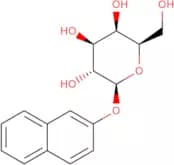
CAS:2-Naphthyl beta-D-galactopyranoside is a glycoside that is found in the flowers of the plant Eschscholzia californica. It is used as a localizer for bacterial strains and can be hydrolyzed by enzymes to release naphthalene. 2-Naphthyl beta-D-galactopyranoside has been shown to inhibit the growth of corynebacterium and diazonium salt, which may be due to its ability to bind to DNA and disrupt protein synthesis. The potential use of this molecule is for its insolubility, which prevents it from being absorbed by skin cells.
Formula:C16H18O6Purity:Min. 99 Area-%Color and Shape:PowderMolecular weight:306.31 g/mol5-Bromo-4-chloro-3-indoxyl phosphate, disodium salt sesquihydrate
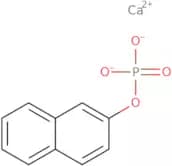
CAS:Water soluble, chromogenic substrate for visualizing alkaline phosphatase activity. Produces a blueinsoluble end product that is detected visually when used together with nitroblue tetrazolium. The substrate system is versatile and functions in a variety of applications, including Northern, Southern, and Western blotting, in situhybridization, ELISAs and immunohistochemistry.Formula:C8H4BrClNNa2O4P·5(H2O)Purity:Min. 98.0 Area-%Molecular weight:397.45 g/molCalcium 2-naphthylphosphate
CAS:Calcium 2-naphthylphosphate, which is the calcim salt of 2-naphthylphosphate, is a chromogenic substrate to measure alkaline phosphatase activity. After enzymatic cleavage, the product yielded (2-naphthol) generates a red-colored complex upon reaction with a diazonium salt like Fast Blue RR or Fast Garnet GBC.
Purity:(%) Min. 95%Color and Shape:PowderMolecular weight:282.24 g/molAldol® 514 inositol-phosphate, ammonium salt, Biosynth Patent: EP 2427431 and US 8940909
CAS:Aldol® 514 inositol-phosphate is a chromogenic enzyme substrate used for detection of phosphatidylinositol specific phospholipase C (PI-PLC, EC 4.6.1.13). The colorless enzyme substrate is cleaved by PI-PLC positive microorganisms, yielding a red-orange color. The substrate thus enables the detection and identification of various bacteria, such as, pathogenic strains of Listeria, Clostridium, Bacillus, and Staphylococcus. Aldol® 514 inositol-phosphate is suitable for use under aerobic and anaerobic conditions.
Formula:C26H28BrClN3O10PPurity:Min. 95.0 Area-%Molecular weight:688.85 g/mol