Chromogenic Substrates
Found 712 products of "Chromogenic Substrates"
2-Naphthyl b-D-glucopyranoside monohydrate
CAS:2-Naphthyl-lpha-D-glucopyranoside is a substrate for α-glucosidase. 2-Naphthol is released upon hydrolyzation. By simultaneous coupling with a suitable staining reagent, such as hexazonium p-rosaniline, the corresponding reddish-brown azo-dye is formed. Naphthols can also be detected by fluorescence analysis.
Purity:Min. 95%Color and Shape:PowderMolecular weight:324.33 g/molRef: 3D-EN06885
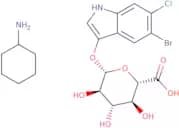
Discontinued product5-Bromo-6-chloro-3-indolyl b-D-glucuronide cyclohexylammonium salt
CAS:5-Bromo-6-chloro-3-indolyl b-D-glucuronide cyclohexylammonium salt is a magenta enzyme substrate commonly used in biochemical assays. This compound is a derivative of indole, containing bromine and chlorine atoms at positions 5 and 6, respectively. The glucuronide moiety is attached to the indolyl ring, and the cyclohexylammonium cation serves as a counterion to balance the charge. This substrate is often utilized in the detection and quantification of β-glucuronidase activity, an enzyme involved in the metabolism of glucuronides. Upon cleavage by β-glucuronidase, the substrate produces a magenta-colored product, allowing for easy visualization and measurement of enzyme activity.
Formula:C14H13BrClNO7·C6H13NPurity:Min. 98 Area-%Color and Shape:PowderMolecular weight:521.79 g/molRef: 3D-EB03300
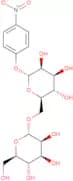
Discontinued product4-Nitrophenyl 6-O-(a-D-mannopyranosyl)-a-D-mannopyranoside
CAS:4-Nitrophenyl 6-O-(alpha-D-mannopyranosyl)-alpha-D-mannopyranoside is a chromogenic substrate for alpha-mannosidase. Upon hydrolysis, para-nitrophenol is released yielding a yellowish colour. 4-Nitrophenyl 6-O-(alpha-D-mannopyranosyl)-alpha-D-mannopyranoside is used in different applications such as the Lysosomal storage disorder diagnosis (e.g., alpha-mannosidosis)
Purity:Min. 95%Color and Shape:PowderMolecular weight:463.39 g/molRef: 3D-EN06126
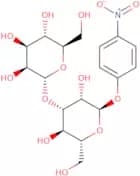
Discontinued product4-Nitrophenyl 3-O-(a-D-mannopyranosyl)-a-D-mannopyranoside
CAS:Chromogenic substrate for α-glucanase
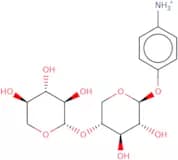
Formula:C18H25NO13Purity:Min. 97 Area-%Color and Shape:White PowderMolecular weight:463.39 g/mol4-Nitrophenyl β-D-xylobioside
CAS:4-Nitrophenyl beta-D-xylobioside is a chromogenic substrate for xylanase. Upon hydrolysis, para-nitrophenol is released yielding a yellowish colour. 4-Nitrophenyl beta-D-xylobioside is used in different applications such as the Xylan degradation studies, paper/pulp industry applicationsFormula:C16H21NO11Purity:Min. 95%Color and Shape:White PowderMolecular weight:403.34 g/molRef: 3D-EN15454
Discontinued productIPTG
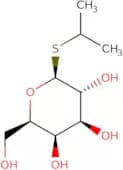
CAS:Isopropyl-beta-D-thiogalactopyranoside (IPTG) is a non-metabolizable allolactose analogue, widely used in molecular biology for overexpression of recombinant proteins from inducible systems under the control of lac promoter. IPTG binds to the LacI repressor and causes its release from the lac operator, allowing gene expression of lac operon to take place. IPTG is present in vectors of pGEX, pGEM-T, pET, pRSET, pMAL class and others.
Formula:C9H18O5SPurity:Min. 99 Area-%Color and Shape:White PowderMolecular weight:238.3 g/molRef: 3D-EI07011
Discontinued productChlorophenol red-β-D-cellotrioside
CAS:Chromogenic substrate for cellulases; red colorFormula:C37H42Cl2O20SPurity:Min. 95%Color and Shape:Orange to red solid.Molecular weight:909.69 g/molRef: 3D-EC30182
Discontinued productAlizarin-2-β-D-galactopyranoside
CAS:Chromogenic substrate targeting beta- galactosidase and whose color is dependent on the metal chelating.Alizarin-2-beta-D-galactopyranoside is a chromogenic substrate for enzymes based on alizarin and has been reported for the detection of bacterial beta-galactosidase by researchers at the University of Northumbria and the Freeman Hospital, Newcastle upon Tyne in the UK (James, 2000).
Formula:C20H18O9Purity:Min. 98.0 Area-%Molecular weight:402.36 g/mol3-Indoxyl phosphate p-toluidine Salt
CAS:Controlled Product3-Indoxyl phosphate p-toluidine salt is a secretor of blood group A. It is used in the detection of the presence of alkaline phosphatase in serum and other body fluids. This compound has been shown to be an isoform of 3-indoxyl phosphate with a molecular mass of about 4,000 daltons. It is also used as a substrate for gel electrophoresis and filtration experiments. The purified form of this compound has been shown to have an alkaline phosphatase activity that is ˜4 times greater than that found in human serum and intestinal extracts.
Formula:C8H8NO4P·C7H9NPurity:Min. 98 Area-%Color and Shape:PowderMolecular weight:320.28 g/molRef: 3D-EI56753
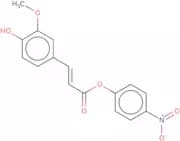
Discontinued product4-Nitrophenyl trans-ferulate
CAS:Substrate for feruloyl esterases
Formula:C16H13NO6Purity:Min. 98 Area-%Color and Shape:PowderMolecular weight:315.28 g/molNitrocefin
CAS:Chromogenic cephalosporin substrate for the detection of beta-lactamase activity
Formula:C21H16N4O8S2Purity:Min. 90 Area-%Color and Shape:Yellow Orange PowderMolecular weight:516.51 g/molRef: 3D-EN46644
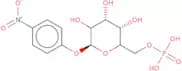
Discontinued product4-Nitrophenyl b-D-glucopyranoside-6-phosphate
CAS:4-Nitrophenyl beta-D-glucopyranoside-6-phosphate is a chromogenic substrate for glucose-6-phosphatase. Upon hydrolysis, para-nitrophenol is released yielding a yellowish colour. 4-Nitrophenyl beta-D-glucopyranoside-6-phosphate is used in different applications such as the Glycogen storage disease diagnosis (e.g., von Gierke disease)
Formula:C12H16NO11PPurity:Min. 98 Area-%Color and Shape:PowderMolecular weight:381.23 g/molRef: 3D-EN32426
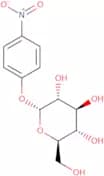
Discontinued product4-Nitrophenyl a-D-glucopyranoside
CAS:Chromogenic substrate for alpha-glucosidase
Formula:C12H15NO8Purity:Min. 98 Area-%Color and Shape:White PowderMolecular weight:301.25 g/mol5-Bromo-6-chloro-3-indoxyl choline phosphate
CAS:Please enquire for more information about 5-Bromo-6-chloro-3-indoxyl choline phosphate including the price, delivery time and more detailed product information at the technical inquiry form on this page
Formula:C13H17BrClN2O4PPurity:Min. 99 Area-%Molecular weight:411.63 g/molRef: 3D-B-7118
Discontinued product5-Bromo-3-indoxyl choline phosphate
Please enquire for more information about 5-Bromo-3-indoxyl choline phosphate including the price, delivery time and more detailed product information at the technical inquiry form on this page
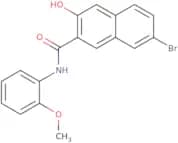
Formula:C13H18BrN2O4PMolecular weight:377.18 g/molNaphthol AS-BI
CAS:Chromogenic substrate for alkaline and acid phosphatase
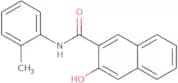
Formula:C18H14BrNO3Purity:Min. 95%Molecular weight:372.21 g/molNaphthol AS-D
CAS:Naphthol AS-D is a diagnostic chemical for phosphatase enzymes and is used to stain cells, tissues, and body fluids for diagnosis. The chemical reacts with the amino groups of proteins in cells and produces a brown color. Naphthol AS-D is not toxic to living cells in concentrations below 5%. It stains basophilic leukemia cells as well as brain cells. This chemical can be used to diagnose cutaneous lesions, such as psoriasis or melanoma, which are difficult to diagnose by standard methods. present in these lesions and produce a brown color.
Formula:C18H15NO2Purity:Min. 95%Color and Shape:PowderMolecular weight:277.32 g/mol5-Bromo-4-chloro-3-indolyl a-L-rhamnoside
5-Bromo-4-chloro-3-indolyl a-L-rhamnoside is a chromogenic substrate used to detect the specific enzymatic activity of alpha-L-rhamnosidase. After cleavage, 5-bromo-4-chloro-indoxyl is released, resulting in a blue to blue-green color change in bacterial colonies or media. 5-Bromo-4-chloro-3-indolyl a-L-rhamnoside is used in bacterial rhamnose metabolism studies (e.g. E. coli).
Formula:C14H15BrClNO5Purity:Min. 95%Color and Shape:SolidMolecular weight:392.63 g/molRef: 3D-EB170531
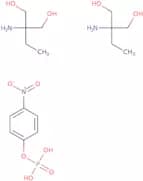
Discontinued product4-Nitrophenyl phosphate mono(2-amino-2-ethyl-1,3-propanediol) salt monohydrate
CAS:Chromogenic substrate for alkaline phosphatase
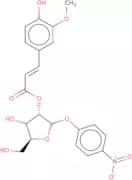
Formula:C26H32N3NaO6S2Purity:Min. 95%Color and Shape:PowderMolecular weight:457.41 g/mol4-Nitrophenyl 2-O-trans-feruloyl-a-L-arabinofuranoside
CAS:4-Nitrophenyl 2-O-trans-feruloyl-alpha-L-arabinofuranoside is a chromogenic substrate for alpha-L-arabinofuranosidase. Upon hydrolysis, para-nitrophenol is released yielding a yellowish colour. 4-Nitrophenyl 2-O-trans-feruloyl-alpha-L-arabinofuranoside is used in different applications such as the Plant biomass analysis, bacterial arabinan degradation assays
Formula:C21H21NO10Purity:Min. 95%Color and Shape:PowderMolecular weight:447.39 g/molRef: 3D-EN16252
Discontinued product