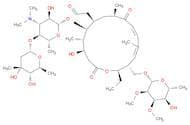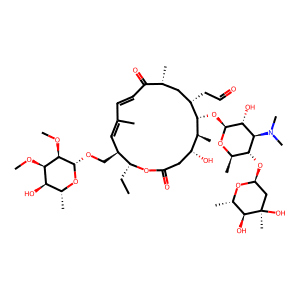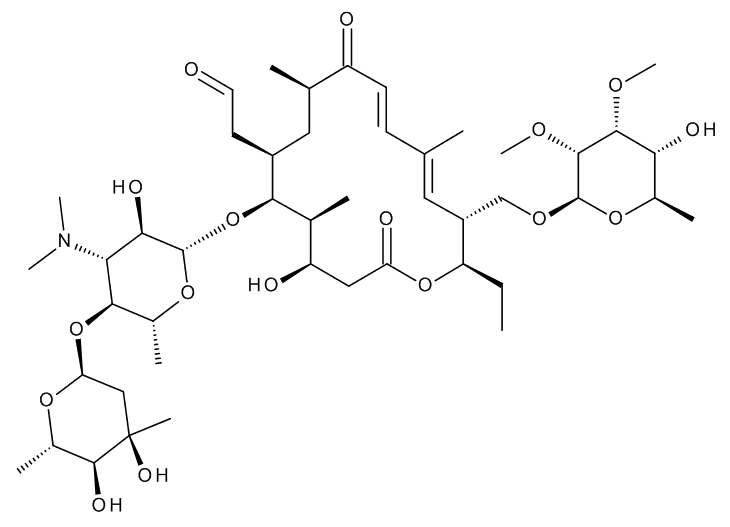
CAS 1401-69-0
:Tylosin
- Fradizine
- Oxacyclohexadeca-11,13-diene-7-acetaldehyde, 15-[[(6-deoxy-2,3-di-O-methyl-β-<span class="text-smallcaps">D</smallcap>-allopyranosyl)oxy]methyl]-6-[[3,6-dideoxy-4-O-(2,6-dideoxy-3-C-methyl-α-<smallcap>L</smallcap>-ribo-hexopyranosyl)-3-(dimethylamino)-β-<smallcap>D</span>-glucopyranosyl]oxy]-16-ethyl-4-hydroxy-5,9,13-trimethyl-2,10-dioxo-, [4R-(4R*,5S*,6S*,7R*,9R*,11E,13E,15R*,16R*)]-
- Oxacyclohexadeca-11,13-diene-7-acetaldehyde, 15-[[(6-deoxy-2,3-di-O-methyl-β-D-allopyranosyl)oxy]methyl]-6-[[3,6-dideoxy-4-O-(2,6-dideoxy-3-C-methyl-α-L-ribo-hexopyranosyl)-3-(dimethylamino)-β-D-glucopyranosyl]oxy]-16-ethyl-4-hydroxy-5,9,13-trimethyl-2,10-dioxo-, [4R-(4R*,5S*,6S*,7R*,9R*,11E,13E,15R*,16R*)]-
- Oxacyclohexadecane, tylosin deriv.
- Tilan
- Tilosina
- Tylocine
- Tylosin A
- Tylosin base
- Tylosine
- Vubityl 200
- [(2R,3R,4E,6E,9R,11R,12S,13S,14R)-12-{[3,6-dideoxy-4-O-(2,6-dideoxy-3-C-methyl-alpha-L-ribo-hexopyranosyl)-3-(dimethylamino)-beta-D-glucopyranosyl]oxy}-2-ethyl-14-hydroxy-5,9,13-trimethyl-8,16-dioxo-11-(2-oxoethyl)oxacyclohexadeca-4,6-dien-3-yl]methyl 6-deoxy-2,3-di-O-methyl-beta-D-allopyranoside
- [(2R,3R,4E,6E,9R,11R,12S,13S,14R)-12-{[3,6-dideoxy-4-O-(2,6-dideoxy-3-C-methyl-α-L-ribo-hexopyranosyl)-3-(dimethylamino)-β-D-galactopyranosyl]oxy}-2-ethyl-14-hydroxy-5,9,13-trimethyl-8,16-dioxo-11-(2-oxoethyl)oxacyclohexadeca-4,6-dien-3-yl]methyl 6-deoxy-2,3-di-O-methyl-D-allopyranoside
- [(2R,4E,6E,9R,11R,12S,13S,14R)-12-{[3,6-dideoxy-4-O-(2,6-dideoxy-3-C-methyl-alpha-L-ribo-hexopyranosyl)-3-(dimethylamino)-beta-D-glucopyranosyl]oxy}-2-ethyl-14-hydroxy-5,9,13-trimethyl-8,16-dioxo-11-(2-oxoethyl)oxacyclohexadeca-4,6-dien-3-yl]methyl 6-deoxy-2,3-di-O-methyl-beta-D-allopyranoside
- [(2R,4E,6E,9R,11R,12S,14R)-12-{[3,6-dideoxy-4-O-(2,6-dideoxy-3-C-methyl-α-L-ribo-hexopyranosyl)-3-(dimethylamino)-β-D-glucopyranosyl]oxy}-2-ethyl-14-hydroxy-5,9,13-trimethyl-8,16-dioxo-11-(2-oxoethyl)oxacyclohexadeca-4,6-dien-3-yl]methyl 6-deoxy-2,3-di-O-methyl-D-allopyranoside
- [4R-(4R*,5S*,6S*,7R*,9R*,11E,13E,15R*,16R*)]-15-[[(6-Deoxy-2,3-di-O-methyl-β-<span class="text-smallcaps">D</smallcap>-allopyranosyl)oxy]methyl]-6-[[3,6-dideoxy-4-O-(2,6-dideoxy-3-C-methyl-α-<smallcap>L</smallcap>-ribo-hexopyranosyl)-3-(dimethylamino)-β-<smallcap>D</span>-glucopyranosyl]oxy]-16-ethyl-4-hydroxy-5,9,13-trimethyl-2,10-dioxooxacyclohexadeca-11,13-diene-7-acetaldehyde
- [4R-(4R*,5S*,6S*,7R*,9R*,11E,13E,15R*,16R*)]-15-[[(6-Deoxy-2,3-di-O-methyl-β-D-allopyranosyl)oxy]methyl]-6-[[3,6-dideoxy-4-O-(2,6-dideoxy-3-C-methyl-α-L-ribo-hexopyranosyl)-3-(dimethylamino)-β-D-glucopyranosyl]oxy]-16-ethyl-4-hydroxy-5,9,13-trimethyl-2,10-dioxooxacyclohexadeca-11,13-diene-7-acetaldehyde
- Weitere Synonyme anzeigen
FIRST INTERNATIONAL STANDARD FOR TYLOSIN
CAS:FIRST INTERNATIONAL STANDARD FOR TYLOSINFormel:C46H77NO17Molekulargewicht:916.1001Tylosin
CAS:Antibiotics nesoiFormel:C46H77NO17Farbe und Form:White Off-White Yellow PowderMolekulargewicht:916.1 g/molTylosin
CAS:Tylosin (Tylosine) is a macrolide antibiotic obtained from cultures of Streptomyces fradiae.Formel:C46H77NO17Reinheit:mixture - mixtureFarbe und Form:CoaMolekulargewicht:916.10Tylosin
CAS:Formel:C46H77NO17Reinheit:≥ 900IU/mgFarbe und Form:White, almost white or pale yellow powderMolekulargewicht:916.10Tylosin A 100 µg/mL in Acetonitrile
CAS:Formel:C46H77NO17Farbe und Form:Single SolutionMolekulargewicht:916.10GB 31660.1-2019 Macrolide Antibiotics Mixture 167 100 µg/mL in Methanol
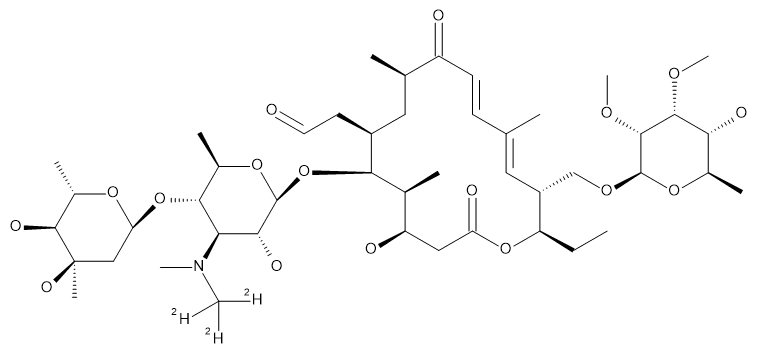
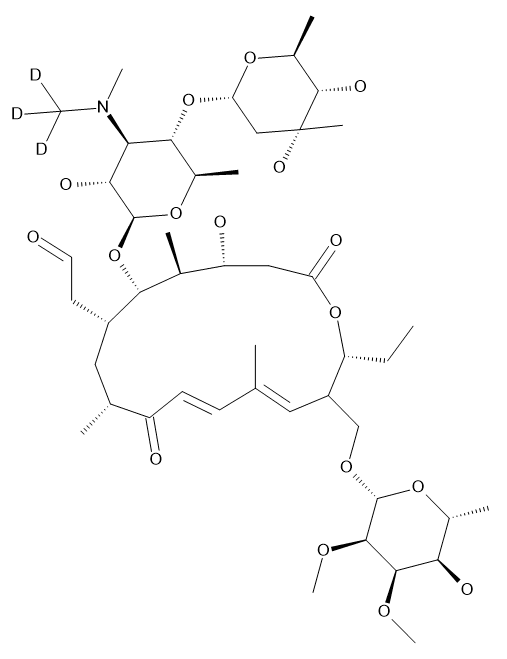
CAS:Kontrolliertes ProduktFarbe und Form:MixtureTylosin-d3
CAS:Kontrolliertes ProduktApplications Labelled Tylosin (T947650). Tylosin is a macrolide antibiotic isolated from a strain of Streptomycetes fradiae found in soil from Thailand. Antibacterial.
Not a dangerous good if item is equal to or less than 1g/ml and there is less than 100g/ml in the package
References Hamill, et al.: Antibiot. Chemother., 11, 328 (1961), Corcoran, J.W., et al.: J. Antibiot., 30, 1012 (1977), Seno, E.T., et al.: Antimicrob. Agents. Chemother., 11, 455 (1977),Formel:C46H74D3NO17Farbe und Form:NeatMolekulargewicht:916.10Tylosin
CAS:Stability Light Sensitive
Applications Tylosin is a macrolide antibiotic isolated from a strain of Streptomycetes fradiae found in soil from Thailand. Antibacterial. This compound is a contaminant of emerging concern (CECs).
Not a dangerous good if item is equal to or less than 1g/ml and there is less than 100g/ml in the package
References Hamill, et al.: Antibiot. Chemother., 11, 328 (1961), Corcoran, J.W., et al.: J. Antibiot., 30, 1012 (1977), Seno, E.T., et al.: Antimicrob. Agents. Chemother., 11, 455 (1977),Formel:C46H77NO17Farbe und Form:Off-WhiteMolekulargewicht:916.1Tylosin-d3 (100 Mug/mL in Methanol)
CAS:Formel:C46H74D3NO17Farbe und Form:ColourlessMolekulargewicht:916.10