Apoptosis
Los inhibidores de la apoptosis son compuestos que previenen o retrasan el proceso de muerte celular programada, conocido como apoptosis. Estos inhibidores son vitales para estudiar los mecanismos de supervivencia celular y se utilizan para investigar enfermedades donde la apoptosis está desregulada, como el cáncer, los trastornos neurodegenerativos y las enfermedades autoinmunes. Al modular la apoptosis, estos inhibidores pueden ayudar en el desarrollo de terapias dirigidas a controlar la muerte celular. En CymitQuimica, ofrecemos una amplia selección de inhibidores de la apoptosis de alta calidad para apoyar su investigación en biología celular, oncología y campos relacionados.
Subcategorías de "Apoptosis"
- ASK(6 productos)
- BCL(11 productos)
- Caspasa(127 productos)
- FOXO1(3 productos)
- IAP(65 productos)
- Mdm2(12 productos)
- PD-1 / PD-L1(126 productos)
- PDK(9 productos)
- PERK(24 productos)
- Serina / treonina quinasa(15 productos)
- Survivin(13 productos)
- TNF(91 productos)
- c-RET(51 productos)
- p53(62 productos)
Mostrar 6 subcategorías más
Se han encontrado 5622 productos de "Apoptosis"
Ordenar por
Pureza (%)
0
100
|
0
|
50
|
90
|
95
|
100
MP-010
CAS:<p>MP-010 is an FKBP12 ligand that regulates cytosolic calcium by stabilizing RyR channel activity. It facilitates functional improvement in SOD1G93A mice with amyotrophic lateral sclerosis (ALS), evidenced by enhanced motor coordination, increased integrity of neuromuscular junctions, and significantly higher spinal motor neuron survival rates. MP-010 is applicable for research in the field of neurological disorders.</p>Fórmula:C14H20N4O2SForma y color:SolidPeso molecular:308.399PSP205
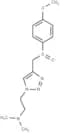
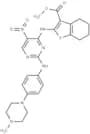
CAS:<p>PSP205 is an effective anticancer agent with cytotoxic properties. It induces apoptosis and triggers autophagy mediated by ER stress. Furthermore, PSP205 enhances the expression of LC3BII protein and increases the expression of CHOP and spliced XBP1 at both mRNA and protein levels.</p>Fórmula:C28H32ClN7O5S2Forma y color:SolidPeso molecular:646.181KIM-161
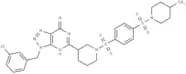
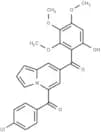
CAS:<p>KIM-161 is a PIK3CA inhibitor. It demonstrates significant antiproliferative activity, with IC50 values of 1.428 and 1.562 µM against PI3KCA-mutant breast cancer cell lines MCF7 and T47D, respectively. KIM-161 induces apoptosis and cell cycle arrest by inhibiting the PI3K/AKT/mTOR signaling pathway, leading to ROS production. It is applicable for research on breast cancer and its PI3KCA-mutant subtypes.</p>Fórmula:C27H25N3O3Forma y color:SolidPeso molecular:439.51ST362
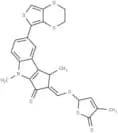
CAS:<p>ST362, an anticancer agent, acts by disrupting DNA repair and halting growth in prostate, colon, lung and breast cancer cells.</p>Fórmula:C25H21NO6SPureza:98%Forma y color:SolidPeso molecular:463.5Casuarinin
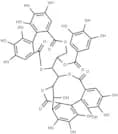
CAS:<p>Casuarinin, an ellagitannin found in pomegranates and certain Casuarina/Stachyurus plants, is a carbonic anhydrase inhibitor and astringent.</p>Fórmula:C41H28O26Forma y color:SolidPeso molecular:936.65FGFR4-IN-7
<p>FGFR4-IN-7 is a covalent, reversible FGFR4 inhibitor (IC50: 0.42 μM) that blocks the FGFR4 signaling pathway, thereby inducing apoptosis.</p>Fórmula:C26H25Cl2N5O3Forma y color:SolidPeso molecular:526.41VEGFR-2-IN-13
<p>VEGFR-2-IN-13 (Compound 19a) is a potent VEGFR-2 inhibitor (IC50: 3.4 nM). vEGFR-2-IN-13 arrests the HepG2 cell cycle in G2/M phase and induces apoptosis.</p>Fórmula:C24H18N6O2SForma y color:SolidPeso molecular:454.5EGFR-IN-44
<p>EGFR-IN-44: potent EGFR kinase inhibitor, orally active, IC50 4.11 nM, 33.57% bioavailability, induces apoptosis, for lung cancer study.</p>Fórmula:C27H29ClN6O2SForma y color:SolidPeso molecular:537.08RET-IN-9
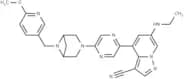
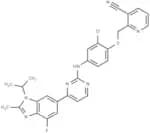
CAS:<p>RET-IN-9 is a potent RET kinase inhibitor, potentially useful for studying RET-related diseases, including lung and thyroid cancer.</p>Fórmula:C26H27N9OForma y color:SolidPeso molecular:481.55Lysosomal P-gp targeted agent 1
CAS:<p>Lysosomal P-gp targeted agent 1 (Compound 14) is an antitumor drug that targets lysosomal P-glycoprotein (Pgp). It is selectively transported to lysosomes via overexpressed Pgp, releasing nitric oxide that generates reactive oxygen species (ROS), causing lysosomal membrane permeabilization (LMP) and inducing apoptosis. This compound can overcome resistance mediated by P-glycoprotein, leading to cell cycle arrest while maintaining relatively low toxicity to normal cells. It exhibits antitumor activity by significantly inhibiting tumor growth.</p>Fórmula:C39H34N2O9SForma y color:SolidPeso molecular:706.76K20
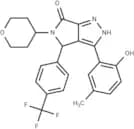
<p>K20 selectively inhibits KRas G12C (IC50: 1.16 nM), shows anticancer activity in H358 cells (IC50: 0.78 μM), and induces apoptosis via Erk dephosphorylation.</p>Fórmula:C24H20Cl2F4N4O2Forma y color:SolidPeso molecular:543.34Antitumor agent-72
CAS:<p>Antitumor agent-72 (compound 6w) is a potent anticancer agent that exhibits its anticancer activity by inducing apoptosis via caspase-3 activation and PARP</p>Fórmula:C25H20ClNO6Forma y color:SolidPeso molecular:465.88T0080
CAS:<p>T0080 is an FPR-1 antagonist. It reduces apoptosis (Apoptosis) and inhibits the production of reactive oxygen species (ROS) and pro-inflammatory cytokines (TNF-α and IL-1β) in plaque macrophages within ApoE−/− mouse models, thereby slowing the progression of atherosclerosis.</p>Fórmula:C24H22F3N3O3Forma y color:SolidPeso molecular:457.45CDK2-IN-9
<p>CDK2-IN-9: potent CDK2 inhibitor (IC50: 0.63 μM), anti-proliferative, arrests S/G2M cell cycle, induces apoptosis, promising for melanoma study.</p>Fórmula:C21H16ClN3O4SForma y color:SolidPeso molecular:441.89PLK1-IN-15
CAS:<p>PLK1-IN-15 is a PLK1 inhibitor with an IC50 of 38.5 nM. It exhibits antiproliferative effects on HepG2, Huh7, H1299, and A549 cells, with IC50 values of 2.03, 2.08, 4.79, and 17.11 μM, respectively. Additionally, PLK1-IN-15 can induce cell cycle arrest in the G2/M phase and trigger apoptosis (Apoptosis), demonstrating anticancer activity.</p>Fórmula:C25H29N7O4SForma y color:SolidPeso molecular:523.61LA-CB1
CAS:<p>LA-CB1 is a derivative of Abemaciclib that targets CDK4/6 and promotes their degradation via the ubiquitin-proteasome pathway, thereby blocking the CDK4/6-Cyclin D1-Rb-E2F axis and inducing G0/G1 cell cycle arrest and apoptosis (Apoptosis). It demonstrates antiproliferative activity against MDA-MB-231 cells with an IC50 of 0.27 µM and effectively inhibits epithelial-mesenchymal transition, cell migration, invasion, and angiogenesis. In highly invasive models like triple-negative breast cancer (TNBC), LA-CB1 significantly suppresses tumor growth, showing robust dose-dependent antitumor activity. This compound can be utilized in breast cancer research.</p>Fórmula:C28H23ClFN7OForma y color:SolidPeso molecular:527.98β-Carotene-13C10
CAS:<p>β-Carotene-13C10 (Provitamin A-13C10) is a form of β-Carotene labeled with 13C. It is a carotenoid compound and serves as a natural precursor to vitamin A. This compound acts as a regulator of reactive oxygen species (ROS), exhibiting both antioxidant and anti-inflammatory properties. Depending on its intrinsic characteristics and the redox potential of the biological environment, β-Carotene can function either as an antioxidant or a pro-oxidant. It also possesses anticancer activity, inducing apoptosis in breast cancer cells.</p>Fórmula:C40H56Forma y color:SolidPeso molecular:546.799Coprostanone
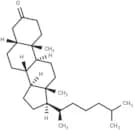
CAS:<p>Coprostanone (5β-cholestan-3-one) is an active metabolite of hydroxycholesterol and cholesterol. It induces apoptosis in primary gallbladder epithelial cells in dogs. Coprostanone holds potential for research into colon cancer or adenomatous polyps.</p>Fórmula:C27H46OForma y color:SolidPeso molecular:386.654PI3K-IN-58
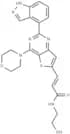
CAS:<p>PI3K-IN-58 (Compound 17f) is an inhibitor of PI3Kα with an IC50 value of 0.039 μM. It shows significant antiproliferative effects on PC-3, 22RV1, MDA-MB-231, and MDA-MB-453 cell lines with IC50 values of 3.48 μM, 1.06 μM, 2.21 μM, and 0.93 μM, respectively. PI3K-IN-58 induces apoptosis by downregulating the expression of anti-apoptotic proteins Bcl-XL and Bcl-2 while upregulating the expression of the pro-apoptotic protein BAX. This compound is applicable for research in cancer targeting through PI3K pathways.</p>Fórmula:C22H22N6O3SForma y color:SolidPeso molecular:450.51DL-Buthionine-(S,R)-sulfoximine hydrochloride
DL-Buthionine-(S,R)-sulfoximine hydrochloride (Buthionine sulfoximine hydrochloride) is a potent and specific glutamylcysteine synthetase biosynthesis inhibitorFórmula:C8H19ClN2O3SForma y color:SolidPeso molecular:258.77