Apoptosis
Los inhibidores de la apoptosis son compuestos que previenen o retrasan el proceso de muerte celular programada, conocido como apoptosis. Estos inhibidores son vitales para estudiar los mecanismos de supervivencia celular y se utilizan para investigar enfermedades donde la apoptosis está desregulada, como el cáncer, los trastornos neurodegenerativos y las enfermedades autoinmunes. Al modular la apoptosis, estos inhibidores pueden ayudar en el desarrollo de terapias dirigidas a controlar la muerte celular. En CymitQuimica, ofrecemos una amplia selección de inhibidores de la apoptosis de alta calidad para apoyar su investigación en biología celular, oncología y campos relacionados.
Subcategorías de "Apoptosis"
- ASK(6 productos)
- BCL(11 productos)
- Caspasa(127 productos)
- FOXO1(3 productos)
- IAP(65 productos)
- Mdm2(12 productos)
- PD-1 / PD-L1(126 productos)
- PDK(9 productos)
- PERK(24 productos)
- Serina / treonina quinasa(15 productos)
- Survivin(13 productos)
- TNF(91 productos)
- c-RET(51 productos)
- p53(62 productos)
Mostrar 6 subcategorías más
Se han encontrado 5622 productos de "Apoptosis"
Ordenar por
Pureza (%)
0
100
|
0
|
50
|
90
|
95
|
100
STAT3-IN-12
CAS:<p>STAT3-IN-12,STAT3 signaling inhibitor. Blocks IL-6-induced JAK/STAT3 activation. Induces apoptosis. Used in HCC and esophageal cancer research.</p>Fórmula:C28H30N4O2Pureza:99.19%Forma y color:SoildPeso molecular:454.56Tofacitinib Prodrug-1
Tofacitinib Prodrug-1: an oral prodrug reducing Tofacitinib's side effects, treats ulcerative colitis in mice effectively with low toxicity.Fórmula:C36H39ClN10O7Forma y color:SolidPeso molecular:759.21PIM-1/HDAC-IN-1
<p>PIM-1/HDAC-IN-1 (4d): inhibits PIM-1 (IC50: 343.87nM), HDAC1 (63.65nM), HDAC6 (62.39nM); induces apoptosis in MCF-7 cells.</p>Fórmula:C22H19N3O3Forma y color:SolidPeso molecular:373.4JH-XVII-10
<p>JH-XVII-10: potent, oral DYRK1A/B inhibitor (IC50: 3/5 nM), shows antitumor activity in HNSCC.</p>Fórmula:C21H16F4N8OForma y color:SolidPeso molecular:472.4TAS-117 hydrochloride
<p>TAS-117 HCl: potent oral Akt inhibitor (Akt1 IC50: 4.8nM, Akt2: 1.6nM, Akt3: 44nM), boosts anti-myeloma effects, induces cell death.</p>Fórmula:C26H25ClN4O2Forma y color:SolidPeso molecular:460.96ZLWT-37
<p>ZLWT-37: Oral CDK inhibitor, CDK9 IC50=0.002 µM, CDK2 IC50=0.054 µM; halts HCT116 cells at G2/M, induces apoptosis.</p>Fórmula:C26H30ClN5OForma y color:SolidPeso molecular:464VEGFR-2-IN-18
<p>VEGFR-2-IN-18 is a potent VEGFR-2 inhibitor with a 60 nM IC50, promoting cell apoptosis and anticancer effects.</p>Fórmula:C20H13ClN4O2Forma y color:SolidPeso molecular:376.8YK5
CAS:<p>YK5 is an allosteric inhibitor pocket of Hsp70 and represents a previously unknown chemical tool to investigate cellular mechanisms associated with Hsp70.</p>Fórmula:C18H24N8O3SPureza:98%Forma y color:SolidPeso molecular:432.50Fluvastatin sodium monohydrate
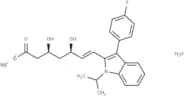
CAS:<p>Fluvastatin (XU 62-320) sodium monohydrate, a fully synthetic competitive HMG-CoA reductase inhibitor, features an IC 50 of 8 nM. This compound also safeguards vascular smooth muscle cells from oxidative stress via the Nrf2-dependent antioxidant pathway [1] [2].</p>Fórmula:C24H27FNNaO5Forma y color:SolidPeso molecular:451.46FLT3-IN-13
<p>FLT3-IN-13 inhibits topoisomerase II/FLT3 in leukemia with IC50 of 2.26 μM, causes G2/M arrest, and promotes apoptosis.</p>Fórmula:C20H14N4O2Forma y color:SolidPeso molecular:342.35AKT-IN-3
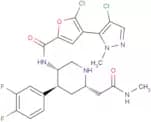
CAS:AKT-IN-3: potent oral Akt inhibitor with low hERG blockage. IC50: 1.4-1.7 nM for Akt1-3. Inhibits AGC kinases like PKA, PKC.Fórmula:C23H23Cl2F2N5O3Pureza:98%Forma y color:SolidPeso molecular:526.36GLI1-IN-1
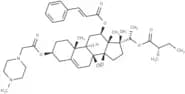
CAS:<p>GLI1-IN-1 (CBC-1), a GLI-1 inhibitor, exhibits superior water solubility and anticancer properties. It effectively induces apoptosis and inhibits colorectal cancer growth by targeting the Hedgehog (HH) pathway (IC 50 = 1.3 μM) [1].</p>Fórmula:C42H60N2O9Forma y color:SolidPeso molecular:736.93MA242
CAS:<p>MA242 is a nuclear factor of activated T cells 1 (NFAT1) for Pancreatic Cancer Therapy and dual inhibitor of murine double minute 2 (MDM2).</p>Fórmula:C26H21ClF3N3O5SPureza:98%Forma y color:SolidPeso molecular:579.98[D-Leu-4]-OB3
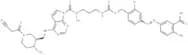
CAS:[D-Leu-4]-OB3 suppresses the expression of genes associated with inflammation, proliferation, and metastasis, as well as the expression of PD-L1.Fórmula:C29H50N8O12SForma y color:SolidPeso molecular:734.82Tubulin polymerization-IN-61
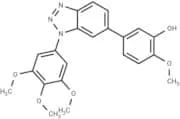
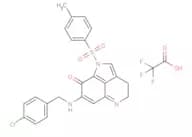
CAS:<p>Tubulin polymerization-IN-61 (Compound 9a), a tubulin polymerization inhibitor, disrupts the microtubule skeleton, arrests the cell cycle at the G2/M phase, induces Apoptosis, and impedes cancer cell migration and colony formation. This compound demonstrates antitumor efficacy in vivo within the 4T1 xenograft model [1].</p>Fórmula:C22H21N3O5Forma y color:SolidPeso molecular:407.42VDX-111
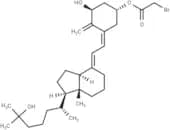
CAS:<p>VDX-111, an analog of vitamin D, exhibits cytotoxicity in ovarian cancer cells by upregulating the RIPK1/RIPK3 pathway and inducing necroptosis. It also promotes the expression of cytokines and demonstrates antitumor activity in a mouse model [1].</p>Fórmula:C29H45BrO4Forma y color:SolidPeso molecular:537.57Necrosis inhibitor 3
CAS:<p>Necrosis Inhibitor 3 (compound B3) effectively inhibits necrosis, demonstrating an IC50 of 0.29 nM in HT29 cells [1].</p>Fórmula:C25H26N4O4SForma y color:SolidPeso molecular:478.56GQN-B37-E
CAS:<p>GQN-B37-E is an effective selective binder and inhibitor of MCL-1. It binds to the BH3-binding domain of MCL-1. GQN-B37-E demonstrates binding affinity for MCL-1 within the sub-micromolar range (Ki= 0.6 μM), yet shows negligible binding to BCL-2 or BCL-XL.</p>Fórmula:C29H23ClN4O4Forma y color:SolidPeso molecular:526.97AQIM-I
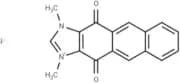
CAS:<p>AQIM-I is a survivin inhibitor that reduces survivin expression and colony formation. It promotes reactive oxygen species (ROS) production, apoptosis, cell cycle arrest, DNA damage, and autophagy. Moreover, AQIM-I effectively inhibits nonsmall cell lung cancer cells A549, with an IC 50 value of 9 nM [1].</p>Fórmula:C17H13IN2O2Forma y color:SolidPeso molecular:404.20HBV/HDV-IN-2
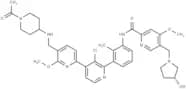
CAS:<p>HBV/HDV-IN-2 (Compd 143) functions as an inhibitor for HBV, HDV, and PD-1/PD-L1, demonstrating an EC 50 of 35 nM in T cell activation.</p>Fórmula:C38H44ClN7O5Forma y color:SolidPeso molecular:714.25



![[D-Leu-4]-OB3](/_next/image/?url=https%3A%2Fstatic.cymitquimica.com%2Fproducts%2FTM%2Fthumb-webp%2FT72906.webp&w=3840&q=75)