Apoptosis
Los inhibidores de la apoptosis son compuestos que previenen o retrasan el proceso de muerte celular programada, conocido como apoptosis. Estos inhibidores son vitales para estudiar los mecanismos de supervivencia celular y se utilizan para investigar enfermedades donde la apoptosis está desregulada, como el cáncer, los trastornos neurodegenerativos y las enfermedades autoinmunes. Al modular la apoptosis, estos inhibidores pueden ayudar en el desarrollo de terapias dirigidas a controlar la muerte celular. En CymitQuimica, ofrecemos una amplia selección de inhibidores de la apoptosis de alta calidad para apoyar su investigación en biología celular, oncología y campos relacionados.
Subcategorías de "Apoptosis"
- ASK(6 productos)
- BCL(11 productos)
- Caspasa(127 productos)
- FOXO1(3 productos)
- IAP(65 productos)
- Mdm2(12 productos)
- PD-1 / PD-L1(126 productos)
- PDK(9 productos)
- PERK(24 productos)
- Serina / treonina quinasa(15 productos)
- Survivin(13 productos)
- TNF(91 productos)
- c-RET(51 productos)
- p53(62 productos)
Mostrar 6 subcategorías más
Se han encontrado 5622 productos de "Apoptosis"
Ordenar por
Pureza (%)
0
100
|
0
|
50
|
90
|
95
|
100
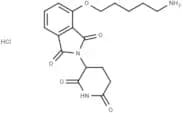
Thalidomide-O-C5-NH2 hydrochloride
CAS:<p>Thalidomide-O-C5-NH2 hydrochloride is a synthetic compound consisting of a ligand-linker conjugate with E3 ligase activity. It combines a cereblon ligand based on Thalidomide and a linker commonly utilized in PROTAC technology.</p>Fórmula:C18H22ClN3O5Forma y color:SolidPeso molecular:395.84Thalidomide-O-amido-C4-NH2 hydrochloride
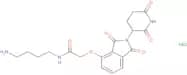
CAS:<p>Thalidomide-O-amido-C4-NH2 hydrochloride, a synthesized E3 ligase ligand-linker conjugate, combines the cereblon ligand derived from Thalidomide with a linker and is commonly used in the synthesis of PROTACs[1].</p>Fórmula:C19H23ClN4O6Pureza:98%Forma y color:SolidPeso molecular:438.86Thalidomide-O-C6-COOH
CAS:<p>Thalidomide-O-C6-COOH is a synthetic conjugate that combines a Thalidomide-derived cereblon ligand with a PROTAC technology linker (E3 ligase ligand-linker).</p>Fórmula:C20H22N2O7Forma y color:SolidPeso molecular:402.403A-192621
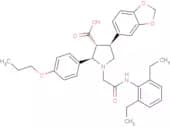
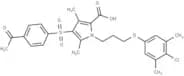
CAS:<p>A-192621 is a potent, nonpeptide, orally active, and selective endothelin B (ETB) receptor antagonist with an IC50 of 4.5 nM and a Ki of 8.8 nM. A-192621 promotes apoptosis in PASMCs and elevates both arterial blood pressure and plasma ET-1 levels[1][2][3]. Its selectivity is 636-fold higher for ETB than ETA (IC50 of 4280 nM and Ki of 5600 nM).</p>Fórmula:C33H38N2O6Pureza:98%Forma y color:SolidPeso molecular:558.66Vatiquinone
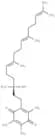
CAS:<p>Vatiquinone, also known as EPI 743, is an orally bioavailable para-benzoquinone being developed for inherited mitochondrial diseases. The mechanism of action of EPI-743 involves augmenting the synthesis of glutathione, optimizing metabolic control, enhanc</p>Fórmula:C29H44O3Forma y color:SolidPeso molecular:440.66Mcl-1 inhibitor 6
CAS:<p>Mcl-1 inhibitor 6 binds Mcl-1 with KD 0.23 nM and Ki 0.02 μM, shows strong selectivity over Bcl-2 family, and demonstrates antitumor efficacy.</p>Fórmula:C26H28ClNO6SForma y color:SolidPeso molecular:518.02ENMD-2076 tartrate
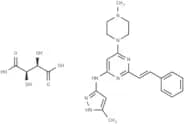
CAS:<p>ENMD-2076 is an orally active kinase inhibitor. It also has antiangiogenic and antiproliferative mechanisms of action.</p>Fórmula:C25H31N7O6Forma y color:SolidPeso molecular:525.56XMU-MP-3
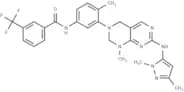
CAS:<p>XMU-MP-3 is a robust, non-covalent inhibitor of BTK, exhibiting exceptional potency with IC50 values of 10.7 nM and 17.0 nM for BTK WT and BTK C481S mutation, respectively, in the presence of 10 μM ATP. Moreover, XMU-MP-3 elicits apoptosis.</p>Fórmula:C27H27F3N8OForma y color:SolidPeso molecular:536.563Ac-IETD-CHO TFA
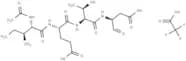
Ac-IETD-CHO TFA is a granzyme B and caspase-8 inhibitor that inhibits caspase8 activity by blocking caspase3 precursor cleavage.Ac-IETD-CHO TFA inhibits Fas-mediated apoptosis.Fórmula:C23H35F3N4O12Forma y color:SoildPeso molecular:616.54RRD-251
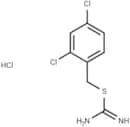
CAS:<p>RRD-251 is an Rb-Raf-1 interaction inhibitor that induces apoptosis in metastatic melanoma cells and synergizes with dacarbazine[1].</p>Fórmula:C8H9Cl3N2SForma y color:SolidPeso molecular:271.59Carubicin hydrochloride
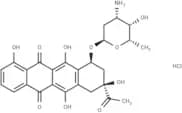
CAS:<p>Carubicin HCl is an anthracycline antineoplastic antibiotic. Through intercalates into DNA and interacts with topoisomerase II, Carubicin inhibits DNA replication and repair and RNA and protein synthesis.</p>Fórmula:C26H28ClNO10Forma y color:SolidPeso molecular:549.95Ingenol 3,20-dibenzoate
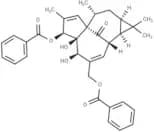
CAS:<p>Ingenol 3,20-dibenzoate is a powerful activator of protein kinase C (PKC) isoforms that effectively induces the translocation of nPKC-delta, -epsilon, and -theta, as well as PKC-mu, from the cytosolic fraction to the particulate fraction. Through de novo synthesis of macromolecules, it triggers apoptosis with characteristic morphology. Moreover, Ingenol 3,20-dibenzoate enhances IFN-γ production and degranulation in NK cells, particularly when stimulated by NSCLC cells[1][2].</p>Fórmula:C34H36O7Forma y color:SolidPeso molecular:556.65CTB
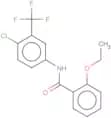
CAS:<p>CTB (Cholera Toxin B subunit) is an activator of p300 histone acetyltransferase and induces apoptosis in MCF-7 cells.</p>Fórmula:C16H13ClF3NO2Pureza:99.82%Forma y color:SolidPeso molecular:343.73anti-TNBC agent-2
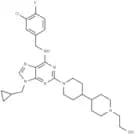
CAS:<p>Anti-TNBC agent-2 (3j), a purine derivative, acts as an anti-triple negative breast cancer (TNBC) therapeutic.</p>Fórmula:C28H37ClFN7OPureza:98%Forma y color:SolidPeso molecular:542.09Ref: TM-T79699
Producto descatalogadoTaltobulin
CAS:<p>Taltobulin (HTI-286) is a synthetic analog of the tripeptide cysteine, a microtubule protein inhibitor that inhibits liver tumor cell proliferation in vitro and tumor growth in vivo.Taltobulin is cytotoxic, induces mitotic arrest and apoptosis, and may be used in the study of breast cancer and microtubule tissue-related diseases.</p>Fórmula:C27H43N3O4Pureza:99.86%Forma y color:SolidPeso molecular:473.65ZSQ836
CAS:<p>ZSQ836 is a dual covalent inhibitor of CDK12/CDK13 with oral bioactivity, displaying an EC50 value of 32 nM against CDK12. This compound can induce cell apoptosis (apoptosis) and demonstrates in vivo anticancer properties. ZSQ836 is applicable for research in ovarian cancer.</p>Fórmula:C27H28AsClN6OS2Forma y color:SolidPeso molecular:627.05Ref: TM-T200333
Producto descatalogadoDETD-35
CAS:<p>DETD-35 is a promising chemical compound in anti-melanoma therapy, functioning as an inhibitor of the MEK-ERK, Akt, and STAT3 signaling pathways. It enhances cancer cell apoptosis (Apoptosis) and diminishes resistance to Vemurafenib in cancer cells. The compound exhibits IC 50 values of 2.7, 6.0, 3.9, 3.1, and 2.5 μM against melanoma cell lines B16-F10, MeWo, SK-MEL-2, A2058c, and A375c, respectively. DETD-35 offers significant potential for advancing research in melanoma treatment strategies.</p>Fórmula:C27H24O6Forma y color:SolidPeso molecular:444.48IHMT-MST1-39
CAS:<p>IHMT-MST1-39 is an orally effective MST kinase inhibitor with IC50 values of 42 nM for MST1 and 109 nM for MST2. It activates the AMPK signaling pathway in hepatocytes and inhibits apoptosis in pancreatic β cells. Additionally, IHMT-MST1-39 improves type 1 diabetes in mice induced by Streptozotocin.</p>Fórmula:C20H18F2N6O3SForma y color:SolidPeso molecular:460.46Ref: TM-T200512
Producto descatalogadoSMIP34
CAS:<p>SMIP34 is an inhibitor of PELP1 that demonstrates the capability to reduce cell viability and colony formation. Additionally, SMIP34 induces cell apoptosis (apoptosis) and causes cell cycle arrest in the S phase. It reduces the expression of PELP1 and exhibits anti-tumor activity. SMIP34 also has potential for research in triple-negative breast cancer (TNBC).</p>Fórmula:C20H15ClFN5O2SForma y color:LiquidPeso molecular:443.88Cyy-272
CAS:<p>Cyy-272 is an orally active JNK inhibitor with IC50 values of 1.25, 1.07, and 1.24 μM against JNK1, JNK2, and JNK3, respectively. It exerts anti-inflammatory effects by inhibiting the phosphorylation of JNK, thereby alleviating acute lung injury (ALI) induced by lipopolysaccharide (LPS). Moreover, Cyy-272 significantly reduces inflammation in cardiomyocytes and cardiac tissues caused by high lipid concentrations, further mitigating resultant cardiac hypertrophy, fibrosis, and apoptosis. Cyy-272 is utilized in the study of obesity-related myocarditis.</p>Fórmula:C23H23F2N7Forma y color:SolidPeso molecular:435.47Ref: TM-T200453
Producto descatalogadoCHMFL-48
CAS:<p>CHMFL-48, an orally active inhibitor of BCR-ABL kinase, demonstrates efficacy against both the wild-type (wt) and various imatinib-resistant mutants. It exhibits potent inhibitory activity, with IC 50 values of 1 nM for the ABL wild-type and 0.8 nM for the ABL T315I mutant. CHMFL-48 operates by inhibiting the autophosphorylation of both wild-type and mutant BCR-ABL, affecting downstream signaling mediators including STAT5 and CRKL. This disruption leads to cell cycle arrest and triggers apoptosis. Given its properties, CHMFL-48 is a promising candidate for research on chronic myeloid leukemia (CML).</p>Fórmula:C31H30F3N7OForma y color:SolidPeso molecular:573.61