Apoptosis
Los inhibidores de la apoptosis son compuestos que previenen o retrasan el proceso de muerte celular programada, conocido como apoptosis. Estos inhibidores son vitales para estudiar los mecanismos de supervivencia celular y se utilizan para investigar enfermedades donde la apoptosis está desregulada, como el cáncer, los trastornos neurodegenerativos y las enfermedades autoinmunes. Al modular la apoptosis, estos inhibidores pueden ayudar en el desarrollo de terapias dirigidas a controlar la muerte celular. En CymitQuimica, ofrecemos una amplia selección de inhibidores de la apoptosis de alta calidad para apoyar su investigación en biología celular, oncología y campos relacionados.
Subcategorías de "Apoptosis"
- ASK(9 productos)
- BCL(1 productos)
- Caspasa(154 productos)
- FOXO1(2 productos)
- IAP(67 productos)
- Mdm2(12 productos)
- PD-1 / PD-L1(110 productos)
- PDK(9 productos)
- PERK(26 productos)
- Serina / treonina quinasa(18 productos)
- Survivin(14 productos)
- TNF(65 productos)
- c-RET(61 productos)
- p53(63 productos)
Mostrar 6 subcategorías más
Se han encontrado 6105 productos de "Apoptosis"
Ordenar por
Pureza (%)
0
100
|
0
|
50
|
90
|
95
|
100
GPX4-IN-3
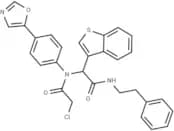
CAS:GPX4-IN-3 (26a) is a potent GPX4 inhibitor, inducing selective ferroptosis with 71.7% inhibition at 1 μM.Fórmula:C29H24ClN3O3SForma y color:SolidPeso molecular:530.04Ac-DMLD-CMK
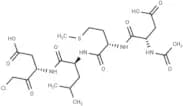
CAS:Ac-DMLD-CMK is a peptide designed to target the caspase3-Gsdme signaling pathway in mice. It specifically inhibits the activation of caspase 3 and Gsdme, preventing the cleavage of Gsdme by caspase 3, which reduces pyroptosis. This process helps alleviate damage to renal tubular epithelial cells and decrease the secretion of inflammatory cytokines. Ac-DMLD-CMK can lower serum creatinine and blood urea nitrogen levels in mice induced by Cisplatin, thereby mitigating the progression of renal dysfunction. It holds potential for research into chemotherapy-induced nephrotoxicity.Fórmula:C22H35ClN4O9SForma y color:SolidPeso molecular:567.053Z-VAD-AMC
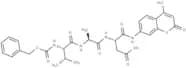
CAS:Z-VAD-AMC acts as a substrate specifically for caspase-9.Fórmula:C30H34N4O9Peso molecular:594.61GlcNAc-MurNAc
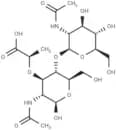
CAS:GlcNAc-MurNAc is a disaccharide and mild TLR4 agonist with a Kd of 383 μM for mouse TLR4. It directly binds to TLR4, activating the downstream NF-κB and IRF pathways. Additionally, GlcNAc-MurNAc ameliorates dextran sulfate sodium salt (DSS)-induced colitis in mice through a TLR4-dependent mechanism, making it useful for inflammatory bowel disease research.Fórmula:C19H32N2O13Forma y color:SolidPeso molecular:496.46Neuroprotective agent 11
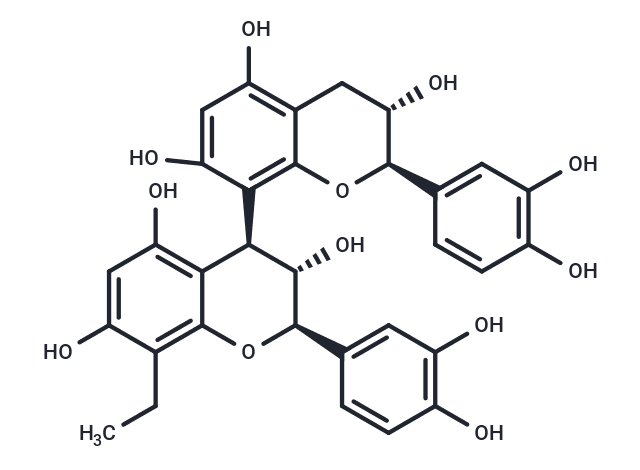
CAS:Neuroprotective agent 11 (Compound 1a) is an orally active polyphenolic compound that offers significant protection against cerebral ischemia. Its primary activities include inhibiting neuronal inflammation and apoptosis, reducing cerebral infarct size, and improving behavioral symptoms in mice with cerebral ischemia. The mechanism involves downregulating inflammatory factors (iNOS, COX-2) and apoptotic proteins (cleaved-Caspase3, p53). Neuroprotective agent 11 is applicable for research in ischemia-related brain diseases, such as ischemic stroke.Fórmula:C32H30O12Forma y color:SolidPeso molecular:606.57Anticancer agent 17
Anticancer agent 17 was effective against HeLa cells (IC50: 0.19 μM) and A2780 cells (IC50: 0.09 μM).Fórmula:C27H34BrN3OForma y color:SolidPeso molecular:496.48MLKL-IN-6
MLKL-IN-6 (compound P28) is a mixed lineage kinase inhibitor that specifically targets the Mixed Lineage Kinase domain-like (MLKL) protein.
Fórmula:C20H18N4O5Pureza:98%Forma y color:SolidPeso molecular:394.38(±)-Perillaldehyde
CAS:(±)-Perillaldehyde exhibits antidepressant effects in mice with stress-induced depressive-like behavior by modulating the olfactory nervous system. Additionally, it demonstrates anti-inflammatory activity by activating JNK in RAW264.7 cells and suppressing the expression of TNF-α, with an IC50 value of 171.7 μM.Fórmula:C10H14OForma y color:SolidPeso molecular:150.22eIF4A3-IN-4
eIF4A3-IN-4 is a novel inhibitor of eIF4A (IC50: 8.6 μM).Fórmula:C24H20N2O5Forma y color:SolidPeso molecular:416.43LLW-018
CAS:LLW-018 is a potent PD-1/PD-L1 inhibitor with an IC50 value of 2.61 nM. It can disrupt the PD-1/PD-L1 interaction, with a cell-based PD-1/PD-L1 blocking bioassay IC50 value of 0.88 μM. LLW-018 holds potential for research in immune-related diseases.Fórmula:C35H38Cl2N4O5SPeso molecular:697.67CIL-102
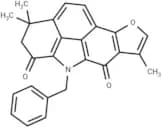
CAS:CIL-102 is an apoptosis inducer that functions as an MMP-2/MMP-9 inhibitor, effectively reducing both the protein expression and mRNA levels of MMP-2/MMP-9. CIL-102 also demonstrates anticancer activity.Fórmula:C19H14N2O2Forma y color:SolidPeso molecular:302.327Siphonaxanthin
CAS:Siphonaxanthin is a carotenoid found in green algae, known for targeting the death receptor 5 (DR5) on cancer cells to induce apoptosis. In human leukemia HL-60 cells, it increases DR5 expression, reduces Bcl-2 levels, and activates caspase-3. It also inhibits fibroblast growth factor receptor-1 (FGFR-1) signaling in endothelial cells. Siphonaxanthin suppresses the proliferation, migration, and tubular formation of human umbilical vein endothelial cells (HUVECs), as well as the growth of microvessels in rat aorta rings. Additionally, it has anti-inflammatory properties by blocking the translocation of high-affinity IgE receptors (FcεRI) to lipid rafts in mast cells. Siphonaxanthin shows potential for research into diseases such as cancer, diabetic retinopathy, and rheumatoid arthritis.Fórmula:C40H56O4Forma y color:SolidPeso molecular:600.87ST362
CAS:ST362, an anticancer agent, acts by disrupting DNA repair and halting growth in prostate, colon, lung and breast cancer cells.Fórmula:C25H21NO6SPureza:98%Forma y color:SolidPeso molecular:463.5Hdm2 E3 ligase inhibitor 1
CAS:Hdm2 E3ligaseinhibitor 1 (Compound 1) is a reversible inhibitor of Hdm2-mediated p53 protein ubiquitination, with an IC50 of 12.7 μM. It binds to Hdm2, blocking the transfer of ubiquitin catalyzed by Hdm2 from pre-linked Ub-Ubc4 to p53, thereby inhibiting p53 ubiquitination, stabilizing p53 protein in tumor cells, and exerting antitumor activity.Fórmula:C10H8F6N2O3SPeso molecular:350.24Bcl-2-IN-6
Bcl-2-IN-6 suppresses Bcl-2, upregulates p53/Bax/caspase-7, arrests cell cycle, and induces MCF-7 apoptosis; IC50s: MCF-7 20.91 μM, others <48 μM.Fórmula:C25H24N4O5S2Forma y color:SolidPeso molecular:524.61RIPK2-IN-6
CAS:RIPK2-IN-6 (Compound 15a) is an inhibitor of RIPK that specifically targets the phosphorylation of RIPK2, thereby suppressing the NF-κB and MAPK signaling pathways. It has demonstrated anti-inflammatory and anti-fibrotic activities in a mouse model of colitis induced by Dextran sodium sulfate.Fórmula:C26H21NO3Forma y color:SolidPeso molecular:395.45HDAC1-IN-5
HDAC1-IN-5 inhibits HDAC1 (IC50=15 nM) & HDAC6 (IC50=20 nM), promotes apoptosis, damages chromatin, and reduces tumor growth in mice.Fórmula:C20H21N3O2SForma y color:SolidPeso molecular:367.46Anticancer agent 45
Anticancer agent 46, potent and selective, induces apoptosis, is cytotoxic to cancer cells, with low toxicity to human lymphocytes.Fórmula:C22H14ClN3O6S2Forma y color:SolidPeso molecular:515.95SF-9-2
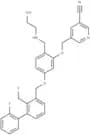
CAS:SF-9-2 is a PD-L1/PD-1 binding inhibitor with an IC50 of 24.9 nM. It suppresses epithelial-mesenchymal transition, migration, invasion, and proliferation of SK-N-SH cells, while also inducing apoptosis and causing cell cycle arrest. SF-9-2 blocks PD-L1-induced growth of SK-N-SH cells via the MAPK signaling pathway. It restores GSK-3β activity and enhances PD-L1 degradation through the ubiquitin-proteasome pathway. In the SK-N-SH NOG mouse model, SF-9-2 inhibits tumor growth without notable toxicity. Additionally, SF-9-2 acts as an immune checkpoint inhibitor, blocking PD-L1 to restore T cell function and is applicable to neuroblastoma research.Fórmula:C30H27F2N3O3Forma y color:SolidPeso molecular:515.55BMS 310705
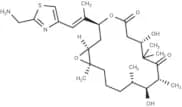
CAS:BMS 310705, an Epothilone B analog, targets ovarian/renal/bladder/lung cancer, inducing apoptosis via mitochondria.Fórmula:C27H42N2O6SForma y color:SolidPeso molecular:522.70