Enzyme
Les inhibiteurs d'enzymes sont des molécules qui se lient aux enzymes et diminuent leur activité. Ces inhibiteurs sont largement utilisés en recherche pour étudier la cinétique enzymatique, la régulation et le rôle spécifique des enzymes dans les voies métaboliques. Les inhibiteurs d'enzymes sont également cruciaux dans le développement de médicaments, car de nombreux agents thérapeutiques agissent en inhibant les enzymes impliquées dans les processus pathologiques. En ciblant les enzymes, ces inhibiteurs peuvent moduler les voies biochimiques et offrir des traitements potentiels pour diverses maladies. Chez CymitQuimica, nous offrons une sélection complète d'inhibiteurs d'enzymes de haute qualité pour soutenir vos recherches en biochimie, pharmacologie et découverte de médicaments.
Sous-catégories appartenant à la catégorie "Enzyme"
- Anhydrase carbonique(192 produits)
- Hydroxylase(35 produits)
- MPO(2 produits)
- Réductase(50 produits)
- Tyrosinase(72 produits)
3614 produits trouvés pour "Enzyme"
Trier par
Degré de pureté (%)
0
100
|
0
|
50
|
90
|
95
|
100
Adenylate Kinase 1, human, recombinant
Adenylate kinase 1 (EC 2.7.4.3) catalyzes interconversion between ATP, ADP and AMP by catalyzing the following reaction: ATP + AMP ⇔ 2 ADP One unit of Adenylate kinase 1 will convert 1.0 µmol ATP and 1.0 µmol AMP to 2.0 µmol ADP per min at optimum conditions.Degré de pureté :Min. 95%α Amylase enzyme
Alpha Amylase (Amylase, α-Amylase, 1,4-α-D-glucan glucanohydrolase, glycogenase, systematic name 4-α-D-glucan glucanohydrolase; EC 3.2.1.1, CAS Number [9000-90-2]) is an enzyme that catalyses hydrolysis of large polysacharides into smaller fragments. Alpha amylase targets alpha bonds of 1→4 glycosidic linkages of poly- and oligosaccharides with three or more D-glucose units. One unit of Alpha Amylase will catalyze the hydrolysis of 1.0 μmol of 2-chloro-4-nitrophenyl-α-D-maltotrioside to yield 2-chloro-4-nitrophenol per minute at 37°C. Human pancreatic Alpha Amylase is supplied as clear, colorless to light yellow liquid solution at ≥400U/mL, specific activity ≥100 U/mg protein.Store at 2-8 °C on arrival.Degré de pureté :Min. 95%Transglutaminase from guinea pig liver
CAS :Transglutaminase (2.3.2.13) is an enzyme that catalyzes formation of isopeptide bonds between the γ-carboxamide groups ( -(C=O)NH2 ) of glutamine side chains and amino groups. The donor of the amino group is usually (but not always) an ε-amino group ( -NH2 ) of lysine residue. The reaction also releases ammonia: Gln-(C=O)NH2 + NH2-Lys → Gln-(C=O)NH-Lys + NH3One unit of transglutaminase will catalyze the formation of 1.0 μmole transglutamination product per min at pH 6.0 and 37 °C.Degré de pureté :Min. 95%EUCODIS® CalB02 IA, engineered variant of Candida antarctica Lipase B, immobilized by adsorption on hydrophobic carrier - ELCB02IA
<p>Lipases belong to the family of esterases and naturally act on triglycerides at lipid-water interfaces. Lipases/esterases can be used as versatile tools in hydrolytic reactions, esterifications and transesterification reactions in industrial and food applications. The CalB02 IA lipase has been immobilized on a hydrophobic carrier by adsorption. The immobilized CalB02 lipase has a temperature optimum in the 40 - 50 °C range and pH optimum between pH 5 and 8.</p>Amylase protein
<p>Alpha Amylase (Amylase, α-Amylase, 1,4-α-D-glucan glucanohydrolase, glycogenase, ptyalin; systematic name 4-α-D-glucan glucanohydrolase; EC 3.2.1.1, CAS Number [9000-90-2]) is an enzyme that catalyses hydrolysis of large polysacharides into smaller fragments. Alpha amylase targets alpha bonds of 1→4 glycosidic linkages of poly- and oligosaccharides with three or more D-glucose units. One unit of Alpha Amylase will catalyze the hydrolysis of 1.0 μmol of 2-chloro-4-nitrophenyl-α-D-maltotrioside to yield 2-chloro-4-nitrophenol per minute at 37°C. Human salivary Alpha Amylase is supplied as clear, colorless liquid solution at ≥2000U/mL, specific activity ≥200 U/mg protein. Store at -20°C on arrival.</p>Degré de pureté :Min. 95%Lipoxidase
CAS :Lipoxidase is an enzyme, which is typically sourced from various plant tissues, animals, and some microorganisms. It functions by catalyzing the oxidation of polyunsaturated fatty acids in the presence of oxygen. This enzymatic action results in the formation of lipid hydroperoxides, which are key intermediates in various biochemical pathways, including those involved in cell signaling and the modulation of gene expression.Degré de pureté :Min. 95%Acid phosphatase
CAS :<p>One unit will hydrolyse 1.0μmol of 4-nitrophenyl phosphate per minute at 37°C and pH 4.8. Substrate for enzyme analysis is the 4-nitrophenyl phosphate disodium hexahydrate (EN08508).</p>Formule :C6H10O2Degré de pureté :Min. 95%Masse moléculaire :114.14 g/molβ-Glucuronidase from Helix pomatia - Type H-2, aqueous solution, ≥85,000 units/mL
CAS :β-Glucuronidase (EC 3.2.1.31) is an enzyme that hydrolyzes glucuronides. It can also be used to cleave benzodiazepine and steroid conjugates. One unit of β-Glucuronidase will hydrolyze a chromogenic substrate mimic 4-nitrophenyl-β-D-glucuronide to produce 1.0 μmole of 4-nitrophenol per minute at pH 5.0 and 37 °C.Degré de pureté :Min. 95%Couleur et forme :Clear LiquidCitrate lyase from klebsiella pneumonia ≥0.20 unit/mg solid
CAS :Citrate lyase (also known as ATP citrate synthase, EC 2.3.3.8) is an enzyme that catalyzes the following reaction:citrate + ATP + CoA → oxaloacetate + Acetyl-CoA + ADP + PiEnzymatic activity: One unit will convert 1.0 micromole of citrate to oxalacetate per minute at pH 7.6 and 25 °C in the presence of required cofactors. Citrate lyase is supplied lyophylized, with activity ≥0.20 unit/mg solid.Degré de pureté :Min. 95%Chitinase
CAS :Chitinase (systematic name (1→4)-2-acetamido-2-deoxy-β-D-glucan glycanohydrolase, EC 3.2.1.14) is a hydrolase that breaks down glycosidic bonds in chitin. One unit of chitinase will yield 1.0 mg of N-acetyl-D-glucosamine from chitin per hour at pH 6.0 and 25 °C.Formule :C17H16N8ZnDegré de pureté :Min. 95%Masse moléculaire :397.74 g/molCathepsin B from human placenta
CAS :<p>Cathepsin B is a lysosomal proteolytic enzyme of the cysteine protease family. It is present in all mammalian cells. It is essential for the intracellular protein turnover. Cathepsin B may be a useful tool in Alzheimer′s research, as it may have a role in the natural defense against the disease.</p>Degré de pureté :Min. 95%Diaphorase (from Clostridium kluyveri)
CAS :<p>Diaphorase (lipoyl dehydrogenase, EC 1.8.1.4) is an NAD+/NADH-dependent oxidoreductase. One unit of diaphorase will convert 1.0 μmole NADH into NAD+ the presence of substrate at pH 7.5 and 25 °C.</p>Degré de pureté :Min. 95%Urate oxidase (from Yeast)
CAS :<p>Urate Oxidase, also known as uricase, catalizes the following reaction: Uric acid + O2 + H2O → 5-hydroxyisourate + H2O2.</p>Formule :C18H26N5O14PDegré de pureté :Min. 95%Masse moléculaire :567.4 g/molLactase - >300U/mg
CAS :<p>beta-Galactosidase (EC 3.2.1.23, shortly beta-Gal, also know as lactase) catalyses the hydrolysis of beta-d-galactoside in the presence of water to galactose and alcohol, or lactose into glucose and galactose. beta-Gal has a molecular weight of 540,000 and is composed of four identical subunits of MW 135,000, each with an independent active site. The enzyme has divalent metals as cofactors, with chelated Mg2+ ions required to maintain active site conformation. The molecule contains numerous sulfhydryl groups and is glycosylated.</p>Creatinase
Creatinase is an enzyme (EC 3.5.3.3) that catalyzes the conversion of creatine to sarcosine and urea.Lipase Kit, 25 unique EUCODIS® lipases, recombinant - EL Kit
<p>Lipases belong to the family of esterases and naturally act on triglycerides at lipid-water interfaces. Lipases/esterases can be used as versatile tools in hydrolytic reactions, esterifications and transesterification reactions in industrial and food applications. The Lipase kit contains 25 lipases with different pH and temperature optima and substrate specificity properties.</p>Neuron-specific enolase human
CAS :<p>Neuron-specific enolase human (ENO2, Enolase 2, Neural enolase, Gamma-enolase, Phosphopyruvate hydratase, 2-phospho-D-glycerate hydro-lyase; EC 4.2.1.11) is the enzyme that is catalyzes the following reaction: 2-phospho-D-glycerate ⇌ phosphoenolpyruvate + H2O One unit of enolase will convert 1.0 μmole of 2-phosphoglycerate to phosphoenolpyruvate per min.</p>Malate dehydrogenase,buffered aqueous glycerol solution, 600-1000 units/mg protein (biuret)
CAS :Malic dehydrogenase is a mitochondrial isozyme and an important catalyst in the tricarboxylic acid cycle. The enzyme catalyzes the following reaction: Oxaloacetate + β-NADH → L-Malate + β-NADOne unit will convert 1.0 μmole of oxalacetate and β-NADH to L-malate and β-NAD per min at pH 7.5 at 25 °C.Degré de pureté :Min. 95%PNPase
<p>Specific activity: >500 units/mg-protein.Unit definition: One unit will polymerize 1.0 micro mole of ADP, releasing 1.0 micro mole of inorganic phosphate in 15 minutes at pH 9.1 at 37 °C.</p>Aminoacyl tRNA synthetase-IN-1
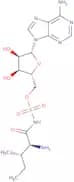
CAS :Enzyme involved in protein translation and catalyzes the aminoacylation reactionFormule :C16H25N7O7SDegré de pureté :Min. 95%Couleur et forme :PowderMasse moléculaire :459.48 g/mol