Enzyme
Les inhibiteurs d'enzymes sont des molécules qui se lient aux enzymes et diminuent leur activité. Ces inhibiteurs sont largement utilisés en recherche pour étudier la cinétique enzymatique, la régulation et le rôle spécifique des enzymes dans les voies métaboliques. Les inhibiteurs d'enzymes sont également cruciaux dans le développement de médicaments, car de nombreux agents thérapeutiques agissent en inhibant les enzymes impliquées dans les processus pathologiques. En ciblant les enzymes, ces inhibiteurs peuvent moduler les voies biochimiques et offrir des traitements potentiels pour diverses maladies. Chez CymitQuimica, nous offrons une sélection complète d'inhibiteurs d'enzymes de haute qualité pour soutenir vos recherches en biochimie, pharmacologie et découverte de médicaments.
Sous-catégories appartenant à la catégorie "Enzyme"
- Anhydrase carbonique(192 produits)
- Hydroxylase(35 produits)
- MPO(2 produits)
- Réductase(50 produits)
- Tyrosinase(71 produits)
3613 produits trouvés pour "Enzyme"
Trier par
Degré de pureté (%)
0
100
|
0
|
50
|
90
|
95
|
100
Transglutaminase from guinea pig liver
CAS :Transglutaminase (2.3.2.13) is an enzyme that catalyzes formation of isopeptide bonds between the γ-carboxamide groups ( -(C=O)NH2 ) of glutamine side chains and amino groups. The donor of the amino group is usually (but not always) an ε-amino group ( -NH2 ) of lysine residue. The reaction also releases ammonia: Gln-(C=O)NH2 + NH2-Lys → Gln-(C=O)NH-Lys + NH3One unit of transglutaminase will catalyze the formation of 1.0 μmole transglutamination product per min at pH 6.0 and 37 °C.Degré de pureté :Min. 95%EUCODIS® Nitrilhydratase 23, recombinant enzyme - ENH023
<p>Nitrile hydratase 23 recombinantly expressed in E. coli comes in a freeze-dried formulation. Nitrile hydratases can be utilized to convert nitriles into their corresponding amides, e.g. to produce acrylamide from acrylonitrile. Additional applications include the removal of nitriles from industrial wastewater. Our nitrile hydratases have been tested for hydrolysis of the following substrates:cyclohexanecarbonitrile, cinnamonitrile, benzonitrile, methacrylonitrile, pivalonitrile.</p>Lipase from Candida antarctica
CAS :<p>Lipase from *Candida antarctica* is an enzyme-based biocatalyst, which is derived from the yeast *Candida antarctica*. This enzyme operates via a catalytic mechanism that involves the hydrolysis of ester bonds in lipid substrates, thereby facilitating the breakdown of fats into glycerol and free fatty acids. Its catalytic efficiency and stability in various conditions make it highly versatile for industrial applications.</p>Formule :C11H9N3O2•NaCouleur et forme :PowderMasse moléculaire :233.10 g/molAmylase protein
<p>Alpha Amylase (Amylase, α-Amylase, 1,4-α-D-glucan glucanohydrolase, glycogenase, ptyalin; systematic name 4-α-D-glucan glucanohydrolase; EC 3.2.1.1, CAS Number [9000-90-2]) is an enzyme that catalyses hydrolysis of large polysacharides into smaller fragments. Alpha amylase targets alpha bonds of 1→4 glycosidic linkages of poly- and oligosaccharides with three or more D-glucose units. One unit of Alpha Amylase will catalyze the hydrolysis of 1.0 μmol of 2-chloro-4-nitrophenyl-α-D-maltotrioside to yield 2-chloro-4-nitrophenol per minute at 37°C. Human salivary Alpha Amylase is supplied as clear, colorless liquid solution at ≥2000U/mL, specific activity ≥200 U/mg protein. Store at -20°C on arrival.</p>Degré de pureté :Min. 95%Glutathione peroxidase
CAS :<p>Glutathione peroxidase (EC 1.11.1.9) is an enzyme that reduces peroxides to limit oxidative damage, by catalyzing the following reaction: 2 GSH + H2O2 → GS–SG + 2 H2O One unit of glutathione peroxidase will catalyze the conversion of 1.0 µmole of H2O2 per minute at pH 7.0 and 25 °C in the presence of reduced glutathione. Reduced glutahione is available here.</p>Degré de pureté :Min. 95%Masse moléculaire :84,500 g/molAlcohol dehydrogenase, from yeast
CAS :<p>Alcohol dehydrogenase (EC 1.1.1.1) is the enzyme that catalyzes interconversion between alcohols and aldehydes or ketones, using NAD+/NADH as a cofactor in the following reaction: CH3CH2OH + NAD+ ⇔ CH3CHO + NADH + H+ One unit of alcohol dehydrogenase will convert 1.0 µmol of ethanol to acetaldehyde per minute at pH 8.8 and 25 °C.</p>Lipase Kit, 25 unique EUCODIS® lipases, recombinant - EL Kit
<p>Lipases belong to the family of esterases and naturally act on triglycerides at lipid-water interfaces. Lipases/esterases can be used as versatile tools in hydrolytic reactions, esterifications and transesterification reactions in industrial and food applications. The Lipase kit contains 25 lipases with different pH and temperature optima and substrate specificity properties.</p>Cathepsin B from human placenta
CAS :<p>Cathepsin B is a lysosomal proteolytic enzyme of the cysteine protease family. It is present in all mammalian cells. It is essential for the intracellular protein turnover. Cathepsin B may be a useful tool in Alzheimer′s research, as it may have a role in the natural defense against the disease.</p>Degré de pureté :Min. 95%Phospholipase D Kit, 4 unique EUCODIS® PLDs, recombinant - EPLD Kit
<p>Phospholipases D belong to the family of esterases and act on phosphatidylcholine in the plasma membrane to release phosphatidic acid (PA) and choline. Phospholipases D can be used as versatile tools in hydrolysis and transphosphatidylation reactions for industrial, chemical and food applications. The Phospholipase D Kit contains 4 enzymes with a broad pH range for transphosphatidylation activity.</p>Lactase - >300U/mg
CAS :<p>beta-Galactosidase (EC 3.2.1.23, shortly beta-Gal, also know as lactase) catalyses the hydrolysis of beta-d-galactoside in the presence of water to galactose and alcohol, or lactose into glucose and galactose. beta-Gal has a molecular weight of 540,000 and is composed of four identical subunits of MW 135,000, each with an independent active site. The enzyme has divalent metals as cofactors, with chelated Mg2+ ions required to maintain active site conformation. The molecule contains numerous sulfhydryl groups and is glycosylated.</p>Phosphoglucose isomerase from baker′s yeast (S. cerevisiae), Type III, ammonium sulfate suspension, ≥400 units/mg protein (biuret)
CAS :<p>Glucose-6-phosphate isomerase (GPI, phosphoglucose isomerase/phosphoglucoisomerase, PGI, phosphohexose isomerase, PHI; EC 5.3.1.9) is an enzyme that catalyses isomerisation between Glucose-6-phosphate and Fructose-6-phosphate: G6P ⇌ F6P One unit of GPI will convert 1.0 mmole of Fructose-6-phosphate to Glucose-6-phosphate per minute at pH 7.4 and 25 °C.</p>Degré de pureté :Min. 95%Couleur et forme :SuspensionNeuron-specific enolase human
CAS :<p>Neuron-specific enolase human (ENO2, Enolase 2, Neural enolase, Gamma-enolase, Phosphopyruvate hydratase, 2-phospho-D-glycerate hydro-lyase; EC 4.2.1.11) is the enzyme that is catalyzes the following reaction: 2-phospho-D-glycerate ⇌ phosphoenolpyruvate + H2O One unit of enolase will convert 1.0 μmole of 2-phosphoglycerate to phosphoenolpyruvate per min.</p>EUCODIS® CalB01 ICE, engineered variant of Candida antarctica Lipase B, covalent immobilization on hydrophobic carrier - ELCB01ICE
<p>Lipases belong to the family of esterases and naturally act on triglycerides at lipid-water interfaces. Lipases/esterases can be used as versatile tools in hydrolytic reactions, esterifications and transesterification reactions in industrial and food applications. The CalB01 ICE lipase has been immobilized on a hydrophobic carrier by a covalent linkage. The immobilized CalB01 lipase has a temperature optimum in the 40 - 50 °C range and pH optimum between pH 5 and 8.</p>PNPase
<p>Specific activity: >500 units/mg-protein.Unit definition: One unit will polymerize 1.0 micro mole of ADP, releasing 1.0 micro mole of inorganic phosphate in 15 minutes at pH 9.1 at 37 °C.</p>Aminoacyl tRNA synthetase-IN-1
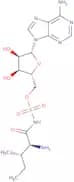
CAS :<p>Enzyme involved in protein translation and catalyzes the aminoacylation reaction</p>Formule :C16H25N7O7SDegré de pureté :Min. 95%Couleur et forme :PowderMasse moléculaire :459.48 g/molCasein Kinase 2
<p>Casein kinase 2 (CK2, CSNK2; EC 2.7.11.1) is a constitutively active serine and threonine protein kinase. It plays a role in a range of cellular processes, including DNA repair, cell cycle control, metabolic regulation, circadian rhythms and more. Its known substrates include hundreds of proteins. One unit of CK2 will phosphorylate of 1 pmol of of peptide substrate in 1 minute at 30°C and presence of ATP.</p>Formule :C45H73N19O24Degré de pureté :Min. 95%Masse moléculaire :1,264.17 g/molSuperoxide dismutase PEG
<p>Superoxide dismutase coupled to polyethylene glycol. Superoxide dismutase (EC 1.15.1.1) is an enzyme that catalyzes the following reaction: 2 H+ + 2 O2− → O2 + H2O2 thus converting an extremely reactive and cytotoxic superoxide radical into oxygen and (significantly less reactive) hydrogen peroxide.</p>Nitrilase
CAS :<p>Nitrilase (nitrile aminohydrolase; EC 3.5.5.1) in an enzyme that catalyzes hydrolysis of nitriles to carboxilic acids and ammonia: R-CN + 2 H2O → R-COO- + NH4+ One unit of nitrilase will yield 1.0 μmol of ammonia per minute under optimal reaction conditions using acrylonitrile as a substrate.</p>Degré de pureté :Min. 95%Butyrylcholinesterase
Butyrylcholinesterase (BCHE, BuChE, PCHE, pseudocholinesterase, plasma cholinesterase, Acylcholine acyl-hydrolase, Choline esterase; EC 3.1.1.8, CAS No [9001-08-5]) is an enzyme that made in the liver and found mainly in blood plasma. It catalyzes the following reaction: Acylcholine + H2O → choline + carboxylic acidOne unit of Butyrylcholinesterase will change absorbance by 0.2 milliunits (mA) per minute at optimal buffer conditions and 37 ̊C. Equine serum butyrylcholinesterase is supplied as white to pale grey-green powder with activity of ≥50U/mg and specific activity of ≥300U/mg protein. It can be dissolved at 5 mg/mL concentration in 50 mM Tris-HCl pH 7.3 - 7.5, giving colorless to slightly green solution. Equine serum butyrylcholinesterase is activated by Ca2+, optimum pH 7-8, KM=18 µM (butyrylthiocholine at 25°C). Store at -20°C on arrival.