Acides cinnamiques
Les acides cinnamiques sont une classe d'acides phénoliques largement présents dans les plantes. Ils possèdent une structure de base d'acide phénylacrylique et sont connus pour leurs propriétés antioxydantes et anti-inflammatoires. Les acides cinnamiques jouent un rôle important dans la biosynthèse de la lignine et d'autres métabolites végétaux. Ces composés sont précieux dans les domaines de recherche liés à la biologie végétale, la pharmacologie et la chimie synthétique.
657 produits trouvés pour "Acides cinnamiques"
Trier par
Degré de pureté (%)
0
100
|
0
|
50
|
90
|
95
|
100
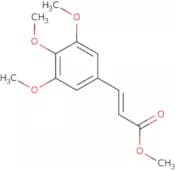
Methyl 3,4,5-trimethoxycinnamate
CAS :<p>Methyl 3,4,5-trimethoxycinnamate (MTMC) is a compound that has been used as the active ingredient in traditional Chinese medicine for the treatment of cardiac disease. It has been shown to have an inhibitory effect on ventricular myocytes and to induce apoptosis in rat heart cells. MTMC also inhibits neutrophil recruitment and reduces the expression of pro-apoptotic proteins. It has also been shown to be effective in treating congestive heart failure by blocking cardiac hypertrophy and myocardial apoptosis. Methyl 3,4,5-trimethoxycinnamate has not been tested on humans or animals for safety or efficacy in treating depression.</p>Formule :C13H16O5Degré de pureté :Min. 95%Couleur et forme :White PowderMasse moléculaire :252.26 g/mol4-Formylcinnamic acid
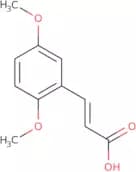
CAS :<p>4-Formylcinnamic acid is a molecule that is produced by the condensation of benzaldehyde and formic acid. The nmr spectra of 4-formylcinnamic acid show that it has a structure with two aromatic rings. It has been shown to activate Toll-like receptor 4 (TLR4) in human liver cells. The radiation induced photochemical properties of this molecule have been studied using x-ray diffraction data and the hydrochloric acid decoupling technique. This molecule has also been shown to suppress tumor xenografts in mice and primary cells in vitro, which may be due to its ability to inhibit cellular proliferation and induce cell death by apoptosis.</p>Formule :C10H8O3Degré de pureté :Min. 97 Area-%Couleur et forme :White PowderMasse moléculaire :176.17 g/mol2,5-Dimethoxycinnamic acid
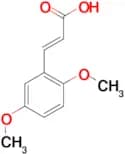
CAS :<p>2,5-Dimethoxycinnamic acid is an unsymmetrical phenolic compound that is synthesized from caffeic acid. It has been shown to have a number of biological activities such as anti-inflammatory, coagulation, and inhibitory effects on platelet aggregation. 2,5-Dimethoxycinnamic acid has also been shown to be a potent inhibitor of platelet aggregation and thrombosis formation in vitro. This natural compound is also found in plants such as green tea leaves which contain the polyphenols epigallocatechin gallate and hydroxyanisole. The chromophore group in the molecule is responsible for the yellow color of this substance.</p>Formule :C11H12O4Degré de pureté :Min. 95%Couleur et forme :PowderMasse moléculaire :208.21 g/molCaffeic acid
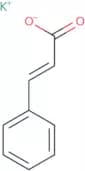
CAS :<p>Caffeic acid is naturally produced by the metabolism of plants and fungi. Caffeic acid has an antioxidant activity that can be higher than tocopherol in oil-in-water emulsions. Caffeic acid has proven antimicrobial activity against Staphylococcus aureus. In mice, caffeic acid inhibits the enzyme 5-lipoxygenase thus inhibititing the biosynthesis of the inflammatory mediators leukotrienes.</p>Formule :C9H8O4Degré de pureté :Min. 98.0 Area-%Masse moléculaire :180.16 g/molPotassium cinnamate
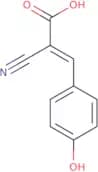
CAS :<p>Potassium cinnamate is a white crystalline solid that is soluble in water, ethanol and acetone. It has been shown to be effective for wastewater treatment and can be used as a reducing agent. Potassium cinnamate has been shown to have high values of hydroxide solution, which are often used in the manufacturing of polymers. Potassium cinnamate also exhibits enzyme activities, such as being able to catalyze the oxidation of propionate. This product has been shown to have anti-oxidant properties and can be used for radiation protection. The polymerization of potassium cinnamate leads to polymaleic acid, which is used in the production of plastics.</p>Formule :C9H7KO2Degré de pureté :Min. 98 Area-%Couleur et forme :White PowderMasse moléculaire :186.25 g/mola-Cyano-4-hydroxycinnamic acid
CAS :<p>a-Cyano-4-hydroxycinnamic acid is a cyclic peptide that has been shown to have cytotoxic and antimicrobial properties. It has been shown to be effective in reducing the viability of cells in vitro by interfering with DNA synthesis and cell signaling pathways, as well as causing oxidative stress. This compound also induces apoptosis in squamous carcinoma cells and hypoxic tumor cells; this effect may be due to its ability to induce the release of cytochrome c from mitochondria. a-Cyano-4-hydroxycinnamic acid has been shown to produce antibacterial activity against Gram-positive bacteria, such as Streptococcus pneumoniae and Staphylococcus aureus, but not against Gram-negative bacteria, such as Escherichia coli or Pseudomonas aeruginosa.</p>Formule :C10H7NO3Couleur et forme :Slightly Yellow PowderMasse moléculaire :189.17 g/molMethyl 4-hydroxy-3-methoxycinnamate
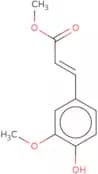
CAS :<p>Methyl 4-hydroxy-3-methoxycinnamate is a natural phenolic compound that is found in small quantities in many plants and foods. It is used to produce other compounds, such as vanillin, which are used as flavoring agents. Methyl 4-hydroxy-3-methoxycinnamate can be quantified using the enzymatic reaction of peroxidase with 3,4,5-trimethoxybenzene. The kinetics of this reaction have been studied by titration calorimetry. Aspergillus niger catalase has been shown to be sensitive to methyl 4-hydroxy-3-methoxycinnamate. Birch and oak wood lignocellulosic biomass can be converted into sugars through a hydrolysis process with methyl 4-hydroxy-3-methoxycinnamate. The carbohydrate content of birch and oak wood was reduced by approximately 60</p>Formule :C11H12O4Degré de pureté :Min. 95%Couleur et forme :PowderMasse moléculaire :208.21 g/mol4-Aminocinnamic acid
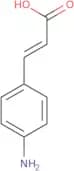
CAS :<p>4-Aminocinnamic acid is a monomer that can be polymerized to form polymers. It is soluble in organic solvents and is resistant to UV light. 4-Aminocinnamic acid has been shown to have photochemical properties and can be used to produce hydrogen bonds with other molecules. This compound has been used as a carbon source for microbial growth and has been shown to be an effective genetic control agent for the bacteria Escherichia coli. 4-Aminocinnamic acid has also been shown to inhibit the growth of butyric acid producing bacteria, such as Clostridium butyricum, while promoting the growth of lactic acid producing bacteria, such as Lactobacillus plantarum.</p>Formule :C9H9NO2Degré de pureté :90%Couleur et forme :PowderMasse moléculaire :163.17 g/mol2-Chloro-4-fluorocinnamic acid
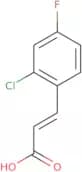
CAS :<p>2-Chloro-4-fluorocinnamic acid is an organic compound that is a useful building block, reagent, and speciality chemical. It is a versatile intermediate for the production of other organic compounds. 2-Chloro-4-fluorocinnamic acid can be used as a reaction component or a scaffold in the synthesis of complex compounds. The synthesis of this product is also possible by coupling it with an appropriate amine, such as 4-(diethylamino)benzaldehyde.</p>Formule :C9H6ClFO2Degré de pureté :Min. 95%Couleur et forme :PowderMasse moléculaire :200.59 g/moltrans-4-Coumaric acid
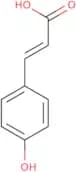
CAS :<p>Trans-4-coumaric acid or p-coumaric acid, is a derivative of the cinnamic acid. It is the initial substrate to produce several intermediates such as ferulic acid, caffeic acid, rosmarinic acid, gallic acid, and carnosic acid. Trans-4-coumaric acid, as well as its derivatives, have antioxidant properties; they are common ingredients in cosmetics and as dietary supplement.</p>Formule :C9H8O3Degré de pureté :Min. 98 Area-%Couleur et forme :PowderMasse moléculaire :164.16 g/moltrans-Ferulic acid
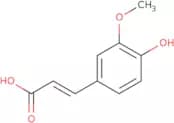
CAS :<p>Hydroxycinnamic acid; inhibitor of 5-LO and 12-LO enzymes</p>Formule :C10H10O4Degré de pureté :Min. 99.0 Area-%Couleur et forme :White PowderMasse moléculaire :194.18 g/mol3,5-Di-tert-butyl-4-hydroxycinnamic acid
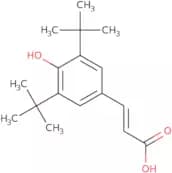
CAS :<p>3,5-Di-tert-butyl-4-hydroxycinnamic acid is a chemical compound that belongs to the group of antihistaminic drugs. It is used as an antiallergic drug and has shown to be effective in treating hay fever and asthma. 3,5-Di-tert-butyl-4-hydroxycinnamic acid has been shown to be metabolised by rat plasma into dimethylformamide, tetrahydrofuran, reactive amides, chlorides and volatile compounds. These metabolites are then excreted via the kidneys or liver. The synthesis of 3,5-Di-tert-butyl-4-hydroxycinnamic acid can be done through a two step process that starts with the reaction of pivalaldehyde with hydrochloric acid followed by hydrogenation with rhodium on charcoal catalyst.</p>Formule :C17H24O3Degré de pureté :Min. 95%Couleur et forme :PowderMasse moléculaire :276.37 g/mol3-Hydroxycinnamic acid
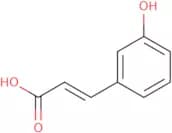
CAS :<p>3-Hydroxycinnamic acid is a natural compound that belongs to the group of caffeic acids. It is found in many plants, including coffee beans and tea leaves. 3-Hydroxycinnamic acid has been shown to inhibit the proliferation of 3T3-L1 preadipocytes and HL-60 cells by inhibiting mitochondrial membrane potential. This compound also inhibits the activity of 4-hydroxyphenylacetic acid (4HPA) hydroxylase, which converts phenylalanine into tyrosine and 4HPA, an intermediate in the synthesis of melanin. 3-Hydroxycinnamic acid can be used as a model system for studying caffeic acids in vitro. Structural analysis has demonstrated that 3-hydroxycinnamic acid contains nitrogen atoms, which may be essential for its anti-inflammatory activities.</p>Formule :C9H8O3Degré de pureté :Min. 95%Couleur et forme :PowderMasse moléculaire :164.16 g/mol3,4,5-Trimethoxycinnamic acid
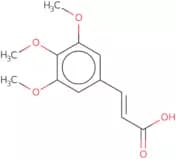
CAS :<p>3,4,5-Trimethoxycinnamic acid (TMC) is a hydroxycinnamic acid that is an intermediate in the synthesis of protocatechuic acid. TMC has been found to have an inhibitory effect on the matrix metalloproteinase activity in the cerebellar granule cells and may be useful for treating allergic reactions. It also has anti-inflammatory properties and can be used as a replacement for sodium carbonate in certain industrial processes. TMC also has been shown to have GABA-ergic effects, increasing locomotor activity and reducing anxiety. TMC can also be used as a Chinese herb for the treatment of ganoderma lucidum.</p>Formule :C12H14O5Degré de pureté :Min. 98 Area-%Couleur et forme :PowderMasse moléculaire :238.24 g/molcis-4-Chloro-3-nitrocinnamic acid
<p>Cis-4-Chloro-3-nitrocinnamic acid is an aromatic organic compound with potential utility in biochemical research and synthesis. This compound is typically derived from synthetic chemical processes involving chlorination and nitration reactions on cinnamic acid derivatives. Its molecular structure, characterized by both chloro and nitro functional groups, allows it to interact in unique ways with various biochemical pathways and molecular frameworks.</p>Formule :C9H6ClNO4Degré de pureté :Min. 95%Couleur et forme :White PowderMasse moléculaire :227.6 g/molEthyl 4-aminocinnamate
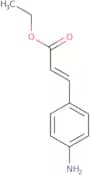
CAS :<p>Ethyl 4-aminocinnamate is a supramolecular, homologous, activated, linear polymer. It is used as an amine and phosphazene ligand in mesomorphic solid-state chemistry. It has a reversible covalent bond that can be thermally broken and re-formed. This property allows for the synthesis of polymers with functional groups on both ends of the molecule. The nitro group on this compound can be reduced to amine to give another functional group. Ethyl 4-aminocinnamate has been shown to have pharmacokinetic properties that are similar to those of ethyl 4-aminobenzoate (EB). EB is an inhibitor of NS5B polymerase that blocks RNA synthesis and leads to inhibition of viral replication. EB also inhibits ring opening reactions in the presence of nitro groups, which may explain its inhibitory effect on HIV RNA synthesis.</p>Formule :C11H13NO2Degré de pureté :Min. 95%Couleur et forme :PowderMasse moléculaire :191.23 g/moltrans-4-Nitrocinnamic acid
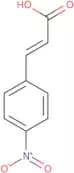
CAS :<p>Trans-4-nitrocinnamic acid is an organic compound that is synthesized from 4-hydroxycinnamic acid by nitration with aqueous or alcoholic nitric acid. Trans-4-Nitrocinnamic acid has been shown to inhibit tyrosinase activity in the presence of metal hydroxides, such as copper, zinc, and iron. The reaction mechanism is unclear but may involve an initial protonation of the phenolic group followed by an electron transfer to the nitro group. This reaction results in an irreversible inhibition of tyrosinase activity. Trans-4-Nitrocinnamic acid also reacts with hydrochloric acid to produce a carboxylate salt that can be used for sample preparation.</p>Formule :C9H7NO4Degré de pureté :Min. 95%Couleur et forme :PowderMasse moléculaire :193.16 g/mol3-(2,4,5-Trimethoxyphenyl)acrylic acid
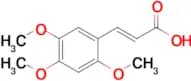
CAS :Formule :C12H14O5Degré de pureté :98%Masse moléculaire :238.239