APIs per la ricerca e le impurità
Sottocategorie di "APIs per la ricerca e le impurità"
- Aminoacidi e Derivati(12.440 prodotti)
- Antrachinoni e Derivati(407 prodotti)
- Derivati del Benzimidazolo e dell’Imidazolo(10.464 prodotti)
- Derivati delle Benzodiazepine(335 prodotti)
- Carboidrati e Glicoconiugati(5.388 prodotti)
- Esteri e Derivati(42.306 prodotti)
- Acidi Grassi e Derivati Lipidici(32.486 prodotti)
- Flavonoidi e Polifenoli(17.100 prodotti)
- Radicali Liberi e Agenti Ossidanti/Riducenti(214 prodotti)
- Chetoni e Derivati(2.692 prodotti)
- Antibiotici Naturali e Semisintetici(6.409 prodotti)
- Nitrili e Derivati Ciano(3.070 prodotti)
- Nitrosammine e Derivati(55 prodotti)
- Nucleosidi e Nucleotidi(3.492 prodotti)
- Fosfati e Fosfonati Organici(1.203 prodotti)
- Solfonati e Solfati Organici(10.451 prodotti)
- Composti Organometallici(4.425 prodotti)
- Altri(6.340 prodotti)
- Peptidi e Proteine(3.164 prodotti)
- Polimeri e Derivati(100 prodotti)
- Derivati delle Purine e Pirimidine(8.974 prodotti)
- Derivati della Chinazolina e Chinolina(66.218 prodotti)
- Chinoni e Derivati(24.378 prodotti)
- Sali e Derivati degli API(92.894 prodotti)
- Steroidi e Derivati(4.987 prodotti)
- Sulfonamidi e Derivati(2.607 prodotti)
- Terpenoidi e Derivati(3.860 prodotti)
- Tiazolidinedioni e Tiopirani(2.755 prodotti)
- Composti β-Adrenergic(231 prodotti)
Trovati 66870 prodotti di "APIs per la ricerca e le impurità"
2-[4-(2-Methylpropanoyl)phenyl] propanoic acid
CAS:2-[4-(2-Methylpropanoyl)phenyl] propanoic acid is a pharmaceutical intermediate that is used for the production of carprofen. It has been found to be an analytical method for the determination of 4-hydroxybenzoic acid and 4-isobutylacetophenone. The compound is analyzed by chromatographic methods and electrophoresis methods. The optimization of the solvent composition, flow rate, and impurities during the synthesis process are also studied in this research. 2-[4-(2-Methylpropanoyl)phenyl] propanoic acid has been found to be a meaningful validation of analytical methods for medicines, with an impurity limit of 0.1%.Formula:C13H16O3Purezza:Min. 98 Area-%Colore e forma:PowderPeso molecolare:220.26 g/molLisinopril EP Impurity E
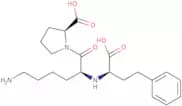
CAS:Lisinopril EP Impurity E is an impurity of lisinopril, which is a prescription drug used to treat high blood pressure. This impurity was found in a preparative high performance liquid chromatography (HPLC) and mass spectroscopy analysis of the drug. The molecular weight of Lisinopril EP Impurity E was determined to be 317.2 amu, which corresponds to the molecular formula C7H13NO2. The FT-IR spectrum showed that this impurity has an ammonium group at 1859 cm-1 and butanoic acid at 1647 cm-1.Formula:C21H31N3O5Purezza:Min. 98 Area-%Colore e forma:PowderPeso molecolare:405.49 g/molN-[2-[[[5-[(Dimethylamino)methyl]-2-furanyl]methyl]thio]ethyl]-2-nitroacetamide sodium salt
CAS:2-Nitroacetamide sodium salt is an impurity of the drug N-[2-[[[5-[(dimethylamino)methyl]-2-furanyl]methyl]thio]ethyl]-2-nitroacetamide, a synthetic chemotherapeutic agent for the treatment of cancers. This compound has been shown to have metabolism studies and natural properties. It has a CAS number of 112251-56-6 and is found in the pharmacopoeia. 2-Nitroacetamide sodium salt is a custom synthesis that can be used as a reference standard for HPLC analysis. It can also be used as a drug product or metabolite in drug development.
Formula:C12H18N3O4SNaPurezza:Min. 95%Colore e forma:PowderPeso molecolare:323.34 g/mol3,4-Dihydroxybenzoic acid 3-o-sulfate sodium salt
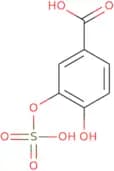
CAS:3,4-Dihydroxybenzoic acid 3-O-sulfate sodium salt is an active compound that has been shown to have potential as a cancer inhibitor. It acts by inhibiting the activity of mutant cells and cancer cells, making it a promising candidate for cancer treatment. This compound has been tested on human cell lines and analogs, demonstrating its ability to inhibit tumor growth and prevent the progression of cancer cells. Additionally, 3,4-Dihydroxybenzoic acid 3-O-sulfate sodium salt has been identified as one of the active agents in Chinese medicine that can regulate protein expression and cell cycle progression by targeting kinases. Its potent anti-cancer properties make it a promising therapeutic agent for the treatment of various forms of cancer.Formula:C7H6O7SPurezza:Min. 95%Colore e forma:PowderPeso molecolare:234.19 g/molS-Methyl-N-cyano-N'-[2-[(5-methyl-1H-imidazol-4-yl)methylthio]ethyl]isothiourea
CAS:Methylisothiourea is a label that can be used to identify cells in vivo. It is a fluorescent molecule that is activated by the presence of cytokines, such as IL-1β and TNF-α. Methylisothiourea has been used to evaluate corneal epithelial cells for their response to injury. The effect of Methylisothiourea on the tissue was assessed by histology and evaluated by the presence of cytokine concordance with the fluorescence intensity. Reconstitution experiments were conducted in vitro using human tissues. It was found that Methylisothiourea was not toxic at concentrations up to 500 μM and that it did not interfere with DNA synthesis or cell division at concentrations up to 10 mM.
Formula:C10H15N5S2Purezza:Min. 95%Colore e forma:White PowderPeso molecolare:269.39 g/molRisedronate sodium hydrate
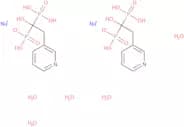
CAS:Risedronate sodium hydrate is a polymorphic, water-soluble salt of risedronate. It has been used in the treatment of osteoporosis and Paget's disease of bone. Risedronate sodium hydrate binds to calcium ions in the body and prevents them from being deposited in bone tissue. This drug also cross-links collagen fibers in the bone matrix, which increases mineralization and decreases the risk of fracture by strengthening the bones. The monosodium salt form of risedronate is soluble in water and is used as an analytical reagent for determining ionic strength or pH. It has been shown to inhibit ionotropic gelation, which may be due to its polyphosphoric acid content. Risedronate sodium hydrate is a polymorphic, water-soluble salt of risedronate that has been used in the treatment of osteoporosis and Paget's disease of bone. Risedronate sodium hyd
Formula:C7H10NNaO7P2·xH2OPurezza:Min. 98 Area-%Colore e forma:PowderPeso molecolare:350.13 g/mol2'-Nor thiaMine
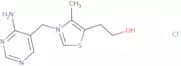
CAS:2'-Nor thiaMine is a drug product, analytical and impurity standard for the manufacture of pharmaceuticals. It is a natural substance found in plants, animals and humans. 2'-Nor thiaMine has been shown to be an impurity of the drug 2-mercaptopurine (2MP), which is used to treat leukemia, lymphoma and psoriasis. This compound can also be used as a research tool or as an impurity standard. 2'-Nor thiaMine is used in metabolism studies of drugs that are metabolized by liver enzymes such as cytochrome P450. It has been shown to inhibit the activity of these enzymes in vitro at concentrations less than 1 μM. CAS No.: 7770-93-6Formula:C11H15ClN4OSPurezza:Min. 95%Peso molecolare:286.78 g/mol6-Epi pravastatin sodium
CAS:6-Epi pravastatin sodium salt is a synthetic compound with the same molecular formula and chemical structure as the natural product. It has been used in pharmacological studies, drug development, and research. 6-Epi pravastatin sodium salt is a metabolite of pravastatin.
Formula:C23H36O7•NaPurezza:Min. 92.0 Area-%Peso molecolare:447.51 g/molDesmethyl tacrolimus
CAS:Tacrolimus is a macrolide antibiotic that binds to the calcineurin receptor and inhibits the production of cytokines. It is used to treat certain types of autoimmunity and hyperproliferation in patients with cancer, organ transplant recipients, and those who have undergone radiation therapy. The drug is available in two forms: tacrolimus (the natural form) and desmethyl tacrolimus (a metabolite). Desmethyl tacrolimus is produced by microbial transformation, which converts the natural form into a more water-soluble derivative. This conversion can be prevented by adding additives such as proton pump inhibitors or pde5 inhibitors. Symptoms of tacrolimus include hyperglycemia, hyperlipidemia, gastrointestinal disturbances, headache, fever, skin rash, diarrhea, and anemia. Tacrolimus has been shown to inhibit the activity of fk506-binding proteins in vitro and in vivo through competitive inhibition.Formula:C43H67NO12Purezza:Min. 90 Area-%Colore e forma:White PowderPeso molecolare:789.99 g/mol2-Mercaptobenzimidazole
CAS:2-Mercaptobenzimidazole is a chemical compound that can be used for the treatment of infectious diseases. It has been shown to have antioxidative properties and inhibit the growth of bacteria. 2-Mercaptobenzimidazole also has an effect on human serum, which may be due to its ability to bind with proteins in serum and form hydrogen bonds. 2-Mercaptobenzimidazole is stable at high temperatures and has been shown as an effective antimicrobial agent against gram positive and gram negative bacteria.
Formula:C7H6N2SPurezza:Min. 99 Area-%Colore e forma:White/Off-White SolidPeso molecolare:150.19 g/molD-Val(10)-Semaglutide
D-Val(10)-Semaglutide is a semaglutide impurity. The amino acid at position 10 has been replaced by the D-form of the amino acid D-valine (D-Val). Semaglutide impurities are structurally related compounds that arise during synthesis, purification, or storage of semaglutide, a long-acting GLP-1 receptor agonist for managing type 2 diabetes and obesity.Formula:C187H291N45O59Peso molecolare:4,113.64 g/molD-Thr(5)-Semaglutide
D-Thr(5)-Semaglutide is a semaglutide impurity. The amino acid at position 5 has been replaced by the D-form of the amino acid D-threonine (D-Thr). Semaglutide impurities are structurally related compounds that arise during synthesis, purification, or storage of semaglutide, a long-acting GLP-1 receptor agonist for managing type 2 diabetes and obesity.Formula:C187H291N45O59Peso molecolare:4,113.64 g/molN-(((5S)-3-(4-(4-Morpholinyl)phenyl)-2-oxo-5-oxazolidinyl)methyl) acetamide
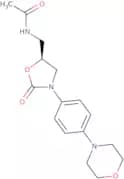
CAS:N-(((5S)-3-(4-(4-Morpholinyl)phenyl)-2-oxo-5-oxazolidinyl)methyl) acetamide is an impurity of the antibiotic linezolid. It is a contaminant that can be found in urine and blood samples. N-(((5S)-3-(4-(4-Morpholinyl)phenyl)-2-oxo-5-oxazolidinyl)methyl) acetamide has been shown to be amyloidogenic, meaning it can form plaques in the brain and lead to Alzheimer's disease.Formula:C16H21N3O4Purezza:Min. 95%Colore e forma:White to off-white solid.Peso molecolare:319.36 g/molDes(2-methylbutyryl) pavastatin sodium
CAS:Des(2-methylbutyryl)pavastatin sodium is a synthetic analog of the natural product, pravastatin. It is the methyl ester of the active metabolite of pravastatin and has been shown to be an effective inhibitor of cholesterol biosynthesis. Des(2-methylbutyryl)pavastatin sodium is used in drug development as an analytical standard and as a research and development impurity standard for HPLC. This compound's CAS number is 151061-28-8, making it a niche product that does not require extensive synthesis.
Formula:C18H29NaO6Purezza:Min. 95%Peso molecolare:364.41 g/molSemaglutide Impurity 56 (D-Glu 21)
D-Glu(21)-Semaglutide is a semaglutide impurity. The amino acid at position 21 has been replaced by the D-form of the amino acid D-glutamic acid (D-Glu). Semaglutide impurities are structurally related compounds that arise during synthesis, purification, or storage of semaglutide, a long-acting GLP-1 receptor agonist for managing type 2 diabetes and obesity.Formula:C187H291N45O59Peso molecolare:4,113.64 g/mol4-Amino-2-chloro-6,7-dimethoxyquinazoline
CAS:4-Amino-2-chloro-6,7-dimethoxyquinazoline (4ACDMQ) is a synthetic compound that has been used as a chemical intermediate. The chemical structure of 4ACDMQ is similar to that of the natural amino acid tryptophan. It is synthesized by reacting phosphorus pentachloride with 2,6,7-trimethoxyquinazoline in the presence of hydroxide solution and hexamethylphosphoramide. 4ACDMQ has been shown to be an inhibitor of ubiquitin proteasome system and has been used in functional studies on this system. The reaction yield for 4ACDMQ can be increased by using sodium hydroxide solution or n-dimethyl formamide as a solvent. Functional assays have shown binding properties for 4ACDMQ to proteins such as ubiquitin and proteasome subunits.Formula:C10H10ClN3O2Purezza:Min. 95%Colore e forma:PowderPeso molecolare:239.66 g/mol
![2-[4-(2-Methylpropanoyl)phenyl] propanoic acid](/_next/image/?url=https%3A%2Fstatic.cymitquimica.com%2Fproducts%2F3D%2Fthumb-webp%2FIM15852.webp&w=3840&q=75)


![N-[2-[[[5-[(Dimethylamino)methyl]-2-furanyl]methyl]thio]ethyl]-2-nitroacetamide sodium salt](/_next/image/?url=https%3A%2Fstatic.cymitquimica.com%2Fproducts%2F3D%2Fthumb-webp%2FID57855.webp&w=3840&q=75)
![S-Methyl-N-cyano-N'-[2-[(5-methyl-1H-imidazol-4-yl)methylthio]ethyl]isothiourea](/_next/image/?url=https%3A%2Fstatic.cymitquimica.com%2Fproducts%2F3D%2Fthumb-webp%2FIM58264.webp&w=3840&q=75)



![[D-Phe6]-Tirzepatide](/_next/image/?url=https%3A%2Fstatic.cymitquimica.com%2Fproducts%2F3D%2Fthumb-webp%2FIP11027.webp&w=3840&q=75)