3D-FA61065 - 5-acetyl-13-dimethylbarbituric-acid
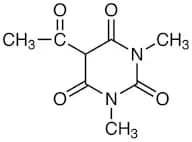
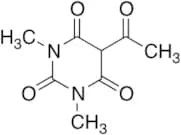
5-Acetyl-1,3-dimethylbarbituric Acid
CAS:Formula:C8H10N2O4Purity:>98.0%(GC)(T)Color and Shape:White to Light yellow powder to crystallineMolecular weight:198.181,3-Dimethylbarbituric Acid
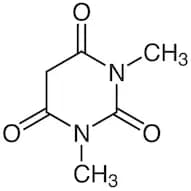
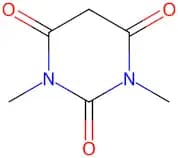
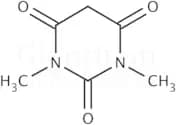
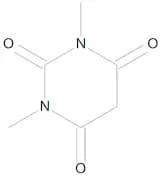
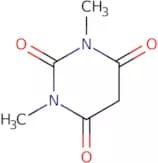
CAS:Formula:C6H8N2O3Purity:>98.0%(GC)(T)Color and Shape:White to Light yellow to Light orange powder to crystalMolecular weight:156.141,3-Dimethylbarbituric acid, 99% (dry wt.), water <6%
CAS:1,3-Dimethylbarbituric acid is used as a catalyst in the Knoevenagel condensation of a series of aromatic aldehydes. It is also used in the synthesis of 5-aryl-6-(alkyl- or aryl-amino)-1,3-dimethylfuro [2,3-d]pyrimidine derivatives and enantioselective synthesis of isochromene pyrimidinedione deriva
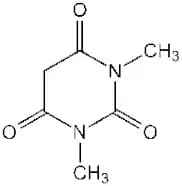
Formula:C6H8N2O3Purity:99%Color and Shape:White to cream or pale yellow, Crystals or powder or crystalline powderMolecular weight:156.141,3-Dimethylbarbituric acid
CAS:Formula:C6H8N2O3Purity:99%Color and Shape:SolidMolecular weight:156.1393Urapidil Impurity 4 (1,3-Dimethylbarbituric Acid)
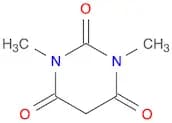
CAS:Formula:C6H8N2O3Color and Shape:White To Off-White SolidMolecular weight:156.141,3-Dimethylbarbituric acid
CAS:Formula:C6H8N2O3Purity:≥ 99.0%Color and Shape:White to off-white crystalline powderMolecular weight:156.142,3,5,6-Tetrafluorophenol
CAS:Formula:C6H2F4OPurity:97%Color and Shape:SolidMolecular weight:166.07311,3-Dimethyl Barbituric Acid
CAS:Controlled ProductApplications 1,3-Dimethyl Barbituric Acid (Urapidil Impurity 4) is a derivative of Barbituric acid (B118650). All of the barbituric acid derivatives which have been reported to have pronounced hypnotic activity are disubstituted in the 5-position.
References Gupta, K., et al.: Eur. J. Med. Chem., 17, 448 (1982), Weber, L., et al.: Curr. Med. Chem., 9, 2085 (2002), Skiles, J., et al.: Curr. Med. Chem., 11, 2911 (2004),Formula:C6H8N2O3Color and Shape:NeatMolecular weight:156.141,3-Dimethyl-2,4,6(1H,3H,5H)-pyrimidinetrione
CAS:Controlled Product1,3-Dimethyl-2,4,6(1H,3H,5H)-pyrimidinetrione is a heterocyclic organic compound, which is synthesized via established chemical procedures involving catalytic methods or direct condensation reactions. This compound is well-known for its role in the biochemical field as a urease inhibitor. Urease, an enzyme that catalyzes the hydrolysis of urea, is targeted by this compound to potentially mitigate issues related to excessive ammonia production in agricultural and medical settings.In addition to its enzymatic inhibition properties, 1,3-Dimethyl-2,4,6(1H,3H,5H)-pyrimidinetrione serves as a pivotal intermediate in barbiturate synthesis. Barbiturates are psychoactive compounds used historically in medicine for their sedative and anesthetic properties. The compound's structure allows it to participate in the Knoevenagel condensation, facilitating the formation of complex molecules essential in pharmaceutical development. These multifunctional applications make it a valuable tool in various scientific research contexts, exploring both inhibitory mechanisms and synthetic pathways for drug discovery and development.Formula:C6H8N2O3Purity:Min. 98 Area-%Color and Shape:PowderMolecular weight:156.14 g/mol5-acetyl-6-hydroxy-1,3-dimethyl-1,2,3,4-tetrahydropyrimidine-2,4-dione
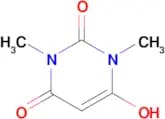
CAS:Controlled ProductApplications 5-acetyl-6-hydroxy-1,3-dimethyl-1,2,3,4-tetrahydropyrimidine-2,4-dione (cas# 58713-03-4) is a useful research chemical.
Formula:C8H10N2O4Color and Shape:NeatMolecular weight:198.18Hexobarbital-D3
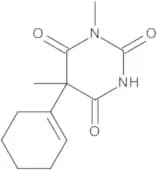
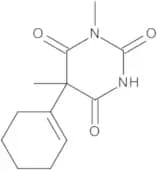
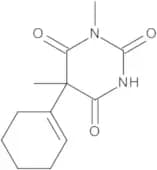
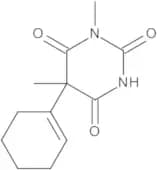
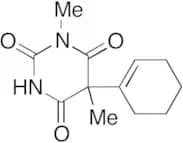
CAS:Controlled ProductApplications Hexobarbital-D3 is a labelled analogue of Hexobarbital (H295350), a barbiturate derivative that exhibits hypnotic and anasthetic effects.
References Laroche, M. & Brodie, B.: J. Pharm. Exp. Ther., 130, 134 (1960); Pira, R. & Lieber, L.: J. Nutr., 105, 1544 (1975)Formula:C12D3H13N2O3Color and Shape:NeatMolecular weight:239.286