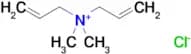
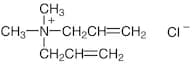
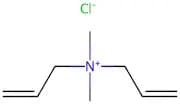
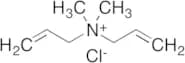
3D-FD180672 - diallyldimethylammonium-chloride
Sorry, no product with reference 3D-FD180672 been found, but please check out the following similar products:
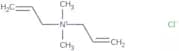
Diallyldimethylammonium chloride
CAS:Formula:C8H16ClNPurity:60%Color and Shape:LiquidMolecular weight:161.6723Diallyldimethylammonium Chloride (60% in Water)
CAS:Formula:C8H16ClNColor and Shape:Colorless to Light yellow to Light orange clear liquidMolecular weight:161.67Diallyldimethylammonium chloride (60% in water)
CAS:Diallyldimethylammonium chloride (60% in water)Purity:60% in waterMolecular weight:161.67g/molDiallyldimethylammonium Chloride (60% w/w in Water)
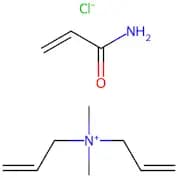
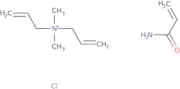
CAS:Controlled ProductFormula:C8H16ClNColor and Shape:Single SolutionMolecular weight:161.67Poly(Acrylamide-Co-Diallyldimethylammonium Chloride) Solution
CAS:Poly(Acrylamide-Co-Diallyldimethylammonium Chloride) SolutionPoly(diallyldimethylammonium chloride) solution, 40% in water
CAS:Poly(diallyldimethylammonium chloride) solution, 40% in water, is an ionic polymer that is used for wastewater treatment. It functions by absorbing water vapor from the air and converting it into a salt solution. Poly(diallyldimethylammonium chloride) has been shown to be stable when exposed to air and heat, as well as when mixed with other chemicals. The polymeric solution can be made using sodium carbonate or sodium citrate as a reactant and particle size can be adjusted by altering the concentration of the reactants. This polymer also reacts with hydroxyl groups on surfaces to form cationic molecules that are soluble in water.Formula:(C8H16ClN)nColor and Shape:Clear LiquidPoly(diallyldimethylammonium chloride),20% aqueous solution
CAS:20% aqueous solutionFormula:C8H16ClNMolecular weight:161.67 g/molN,N-Dimethyl-N-2-Propenyl-2-Propen-1-Aminiumchloridehomopolymer
CAS:N,N-Dimethyl-N-2-Propenyl-2-Propen-1-AminiumchloridehomopolymerPurity:20 wt. % in water,800-1000 cP(25 ℃),PH:3-7N,N-Dimethyl-N-2-Propenyl-2-Propen-1-Aminiumchloridehomopolymer
CAS:N,N-Dimethyl-N-2-Propenyl-2-Propen-1-AminiumchloridehomopolymerPurity:20 wt.% in water,400-800 cP (25 ℃)N,N-Dimethyl-N-2-Propenyl-2-Propen-1-Aminiumchloridehomopolymer
CAS:N,N-Dimethyl-N-2-Propenyl-2-Propen-1-AminiumchloridehomopolymerPurity:aq.35wt 100-200cpN,N-Dimethyl-N-2-Propenyl-2-Propen-1-Aminiumchloridehomopolymer
CAS:N,N-Dimethyl-N-2-Propenyl-2-Propen-1-AminiumchloridehomopolymerPurity:Mw 200,000-350,000 ,20 wt. % in water,250-500 cP(2PolyQuaternium-7 - 10% aqueous solution, tech.
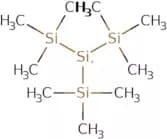
CAS:PolyQuaternium-7 - 10% aqueous solution is a conditioning agent that is used in the production of textile products. It has a high degree of compatibility with cellulose derivatives, such as cotton and wool, but is incompatible with polyester. The most important factor influencing the transport properties of PolyQuaternium-7 - 10% aqueous solution is its particle size. In order to reduce the particle size, it must be dissolved in water and then precipitated by addition of ethanol or other solvents. PolyQuaternium-7 - 10% aqueous solution can also react with ethylene diamine to form cross-links between chains. This process involves condensation and hydrolysis reactions that produce amines and water as byproducts.Color and Shape:Colorless Clear LiquidTris(trimethylsilyl)silane
CAS:Tris(trimethylsilyl)silane is a reactive functional group that is used in the synthesis of monoclonal antibodies. It reacts with halides to form an intermediate, which then undergoes chain reactions with other molecules to form the final product. Tris(trimethylsilyl)silane can be used for cancer therapy and for the detection of antibodies. It has been shown that tris(trimethylsilyl)silane will react with a light emitting compound (e.g., 4-dimethylaminopyridine) and a cationic polymerization initiator (e.g., diallyldimethylammonium chloride). This reaction produces high values of light emission, which can be detected by x-ray crystal structures.
Formula:C9H28Si4Purity:Min. 97 Area-%Color and Shape:Clear LiquidMolecular weight:248.66 g/mol