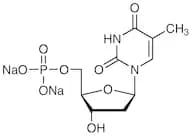
3D-NT32262 - thymidine-5-monophosphate | 365-07-1
Sorry, no product with reference 3D-NT32262 been found, but please check out the following similar products:
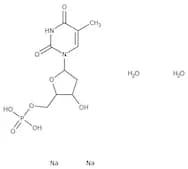
Thymidine 5'-Monophosphate Disodium Salt
CAS:Formula:C10H13N2Na2O8PPurity:>98.0%(HPLC)Color and Shape:White to Almost white powder to crystalMolecular weight:366.17Thymidine 5′-monophosphate p-nitrophenyl ester (sodium)
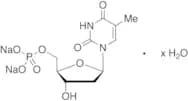
CAS:<p>Thymidine 5′-monophosphate p-nitrophenyl ester (sodium)</p>Purity:98%Thymidine 5''-monophosphate disodium salt hydrate
CAS:Formula:C10H13N2Na2O8P·xH2OPurity:≥ 99.0% (anhydrous basis)Color and Shape:White or almost white powderMolecular weight:366.18 (anhydrous)Thymidine 5'-Monophosphate Disodium Salt Hydrate
CAS:Controlled Product<p>Stability Hygrosopic<br>Applications A nucleoside monophosphate derived from phosphorylation of Thymidine (T412000). It is converted to Thymidine diphosphate by Thymidylate kinase (TMPK), a nucleoside monophosphate kinase. A constituent of Deoxyribonucleic Acid.<br>References Van de Vorst, A. et al.: Biochim. Biophys. Acta Nucleic Acids Protein Synth., 238, 417 (1971);<br></p>Formula:C10H13N2Na2O8P•xH2OColor and Shape:NeatMolecular weight:366.17Thymidine 5'- triphosphate-3'-monophosphate
CAS:<p>Thymidine 5'-triphosphate-3'-monophosphate is a nucleoside that is used in the synthesis of DNA. It is an activator of anticancer drugs, and has been shown to have antiviral properties. Thymidine 5'-triphosphate-3'-monophosphate can be used for the treatment of viral diseases such as herpes simplex virus type 1 (HSV-1), herpes simplex virus type 2 (HSV-2), cytomegalovirus (CMV), and human immunodeficiency virus (HIV) infection. This nucleoside also plays a role in the prevention of tumor growth and metastasis because it inhibits DNA synthesis.</p>Formula:C10H18N2O17P4Purity:Min. 95%Molecular weight:562.15 g/molThymidine 3':5'-cyclic monophosphate sodium
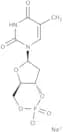
CAS:<p>Please enquire for more information about Thymidine 3':5'-cyclic monophosphate sodium including the price, delivery time and more detailed product information at the technical inquiry form on this page</p>Formula:C10H13N2O7P•NaPurity:Min. 95%Molecular weight:327.18 g/mol2',3'-Didehydro-3'-dideoxy-thymidine-5'-monophosphate, lithium salt
<p>2',3'-Didehydro-3'-dideoxy-thymidine-5'-monophosphate, lithium salt is a novel antiviral nucleoside analog that inhibits the synthesis of DNA. The drug is currently being studied to treat herpes simplex virus infections. It has been shown to inhibit viral replication in vitro and in vivo, and to induce reactivation of latent virus. 2',3'-Didehydro-3'-dideoxy-thymidine-5'-monophosphate, lithium salt also has anticancer activity by inhibiting DNA synthesis and inducing apoptosis via activation of the caspase cascade.<br>2',3'-Didehydro-3'-dideoxy-thymidine-5'-monophosphate, lithium salt is a modified nucleoside analog that is synthesized from 3’,5’-O-(1H-tetrazole)-2’,4’,6</p>Purity:Min. 95%L-Thymidine-5'-monophosphate sodium salt
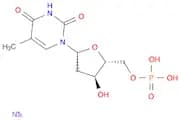
<p>L-Thymidine-5'-monophosphate sodium salt is a synthetic nucleoside that is used as an antiviral agent. L-Thymidine-5'-monophosphate sodium salt has been shown to have high antiviral activity in vitro against human herpesvirus type 1, and in vivo against foot-and-mouth disease virus. The drug also inhibits the synthesis of DNA and RNA by inhibiting the enzyme ribonucleotide reductase. L-Thymidine-5'-monophosphate sodium salt acts as a phosphate donor for the phosphoramidite method of oligonucleotide synthesis. This novel nucleoside can be used in anticancer therapy due to its ability to inhibit DNA synthesis.</p>Purity:Min. 95%Thymidine 5′-monophosphate p-nitrophenyl ester sodium
CAS:<p>Thymidine 5′-monophosphate p-nitrophenyl ester sodium is a fluorogenic substrate that is used in food testing and environmental testing. It is an important component of the Ligand Assay, a diagnostic test for the detection of antibodies to HIV. Thymidine 5′-monophosphate p-nitrophenyl ester sodium has been shown to be a good substrate for use in enzyme assays, such as DNA polymerase, DNA ligase, and RNA polymerase. This product is also used in bioluminescence and chemiluminescence reactions.</p>Formula:C16H18N3O10P•NaPurity:Min. 95%Molecular weight:466.29 g/molThymidine-5'-monophosphate disodium salt
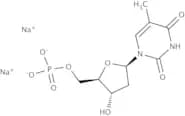
CAS:<p>Thymidine-5'-monophosphate disodium salt is a nucleoside monophosphate used to prepare thymidine diphosphate by thymidylate kinase (TMPK) which is a nucleoside monophosphate kinase. In addition to this, it serves as a constituent of deoxyribonucleic acid. This Thermo Scientific Chemicals brand produ</p>Formula:C10H13N2Na2O8PColor and Shape:Powder, WhiteMolecular weight:366.17Ref: IN-DA001P75
5g22.00€10g26.00€1kg172.00€25g26.00€50g28.00€5kgTo inquire100g43.00€10kgTo inquire25kgTo inquire500g112.00€5'-Thymidylic acid, disodium salt
CAS:Formula:C10H13N2Na2O8PPurity:98%Color and Shape:SolidMolecular weight:366.17213'-Azido-3'-deoxythymidine 5'-monophosphate sodium salt
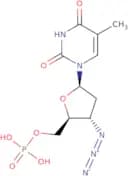
CAS:<p>3'-Azido-3'-deoxythymidine 5'-monophosphate sodium salt is a synthetic nucleoside that is structurally related to thymidine. It has antiviral and anticancer properties, as well as the potential for use in gene therapy. 3'-Azido-3'-deoxythymidine 5'-monophosphate sodium salt is active against herpes simplex virus type 1 (HSV-1) and HSV-2, human immunodeficiency virus type 1 (HIV-1), human papillomavirus types 16 and 18 (HPV), Epstein Barr Virus (EBV), and cytomegalovirus (CMV). 3'-Azido-3'-deoxythymidine 5'-monophosphate sodium salt inhibits the production of HIV by preventing the viral reverse transcriptase from synthesizing DNA from RNA.</p>Formula:C10H13N5NaO7PPurity:Min. 95%Molecular weight:369.23 g/mol3’-Deoxy-3’-fluorothymidine-5’-monophosphate-d3 Disodium Salt
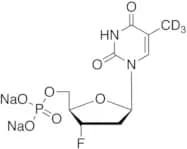
CAS:Controlled ProductFormula:C10D3H9FN2Na2O7PColor and Shape:NeatMolecular weight:371.182Capecitabine-d11
CAS:<p>Capecitabine-d11 is a deuterated compound of Capecitabine. Capecitabine has a CAS number of 154361-50-9. Capecitabine is a fluoropyrimidine carbamate belonging to the class of antineoplastic agents called antimetabolites. As a prodrug, capecitabine is selectively activated by tumor cells to its cytotoxic moiety, 5-fluorouracil (5-FU); subsequently, 5-FU is metabolized to two active metabolites, 5-fluoro-2-deoxyuridine monophosphate (FdUMP) and 5-fluorouridine triphosphate (FUTP) by both tumor cells and normal cells. FdUMP inhibits DNA synthesis and cell division by reducing normal thymidine production, while FUTP inhibits RNA and protein synthesis by competing with uridine triphosphate for incorporation into the RNA strand.</p>Formula:C15H11D11FN3O6Color and Shape:SolidMolecular weight:370.42Thymidine 5’-Diphosphate Sodium Salt (~90%)
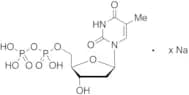
CAS:<p>Stability Hygroscopic<br>Applications Thymidine 5’-Diphosphate Sodium Salt is a nucleoside diphosphate derived from phosphorylation of Thymidine (T412000). It is produced from Thymidine monophosphate by Thymidylate kinase (TMPK), a nucleoside monophosphate kinase and can be futher phosphorylated to its active triphosphate antiviral or antitumor moieties. A proximate precursor for DNA synthesis.<br>References Baumann, E.A. et al.: Biochim. Biphys. Acta Nucleic Acid Protein Synth., 565, 107 (1979); Kohler, J.J. et al.: Lab. Invest., 90, 383 (2010);<br></p>Formula:C10H15N2O11P2·NaPurity:~90%Color and Shape:NeatMolecular weight:424.175-Aminoimidazole-4-carboxamide HCl
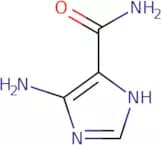
CAS:<p>5-Aminoimidazole-4-carboxamide HCl (5-AICA) is a compound that is used for the treatment of bowel disease. It inhibits the synthesis of 5'-nucleotidase and phosphoribosyl transferase, which are enzymes responsible for the conversion of nucleotide monophosphates to nucleotide diphosphates. This inhibition leads to a decrease in the amount of adenosine triphosphate (ATP) produced by cells, which may be due to its ability to inhibit ATP synthase activity. 5-AICA also has been shown to bind to DNA and inhibit transcriptional activities. The binding of 5-AICA may be due to its ability to form hydrogen bonds with guanine residues in DNA or its capability to form covalent bonds with thymidine residues in DNA. 5-AICA also has been shown to have cytotoxic effects on HL60 cells, as well as other</p>Purity:Min. 95%Color and Shape:PowderMolecular weight:126.12 g/mol5-(2-Azidoethyl)uridine
CAS:<p>5-(2-Azidoethyl)uridine is a nucleoside that has antiviral activity. It inhibits the replication of DNA and RNA by binding to the active site of the enzyme thymidine kinase, which is involved in DNA synthesis. 5-(2-Azidoethyl)uridine also has anticancer activity and can be used as an alternative to cytotoxic agents such as 5-fluorouracil. This drug also acts as a deoxyribonucleoside monophosphate (dNMP), which may have applications in pharmaceutical research.</p>Purity:Min. 95%