


- Pharmaceutical Standards
- Natural Products and Phytochemicals by Botanical Origin
- Phytochemicals
- APIs for research and impurities
- Pharmaceutical and Veterinary Compounds and Metabolites
- Sodium Channel
- Chiral Organic Compounds
- Toxicology
Product Information
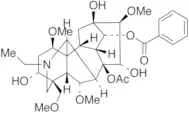
- Aconitane-3,8,13,14,15-pentol
- 20-ethyl-1,6,16-trimethoxy-4-(methoxymethyl)-
- 8-acetate 14-benzoate
- (1α,3α,6α,14α,15α,16β)-
- 2H-12,3,6a-Ethanylylidene-7,9-methanonaphth[2,3-b]azocine-4,8,9,11,11a(1H,7H)-pentol
- 1-ethyldecahydro-6,10,13-trimethoxy-3-(methoxymethyl)-
- 11a-acetate 8-benzoate (7CI)
- Aconitine (8CI)
- 2H-12,3,6a-Ethanylylidene-7,9-methanonaphth[2,3-b]azocine
- aconitane-3,8,13,14,15-pentol deriv.
- (1α,3α,6α,14α,15α,16β)-20-Ethyl-1,6,16-trimethoxy-4-(methoxymethyl)aconitane-3,8,13,14,15-pentol 8-acetate 14-benzoate
Applications Neurotoxin. Activates tetrodotoxin-sensitive Na+ channels, inducing presynaptic depolarization, thus blocking the nerve action potential which, in turn, blocks the release of neurotransmitters and decreases the end plate potential at the neuromuscular junction. Aconitine also blocks norepinephrine reuptake. In the heart, aconitine induces ventricular tachycardia after intracoronary injection. In cultured ventricular myocytes, aconitine increases the duration of the action potential and induces the appearance of early after depolarization.Used in producing heart arrhythmia in experimental animals.
Not a dangerous good if item is equal to or less than 1g/ml and there is less than 100g/ml in the package
References Derbre, S., et al.: Anal. Bioanal. Chem., 398, 1747 (2010), Li, M., et al.: J. Pharm. Biomed. Anal., 53, 1063 (2010),
Chemical properties
Technical inquiry about: Aconitine
Please use instead the cart to request a quotation or an order