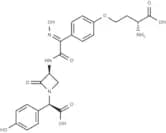
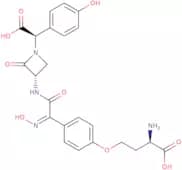
TR-N634012 - nocardicin-b-15nd2 | 1356847-49-8
Sorry, no product with reference TR-N634012 been found, but please check out the following similar products:
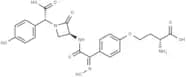
Nocardicin A
CAS:Nocardicin A, a moderate antibiotic agent, shows inhibitory for a wild spectrum of gram-negative bacteria.Formula:C23H24N4O9Purity:98%Color and Shape:SolidMolecular weight:500.46Nocardicin G
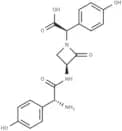
CAS:Nocardicin G is a universal precursor of nocardicins.Formula:C19H19N3O6Color and Shape:SolidMolecular weight:385.37Nocardicin E
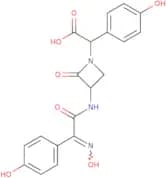
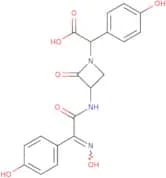
CAS:Nocardicin E is a β-lactam antibiotic, which is produced by the actinomycetes of the genus Nocardia. This antibiotic functions by inhibiting the biosynthesis of bacterial cell walls, specifically targeting the transpeptidation step in peptidoglycan synthesis, crucial for bacterial structural integrity. The compound acts as an irreversible inhibitor of the bacterial enzyme D-alanyl-D-alanine carboxypeptidase, contributing to its antibacterial efficacy, particularly against Gram-positive organisms. The mode of action interferes with the normal cross-linking of peptidoglycan layers, leading to cell lysis and death.Formula:C19H17N3O7Purity:Min. 95%Molecular weight:399.4 g/molNocardicin F
CAS:<p>Nocardicin F is a beta-lactam antibiotic, which is derived from various actinomycetes strains. As an antimicrobial compound, its mode of action involves the inhibition of bacterial cell wall synthesis. Specifically, Nocardicin F interferes with the transpeptidation reaction, which is crucial for the cross-linking of peptidoglycan layers. This inhibition leads to a weakened bacterial cell wall, culminating in lysis and cell death, particularly affecting gram-negative bacteria.</p>Formula:C19H17N3O7Purity:Min. 95%Molecular weight:399.4 g/molNocardicin G
CAS:<p>Nocardicin G is a monocyclic β-lactam antibiotic, which is sourced from certain strains of the soil-dwelling actinobacterium *Nocardia*. This organism is known for its ability to synthesize various bioactive compounds. The mode of action of Nocardicin G involves inhibiting bacterial cell wall synthesis by targeting penicillin-binding proteins, resulting in the bactericidal effect against susceptible bacterial strains. This compound specifically disrupts the formation of the peptidoglycan layer, which is essential for bacterial integrity and survival.</p>Formula:C19H19N3O6Purity:Min. 95%Molecular weight:385.4 g/molNocardicin B
CAS:Nocardicin B was originally isolated from Nocardia uniformis subsp. tsugamanensis [ATCC 21806], showing weak antibacterial activity against Proteus and Corynebacterium species.Formula:C23H24N4O9Color and Shape:SolidMolecular weight:500.46Nocardicin A
Nocardicin A is a peptide antibiotic that binds to the penicillin-binding protein on the surface of the bacterial cell wall. It has been shown to cause cell lysis in Gram-positive bacteria, such as Staphylococcus species. Nocardicin A also has potent antimicrobial activity against Gram-negative bacteria, such as Escherichia coli. This antibiotic has been used to treat infectious diseases, such as tularemia and brucellosis. Nocardicin A is an antimicrobial peptide that belongs to the group of cationic host defense peptides (HDP). These small proteins have high affinity for negatively charged membranes and can disrupt bacterial membranes by forming pores or by acting as surfactants. The antimicrobial activity of nocardicin A is due to its ability to form hydrogen bonds with water molecules and other hydrophobic compounds in the membrane bilayer.Formula:C23H24N4O9Purity:Min. 95%Molecular weight:500.46 g/molNocardicin B
Nocardicin B is a bacterial protein that has been shown to inhibit the synthesis of proteins in wild-type and mutant strains of bacteria. It binds to peptides on the surface of cells by forming hydrogen bonds with them. This binding prevents the peptides from being used as substrates for protein synthesis, resulting in cell lysis. Nocardicin B is also active against penicillin-binding proteins found in bacterial cell walls, which are essential for cell division.Formula:C23H24N4O9Purity:Min. 95%Molecular weight:500.46 g/molNocardicin D
Nocardicin D is a synthetic antimicrobial that belongs to the class of monobactams. It is active against aerobic bacteria and has been shown to have an inhibitory effect on bacterial growth. Nocardicin D has been shown to be active against a number of Gram-positive and Gram-negative bacteria, including Enterococcus faecalis, Staphylococcus aureus, Pseudomonas aeruginosa, Klebsiella pneumoniae, Escherichia coli, Salmonella enterica serovar Typhimurium, and Mycoplasma pneumoniae. Nocardicin D also inhibits the growth of Streptococcus pyogenes. The compound is not active against anaerobic bacteria or fungi.Formula:C23H23N3O9Purity:Min. 95%Molecular weight:485.44 g/molIsocyanodiphenylmethane
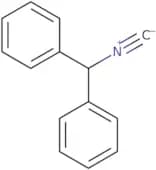
Isocyanodiphenylmethane is a natural product with a chemical diversity. It has been found to have pharmaceutical preparations, high yield and is an isocyanide. Isocyanodiphenylmethane can be used as a molecule for the synthesis of β-lactams, which are molecules that inhibit bacterial growth by inhibiting cell wall biosynthesis. This compound also has modulated effects on dyslipidemia and yields of benzyl and nocardicin.Formula:C14H11NPurity:Min. 95%Molecular weight:193.25 g/mol