Microbiologia/Virologia
Os inibidores de microbiologia e virologia são compostos que têm como alvo microrganismos, incluindo bactérias, vírus e fungos, interrompendo seu crescimento, replicação ou sobrevivência. Esses inibidores são essenciais para estudar a patogênese microbiana, entender os mecanismos de resistência e desenvolver novas terapias antimicrobianas e antivirais. Os inibidores nessa categoria são usados para combater doenças infecciosas, explorar a ecologia microbiana e investigar as interações hospedeiro-patógeno. Na CymitQuimica, oferecemos uma ampla seleção de inibidores de alta qualidade para microbiologia e virologia para apoiar sua pesquisa em doenças infecciosas, microbiologia e virologia.
Subcategorias de "Microbiologia/Virologia"
- Antibacteriano(2.968 produtos)
- Antibiótico(922 produtos)
- Antifecção(23 produtos)
- DHFR(33 produtos)
- Síntese de DNA/RNA(711 produtos)
- HBV(177 produtos)
- HIV Protease(451 produtos)
- HSV(91 produtos)
- Integrase(2 produtos)
- Ribossomo(13 produtos)
Exibir 2 mais subcategorias
Foram encontrados 5863 produtos de "Microbiologia/Virologia"
Ordenar por
Pureza (%)
0
100
|
0
|
50
|
90
|
95
|
100
Salivaricin B
CAS:Salivaricin B is a broad-spectrum bacteriocin produced by Lactobacillus M7, capable of inhibiting the growth of Listeria monocytogenes, Bacillus cereus, Brochothrix thermosphacta, Enterococcus faecalis, and various Lactobacilli.Fórmula:C120H182N34O36S4Cor e Forma:SolidPeso molecular:2805.2Saptomycin D
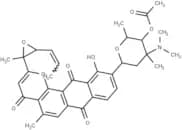
CAS:<p>Saptomycin D, an antibiotic (antibiotic) isolated from the Streptomyces sp. HP530 strain, exhibits potent antitumor activity. It demonstrates strong inhibitory effects on Gram-positive bacteria and weaker inhibition against certain Gram-negative bacteria and yeasts. Additionally, Saptomycin D shows significant antitumor properties that make it a candidate for research in cancer therapy.</p>Fórmula:C35H37NO9Cor e Forma:SolidPeso molecular:615.67Neamine tetrahydrochloride
CAS:<p>Neamine tetrahydrochloride has antimicrobial and neuroprotective activities and inhibits the growth of pancreatic cancer cells.</p>Fórmula:C12H30Cl4N4O6Pureza:98.98% - 99.09%Cor e Forma:SolidPeso molecular:468.23-Deoxyaphidicolin
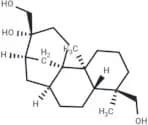
CAS:<p>3-Deoxyaphidicolin is a phytotoxin that inhibits root growth in lettuce seedlings. Additionally, 3-Deoxyaphidicolin exhibits inhibitory activity against the protozoan parasites Leishmania major and Leishmania braziliensis.</p>Fórmula:C20H34O3Cor e Forma:SolidPeso molecular:322.48HYNIC-UBI29-41
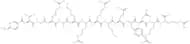
CAS:<p>HYNIC-UBI29-41 is composed of the bifunctional chelator HYNIC and the antimicrobial peptide UBI 29-41. It retains the antimicrobial properties of UBI 29-41, showing strong affinity for both Gram-positive and Gram-negative bacteria. When labeled with the radioactive element Technetium (99mTc), HYNIC-UBI29-41 can be used as an imaging agent for detecting bacterial infections in mouse models.</p>Fórmula:C74H126N34O19SCor e Forma:SolidPeso molecular:1828.07SARS-CoV-2 Mpro-IN-43
<p>SARS-CoV-2 Mpro-IN-43 (Compound 1) is an inhibitor of the coronavirus main protease (Mpro) with an IC50 of 72 μM. It exerts its antiviral effects by interacting non-covalently with the key residues at the Mpro active site. This compound exhibits moderate to low cytotoxicity with CC50 values of 13.24, 41.02, and 42.26 µM in HaCaT, HEK293T, and HepG2 cells, respectively. SARS-CoV-2 Mpro-IN-43 is applicable for SARS-CoV-2 research.</p>Fórmula:C32H41F3N2O4S2Cor e Forma:SolidPeso molecular:638.24598Biotin protein ligase-IN-1
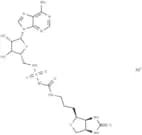
<p>Biotin protein ligase-IN-1 (Compound Bio-9) is an inhibitor of biotin protein ligase (BPL) with a Kd of 7 nM. This compound exhibits antimicrobial activity, with minimum inhibitory concentration (MIC) values of 0.2 μM against Staphylococcus aureus (including MRSA and MSSA) and 20 μM against Mycobacterium tuberculosis.</p>Fórmula:C19H27N10NaO7S2Cor e Forma:SolidPeso molecular:594.65-Nitrobarbituric acid
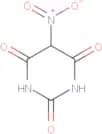
CAS:<p>Compound 480-68-2, with CAS No. 480-68-2, is a fragment molecule that serves as an important scaffold for molecular linking, expansion, and modification. Compound 480-68-2 provides a structural basis and research tool for the design and screening of novel drug candidates, and is commonly used in drug discovery, drug synthesis, and related research.</p>Fórmula:C4H3N3O5Pureza:>99.99%Cor e Forma:SolidPeso molecular:173.084Anhydrotetracycline hydrochloride
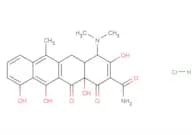
CAS:<p>Anhydrotetracycline (hydrochloride) is a potent competitive inhibitor of broad-spectrum tetracycline destructase enzymes.</p>Fórmula:C22H23ClN2O7Pureza:98.90%Cor e Forma:SolidPeso molecular:462.88MC-VC-PAB-O-Gemcitabine
CAS:<p>MC-VC-PAB-O-Gemcitabine is a linker-antibiotic intermediate that forms part of the antibody-antibiotic conjugate (AAC) molecule. It is synthesized by conjugating the linker with the antibiotic Gemcitabine. This compound is useful in studying the immunotherapy of bacterial infections and developing novel antibacterial drugs.</p>Fórmula:C38H49F2N9O12Cor e Forma:SolidPeso molecular:861.85Neoabietic acid
CAS:<p>Neoabietic acid, from Pinus palustris resin, is acid-sensitive and has antibacterial properties.</p>Fórmula:C20H30O2Cor e Forma:SolidPeso molecular:302.458Clindamycin palmitate hydrochloride
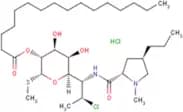
CAS:Clindamycin palmitate hydrochloride (Clindamycin palmitate HCl) is the hydrochloride salt of clindamycin and palmitate, a lincosamide antibiotic.Fórmula:C34H63ClN2O6S·HClPureza:98%Cor e Forma:SolidPeso molecular:699.85Morantel tartrate
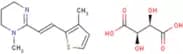
CAS:Morantel tartrate (CP-12009-18 tartrate) is an antinematodal agent used mainly for livestock.Fórmula:C16H22N2O6SPureza:98.08%Cor e Forma:White Or Pale Yellow Crystalline PowderPeso molecular:370.42(S)-Dinotefuran
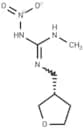
CAS:<p>(S)-Dinotefuran, a neonicotinoid, more toxic to bees than its R-isomer, targets α8 nAChR.</p>Fórmula:C7H14N4O3Cor e Forma:SolidPeso molecular:202.21BRD1401
<p>BRD1401 is a small molecule that targets the outer membrane protein OprH. It disrupts the interaction between OprH and LPS and can increase membrane fluidity.</p>Fórmula:C17H17N5O3Peso molecular:339.13314Antibacterial agent 220
<p>Antibacterialagent 220 is a potent antibacterial compound that directly disrupts bacterial cell membranes. It is effective against both Gram-positive and Gram-negative bacteria, including resistant strains.</p>Fórmula:C37H54N8O8SPeso molecular:770.37853Protorubradirin
CAS:<p>Protorubradirin is an antibiotic that can be isolated from the non-pigmented Streptomyces achromogenes var. rubradiris alongside Rubradirin. It exhibits inhibitory activity against HIV reverse transcriptase. In vitro studies show that Protorubradirin also inhibits strains of Staphylococcus aureus and Streptococcus. In infected mice, subcutaneous administration of Protorubradirin demonstrates in vivo efficacy against antibiotic-resistant Staphylococcus aureus strains. However, oral administration may significantly reduce its activity compared to Rubradirin, possibly due to its C-nitroso sugar decomposing more rapidly in acidic gastric conditions.</p>Fórmula:C48H46N4O19Peso molecular:982.89Chalcomycin
CAS:Chalcomycin is a macrolide antibiotic effective against Gram-positive Staphylococcus aureus and Streptococcus pyogenes. It protects mice from infections caused by various Staphylococcus and Streptococcus strains and exhibits no significant toxicity (LD50>2500 mg/kg).Fórmula:C35H56O14Peso molecular:700.36701DOTA-ubiquicidin (29-41)
<p>DOTA-ubiquicidin (29-41) is a derivative of an antimicrobial peptide fragment employed for synthesizing [68Ga]Ga-DOTA-Ubiquicidin29-41, which is subsequently utilized in PET/CT imaging of infection processes. Additionally, DOTA-ubiquicidin (29-41) is applicable in the synthesis and research of radiopharmaceuticals known as radionuclide conjugates (RDC).</p>Fórmula:C84H147N35O25SPeso molecular:2078.10281DENV ligand 2
<p>DENV ligand 2 is a ligand for the DENV E protein. It is used in the synthesis of the PROTAC degrader ZXH-8-004 and serves as the active form of DENV ligand 1.</p>Fórmula:C19H12F6N4O4Peso molecular:474.07627