Nucleosídeos
Foram encontrados 3573 produtos de "Nucleosídeos"
5-Methyl-2',3'-stannyluridine
5-Methyl-2',3'-stannyluridine is a nucleoside analog that is a potent inhibitor of viral replication and can be used for the treatment of HIV. It has been shown to inhibit the activity of RNA polymerase, thereby preventing transcription and replication. 5-Methyl-2',3'-stannyluridine also inhibits DNA synthesis by inhibiting the activity of DNA polymerase. This drug also acts as an antitumor agent and has been shown to inhibit tumor growth in animal models. The high purity of this drug makes it suitable for use in pharmaceutical applications.
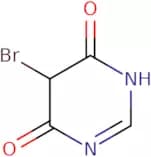
5-Methyl-2',3'-stannyluridine is a modified nucleoside that has been modified with a stannyl group at the 2' position on the sugar moiety and an allyl group at the 3' position on the sugar moiety. The phosphoramidites are synthesized from 5-methyl-2',3'-stannylPureza:Min. 95%5-Bromopyrimidine-4,6(1H,5H)-dione
CAS:5-Bromopyrimidine-4,6(1H,5H)-dione is a novel nucleoside analogue. It can be used as an antiviral agent and an anticancer drug. It inhibits viral DNA replication by competitively binding to the viral DNA polymerase, thereby blocking the incorporation of deoxyribonucleotides into the growing DNA chain. 5-Bromopyrimidine-4,6(1H,5H)-dione also has antitumour activity. It has been shown to inhibit the growth of human cancer cells in vitro and in vivo.
Pureza:Min. 95%2'-Deoxy-2'-fluoro-2'-C-methyl-5-methyluridine
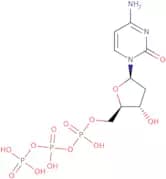
2'-Deoxy-2'-fluoro-2'-C-methyl-5-methyluridine is a modified nucleoside that inhibits the proliferation of cancer cells. It has been shown to be effective against HIV, Hepatitis B and C, influenza, herpes simplex virus type 1 and 2, and human cytomegalovirus. This drug is synthesized by phosphoramidite chemistry and is used as a DNA activator in the synthesis of oligonucleotides. 2'-Deoxy-2'-fluoro-2'-C-methyl-5-methyluridine is a novel compound that exhibits high quality with high purity.Pureza:Min. 95%dCTP - 100mmol solution
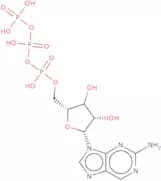
CAS:dCTP is a nucleotide that is an important component of the DNA molecule. It is used in biochemical research and as a drug for treatment of certain cancers. The biochemical properties of dCTP are similar to those of other nucleotides, including ATP and GTP. The main difference is that dCTP has a low solubility in water, while ATP and GTP are soluble in water. This property makes it difficult to study the use of dCTP in biosensors. Another difference is that dCTP does not have a signal peptide sequence, which may be due to its chemical structure or biological function. In addition, dCTP does not interfere with the polymerase chain reaction (PCR) process because it does not possess reactive groups on its phosphate groups.Fórmula:C9H16N3O13P3Pureza:Min. 95%Peso molecular:467.16 g/mol2-Amino-9-(b-D-ribofuranosyl)purine 5'-O-triphosphate - 10mM aq. solution
CAS:2-Amino-9-(b-D-ribofuranosyl)purine 5'-O-triphosphate is a synthetic nucleoside that is modified by phosphoramidite chemistry. This compound is an antiviral agent that inhibits viral DNA synthesis and replication. It has also been shown to have anticancer properties. 2-Amino-9-(b-D-ribofuranosyl)purine 5'-O-triphosphate inhibits the enzymatic activity of the enzyme ribonucleotide reductase, which converts ribonucleotides into deoxyribonucleotides. The resulting monophosphate form of this compound accumulates in cells, which leads to cell death.Fórmula:C10H16N5O13P3Pureza:Min. 95%Cor e Forma:PowderPeso molecular:507.18 g/mol3-Deazauridine-5'-triphosphate sodium salt
3-Deazauridine-5'-triphosphate sodium salt is a modified monophosphate nucleotide analogue. It is an antiviral agent that inhibits the production of viral RNA and DNA, thereby inhibiting the synthesis of viral proteins and the formation of new viruses. 3-Deazauridine-5'-triphosphate sodium salt also has anticancer properties and has been shown to activate transcription from plasmid vectors in vitro. It binds to ribonucleoside triphosphates in the active site, causing it to release pyrophosphate and produce diphosphate as an intermediate product. This means that 3-Deazauridine-5'-triphosphate sodium salt can inhibit both DNA polymerase and RNA polymerase, which are enzymes needed for replication of both DNA and RNA.Fórmula:C10H16NO15P3·xNaPureza:Min. 95%Cor e Forma:PowderPeso molecular:483.15 g/mol5'-Deoxy-5-fluoro-N-[(2-methylbutoxy)carbonyl]cytidine
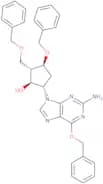
CAS:5'-Deoxy-5-fluoro-N-[(2-methylbutoxy)carbonyl]cytidine is an antiviral drug that has been shown to be a potent inhibitor of HIV-1 replication in cell culture. It is an analog of cytidine, and it binds to the viral reverse transcriptase enzyme via phosphoramidite chemistry. 5'-Deoxy-5-fluoro-N-[(2-methylbutoxy)carbonyl]cytidine is a monophosphate, which inhibits the synthesis of DNA by preventing the incorporation of deoxyribonucleotides in the process. This agent does not have any anticancer activity.Fórmula:C15H22FN3O6Pureza:Min. 95%Peso molecular:359.35 g/mol(1S,2S,3S,5S)-5-(2-Amino-6-(benzyloxy)-9H-purin-9-yl)-3-(benzyloxy)-2-(benzyloxymethyl)cyclopentanol
CAS:(1S,2S,3S,5S)-5-(2-Amino-6-(benzyloxy)-9H-purin-9-yl)-3-(benzyloxy)-2-(benzyloxymethyl)cyclopentanol is a synthetic compound that is used to treat patients with chronic myeloid leukemia. It has been shown to inhibit tyrosine kinase and interacts with the guanine binding site of the purine nucleoside phosphorylase. This drug also inhibits the enzyme (deoxy)ribonucleotide reductase and competes with adenosine for binding to adenosine receptors. The stereoisomers of this drug are active against chronic myeloid leukemia cells. The S enantiomer is more potent than the R enantiomer and exhibits greater selectivity for leukemic cells than healthy cells. It has also been shown to inhibit nitric oxide synthase and may have anti-
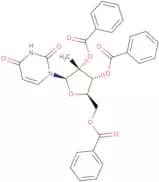
Fórmula:C32H33N5O4Pureza:Min. 95%Cor e Forma:White PowderPeso molecular:551.64 g/mol2',3',5'-Tri-O-benzoyl-2'-C-methyluridine
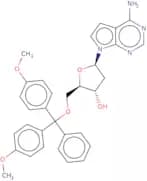
CAS:2',3',5'-Tri-O-benzoyl-2'-C-methyluridine is a modified nucleoside that can be used as an antiviral and anticancer agent. It is synthesized by reacting 2-amino-5-(3,4,5,6-tetrahydropyrimidin-2(1H)-yl)benzoic acid with methyl 2',3',5'-tri-O-benzoylcytidine 5'-monophosphate in the presence of triethylamine. This compound has been shown to inhibit DNA synthesis by inhibiting the activity of DNA polymerase. The modification of the uracil ring with 3,4,5,6 tetrahydropyrimidine (THP) moieties provides additional stability to the molecule and confers antiviral activity.Fórmula:C31H26N2O9Pureza:Min. 95%Peso molecular:570.55 g/mol7-Deaza-2'-deoxy-5'-O-DMT-adenosine
CAS:7-Deaza-2'-deoxy-5'-O-DMT-adenosine is a nucleoside that has been synthesized by reacting 7-deaza-2'-deoxyadenosine with 5,6,7,8-tetrahydro-1H-[1]pyrazolo[3,4]pyrimidin-4(3H)-one. It is a novel anticancer agent that has been shown to inhibit the proliferation of various tumor cells in vitro. The cytotoxic effects of 7-deaza-2'-deoxy-5'-O-DMT adenosine are due to its ability to activate DNA synthesis while inhibiting DNA repair. It also inhibits ribonucleotide reductase and protein synthesis.Fórmula:C32H32N4O5Pureza:Min. 95%Peso molecular:552.62 g/mol2'-O-tert-Butyldimethylsilyl-5'-O-DMT-3-methyluridine 3'-CE phosphoramidite
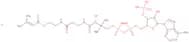
CAS:2'-O-tert-Butyldimethylsilyl-5'-O-DMT-3-methyluridine 3'-CE phosphoramidite is a modified nucleoside that has antiviral and anticancer properties. It is synthesized by the reaction of 2'-O-tert-butyldimethylsilyl-5'-O-DMT (2,6-dimethoxytrityl) with 3 methyluridine. The compound has been shown to be an activator for DNA polymerase, ribonucleases and deoxyribonucleases in vitro. It also inhibits tumor cell proliferation and induces apoptosis in cultured cells. This compound is a high quality product with CAS number 179762-50-6 and is available at high purity.Fórmula:C46H63N4O9PSiPureza:Min. 95%Peso molecular:875.07 g/molb-Methylcrotonyl coenzyme A lithium salt
CAS:b-Methylcrotonyl coenzyme A lithium salt is a phosphoramidite that has antiviral and anticancer properties. It is used as an activator in the synthesis of DNA, as well as a novel deoxyribonucleoside monophosphate. b-Methylcrotonyl coenzyme A lithium salt also has high purity and high quality.Pureza:Min. 95%Pyrimidine-5-carbothioic acid amide
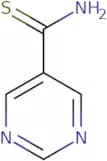
CAS:Pyrimidine-5-carbothioic acid amide (PCA) is an organic compound that contains a pyrimidine ring and a carboxylic acid amide group. PCA forms crystalline solids with the molecular formula C4H10N2O4. The x-ray crystal structure of PCA has been determined, revealing the molecule to have a chair conformation with two hydrogen bonds. The molecule can be considered as stabilized by the base formation between the nitrogen atom in the pyrimidine ring and the oxygen atom in the carboxylic acid amide group. PCA has been used as a building block for other molecules, such as enamines, which are useful for computation studies. PCA is also an intermediate in chemical reactions involving nucleophilic substitution reactions and hydrogen abstraction reactions.Fórmula:C5H5N3SPureza:Min. 95%Peso molecular:139.18 g/mol6-Chloro-N4-methyl-4,5-pyrimidinediamine
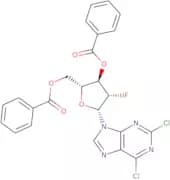
CAS:6-Chloro-N4-methyl-4,5-pyrimidinediamine is a monophosphate nucleotide. It is a synthetic compound that is used as an antiviral agent and as an anticancer drug. The compound has been shown to inhibit the replication of DNA by inhibiting the activity of DNA polymerase. 6-Chloro-N4-methyl-4,5-pyrimidinediamine also inhibits the synthesis of RNA by inhibiting the enzyme RNA polymerase. As a result, this compound is toxic to cells because it prevents protein production and replication. This product has high purity and high quality. It can be used in phosphoramidites, which are necessary for the production of DNA and RNA in cells.Pureza:Min. 95%2,6-Dichloro-9-(3',5'-di-O-benzoyl-2'-deoxy-2'-fluoro-b-D-arabinofuranosyl)purine
CAS:2,6-Dichloro-9-(3',5'-di-O-benzoyl-2'-deoxy-2'-fluoro-b-D-arabinofuranosyl)purine is a nucleoside analog that is a potent activator of the immune system. It is a novel synthetic compound with high purity and high quality. This compound has antiviral effects against HIV and other viruses. It also has anticancer properties, which are thought to be due to its ability to inhibit DNA synthesis in tumor cells.Fórmula:C24H17CI2FN4O5Pureza:Min. 95%Peso molecular:531.33 g/mol2'-Methyl-adenosine-(benzoyl)-succinyl-CPG; 500 Å (RNA)
2'-Methyl-adenosine-(benzoyl)-succinyl-CPG; 500 Å (RNA) is a nucleic acid that is used to synthesize DNA. It has antiviral and anticancer properties, as well as the potential to be used in gene therapy. 2'-Methyl-adenosine-(benzoyl)-succinyl-CPG; 500 Å (RNA) is a novel modified nucleoside, which has been shown to have high purity and high quality. It has been registered with the Chemical Abstract Service (CAS No.).Pureza:Min. 95%2-Bromoadenosine
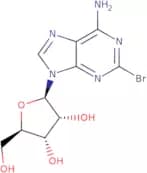
CAS:2-Bromoadenosine is a nucleoside that is structurally similar to adenosine. It has shown to have high resistance against blood pressure and l1210 cells. 2-Bromoadenosine also inhibits kinase activities in microns and spontaneous cell cultures, as well as chemical diversity. This drug has been shown to have high values in neurotransmission, carbonic anhydrase, cardiac muscle, and RNA synthesis. 2-Bromoadenosine blocks the receptor of adenine nucleotides, which causes cell death by inhibiting the production of adenosine. This product may be used for the treatment of cardiac disease or cancer.
Fórmula:C10H12BrN5O4Pureza:Min. 95%Cor e Forma:PowderPeso molecular:346.14 g/mol2'-Methyl-adenosine-(Bz)-succinyl-CPG; 500 Å (RNA)
2'-Methyl-adenosine-(Bz)-succinyl-CPG; 500 Å (RNA) is a synthetic nucleotide that has antiviral and anticancer properties. It is a novel nucleotide with the phosphate group at the 2' position of the ribose sugar, which can be phosphorylated to form monophosphate or diphosphate. This product is highly purified and has been shown to have antiviral activity against HIV and anticancer activities in vitro.Pureza:Min. 95%3'-Deoxy-3'-N-MMT-thymidine 5'-CE phosphoramidite
3'-Deoxy-3'-N-MMT-thymidine 5'-CE phosphoramidite is a modified nucleoside. It is used as an activator in the synthesis of DNA and RNA.Pureza:Min. 95%






![5'-Deoxy-5-fluoro-N-[(2-methylbutoxy)carbonyl]cytidine](/_next/image/?url=https%3A%2Fstatic.cymitquimica.com%2Fproducts%2F3D%2Fthumb-webp%2FND16526.webp&w=3840&q=75)