Polissacáridos
Foram encontrados 506 produtos de "Polissacáridos"
Dextran 40 - MW 35,000 to 45,000
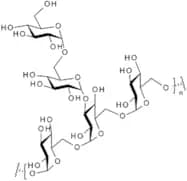
CAS:Dextran is α-(1,6)-linked α-D-glucan with α-(1,3)-linked glucose branch points produced by fermentation of Leuconostoc mesenteroides via the action of the enzyme dextransucrase on sucrose. The main use for native dextran is as an extender in blood transfusions and products having a range of sharp cutoff molecular weights are produced commercially for this and other applications. A complex of iron with dextran, known as iron dextran, is used as a source of iron for baby piglets which are often anaemic at birth.
Pureza:Min. 95%Cor e Forma:White PowderLocust bean gum
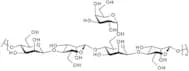
CAS:Locust bean (carob) gum is the refined endosperm of the seed of the carob tree, an evergreen of the legume family (Ceretonia siliqua). The tree grows extensively in Spain and is cultivated in many other Mediterranean countries. Locust bean gum, like guar gum, is a galactomannan with a backbone of (1,4) β-D-mannopyranosyl units having branches of (1,6)-linked α-D-galactopyranosyl units. However, locust bean gum has substantially fewer side chains than guar gum and these are clustered in blocks leaving longer regions of unsubstituted mannosyl regions. The gum is only partially soluble in water and suspensions require heating before solubility is achieved. As with guar, the polysaccharide forms gels with other gums such as carrageenan and xanthan. Applications are in the food industry to enhance texture, in paper making and in the textile industry.Pureza:Min. 95%Cor e Forma:Off-White PowderChitosan - Molecular weight 310,000-375,000
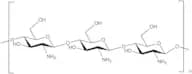
CAS:Chitosan is the deacetylated form of chitin. The polysaccharide is deacetylated in order to render it soluble, which is then possible at pH values of less than 7 (normally in dilute acid). This then allows the material to be used in a number of industrial applications as a binder and film former.Cor e Forma:Beige PowderChitosan - Non-animal origin
CAS:Chitosan from fungal cell walls. It is made by treating cell walls of fungi (agaricus bisporus) with sodium hydroxide.Viscosity typically 20-100 mPa.sMushroom OriginMolecular Weight: 13000DaCor e Forma:PowderChitosan
CAS:Chitosan is the deacetylated form of chitin. The polysaccharide is deacetylated in order to render it soluble, which is then possible at pH values of less than 7 (normally in dilute acid). This then allows the material to be used in a number of industrial applications as a binder and film former.
Fórmula:C56H103N9O39Pureza:Min. 95%Cor e Forma:White PowderGuar gum
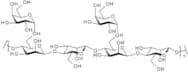
CAS:Guar gum is obtained from the seed of the legume Cyamopsis tetragonolobus, an annual plant that grows mainly in semi-arid regions of India. The structure of the polysaccharide consists of a main chain of (1,4)-linked β-D-mannopyranosyl units with single α-D-galactopyranosyl units linked (1,6) on average to every second main chain unit. Guar has a high viscosity in aqueous solution, shows marked pseudoplastic behaviour and forms synergistic gels in the presence of other gums such as carrageenan and xanthan gum.
Fórmula:C10H14N5Na2O12P3Cor e Forma:White PowderPeso molecular:535.15 g/molChitosan - water soluble
CAS:Chitosan is the deacetylated form of chitin. The polysaccharide is deacetylated in order to render it soluble, which is then possible at pH values of less than 7 (normally in dilute acid). This then allows the material to be used in a number of industrial applications as a binder and film former.MW typically 10-100kDa.Cor e Forma:Off-White PowderChondroitin sulfate C sodium salt
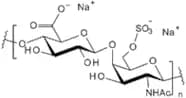
CAS:The disaccharide repeating unit of chondroitin sulphate consists of N-acetyl galactosamine sulphate linked β1,4 to glucuronic acid. Each monosaccharide may be left unsulphated, sulphated once, or sulphated twice. The most common pattern is that the hydroxyl groups of the 4 and 6 positions of the N-acetyl-galactosamine are sulphated, with some chains having the position 2 of the glucuronic acid sulphated. Average molecular weight of 23,000 to 41,000Cor e Forma:White PowderD-Galacto-D-mannan, from carob
CAS:Galactomannan, food additive, fracking fluids, complex formation with XanthanCor e Forma:PowderPropylene glycol alginate
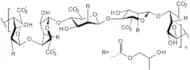
CAS:Propylene glycol alginate is a reaction product of propylene oxide and alginic acid. At the 49th JECFA meeting (1997) it was resolved that the total dietary propylene glycol intake from all sources should be allocated an ADI of 0-25 mg/kg. Applications include as a stabiliser in beer foam due to electrostatic interaction between carboxyl groups on the glycol alginate molecules and amino groups on the peptides in the bubble wall and in ice cream by emulsifying the fat.Esterification is greater then 80%Viscosity (1% aq solution): 200-300 mpa.s
Pureza:Min. 95%Cor e Forma:PowderGlucurono-xylomannan polysaccharide from Tremella fuciformis
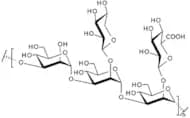
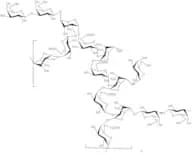
CAS:The polysaccharide, known as glucuronoxylomannan - produced by fruit bodies and in pure culture conditions - has been shown to consist of a mannan backbone that is glycosylated with xylan and glucuronic acid chains in a regular repeating structure. Laboratory tests have associated a number of biological activities with Cryptococcus neoformans glucuronoxylomannan, including immunostimulatory, antidiabetic, anti-inflammatory, hypocholesterolemic, hepatoprotective, and antiallergic effects. The image was kindly provided by Dr. Chris Lawson.Pureza:(%) Min. 60%Cor e Forma:White Off-White PowderCarboxymethyl-dextran sodium salt - Average MW 70,000
CAS:Sodium carboxymethyl dextran is a white, odourless and tasteless powder, which is freely soluble in water or electrolyte solutions. Applications that have been described for carboxymethyl dextran include carriers of paramagnetic contrast agents, preparation of conjugates of pharmacologically active compounds and carboxymethyl dextrans in biosensors. A number of other uses in cosmetics, agriculture, foods, paints and textiles have been the subject of patent applications.Cor e Forma:PowderSodium alginate, low viscosity
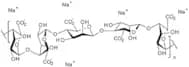
CAS:Sodium salt of a polysaccharide obtained from the brown seaweeds (e.g. Laminaria hyperborea, Fucus vesiculosus, Ascophyllum nodosum). The chemical structure consists of blocks of (1,4) linked-β-D-polymannuronic acid (poly M), (1,4) linked-α-L-polyguluronic acid (poly G) and alternating blocks of the two uronic acids (poly MG). Alginates form strong gels with divalent metal cations and the egg box model has been used to describe this form of gelation. The main use for alginate is in textile printing as a thickener in the printing of cottons with reactive dyes. In the food industry it is used as a thickener and gelling agent. Recently, it has been shown that ternary mixtures of Konjac glucomannan, Xanthan gum and Sodium alginate can form a non-covalently linked complex which exhibits enhanced rheological properties of value in, for example, functional foods. The image was kindly provided by Prof Mike Guiry from Cork who runs ‘The Seaweed Site’.Viscosity: min 50 mPa.sCor e Forma:White Powder(Hydroxypropyl)methyl cellulose - Viscocity 80-120 cP, 2 % in H2O (20 °C)
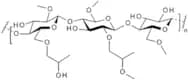
CAS:Hydroxypropyl methylcellulose (HPMC or hypromellose) is a semisynthetic, inert and viscoelastic polymer that is used as eye drops and as semi-synthetic substitute for tear-films. When applied, a hypromellose solution acts to swell and absorb water, by increasing the thickness of the tear-film, resulting in decreased eye irritation. In addition to its use in ophthalmic liquids, hypromellose has been used as an excipient in oral tablet and capsule formulations, where, depending on the grade, it functions as controlled-release agent. It is also used as a binder and as a component of tablet coatings. Hypromellose in aqueous solution, unlike methylcellulose, exhibits thermal gelation properties. HPMC is approved as a food additive, emulsifier, thickening and suspending agent, and as an alternative to animal gelatin (Codex Alimentarius code (E number) is E464).Cor e Forma:White PowderDextran sulfate sodium, MW 50,000
CAS:Dextran sulphate is a dextran derivative whose ulcer (colitis) -causing properties were first reported in hamsters and extrapolated a few years later to mice and rats. The exact mechanisms through which dextran sulphate induces intestinal inflammation are unclear but may be the result of direct damage of the monolayer of epithelial cells in the colon, leading to the crossing of intestinal contents (for e.g. commensal bacteria and their products) into underlying tissue and therefore induction of inflammation. The dextran sulphate sodium induced ulceration model in laboratory animals has some advantages, when compared to other animal models of colitis, due to its simplicity and similarities to human inflammatory bowel disease.Cor e Forma:PowderFucoidan - Pelvetia canaliculata
CAS:A fucan sulphate found in brown marine algae (Phaeophyta-typically Fucus serratus, Ascophyllum nodosum, Pelvitiata canaliculata (illustrated) and Macrocystis pyrifyra) and has been shown to have anticoagulant activity. The main constituents are α-1,4 and α-1,2 linked L-fucose sulphates although galactose also occurs and there are many variations of the basic structure found in different species of Phaeophyta. The image was kindly provided by Prof Mike Guiry from Cork who runs ‘The Seaweed Site’.Pureza:Min. 95%Polymannuronic acid sodium salt - Average MW < 5000 Da
CAS:Polymannuronic acid is produced from alginates by partial hydrolysis and chromatography of brown algae such as Laminaria digitata, Ascophyllum nodosum and Fucus spp. The image was kindly provided by Prof Mike Guiry from Cork who runs ‘The Seaweed Site’.Cor e Forma:PowderRhamnogalacturonan - from Okra
CAS:Rhamnogalacturonan is a natural polysaccharide that is a major component of plant cell walls. It can be synthesized in the laboratory and modified with different functional groups to alter its properties. Rhamnogalacturonan has been shown to have anti-inflammatory, antioxidant, and immunomodulatory activities. It also has the ability to inhibit bacterial growth and stimulate phagocytosis by macrophages. This product has a high purity, is custom synthesized, and can be modified with different functional groups.Pureza:Min. 95%Hydroxypropyl cellulose - Average MW 50,000 - 1250,000
CAS:In water, hydroxypropyl cellulose forms liquid crystals with many mesophases depending on concentration. These mesophases include isotropic, anisotropic, nematic and cholesteric, the latter resulting in many colors such as violet, green and red. Pharmaceutical applications include treatments for medical conditions such as dry eye syndrome (keratoconjunctivitis sicca), recurrent corneal erosions, decreased corneal sensitivity, exposure and neuroparalytic keratitis. It is also used as a binder in tablets. Hydroxypropylcellulose is also used as a thickener, a binder and emulsion stabiliser in foods with E number E463. HPC is used as a support matrix for DNA separations by capillary and microchip electrophoresis.Pureza:Min. 95%Cor e Forma:Clear LiquidInulin - from Jerusalem artichoke
CAS:Inulin is a prebiotic dietary fibre with a mildly sweet taste that promotes digestive health by supporting growth of healthy and balanced microbiota. In diagnostics, inulin is used for determining the glomerular filtration rate in functional kidney testing. Chemically, inulin is a chain of fructose molecules terminated at the reducing end with glucose. Thus, inulin is a fructan consisting of linear chains of β-(2,1) linked fructose residues, terminated at the reducing end by an α-D-(1,2)-glucopyranoside moiety. It has a degree of polymerization typically between 2 and 60 (5). The β-(2,1) bond in inulin resists digestion in the gastrointestinal tract and is therefore responsible for its lower caloric value and beneficial effects on colon microbiota. A more functional form of inulin is produced by removing all fractions with chain lengths lower than 10.Pureza:Min. 95%Cor e Forma:White Powder