Polissacáridos
Foram encontrados 506 produtos de "Polissacáridos"
Methyl cellulose - viscosity ca 15cP
CAS:Methyl cellulose is a water-soluble polymer that is used as a binder or thickener in pharmaceutical, food, and ceramic processing applications. Methylcellulose has an unusual lower critical solution temperature (LCST) between 40 °C and 50 °C. At temperatures below the LCST it is readily soluble in water; above the LCST it is not soluble, which has a paradoxical effect that heating a saturated solution of methylcellulose will turn it solid, because methylcellulose will precipitate out. The temperature at which this occurs depends on DS-value, with higher DS-values giving lower solubility and lower precipitation temperatures because the polar hydroxyl groups are masked.
Cor e Forma:White PowderCarboxymethyl curdlan
CAS:Carboxymethyl curdlan is widely used in the preparation of nanoparticles for biomedical applications. Following the synthesis of superparamagnetic iron oxide nanoparticles (SPIN) capped with carboxymethyl curdlan for use in cellular and in vivo imaging applications, the stability and dispersibility of SPIN in water were greatly improved with the introduction of the carboxymethyl curdlan moiety. Recently, a green and simple route was proposed to synthesize Ag nanoparticles using carboxymethylcurdlan under UV irradiation.
Cor e Forma:PowderRef: 3D-YC46079
Produto descontinuadoKonjac glucomannan
CAS:Konjac glucomannan is an acetylated (1,4)-β-D-glucomannan obtained from the tubers of Amorphophallus konjac or Konnyaku root. It is widely used in foods, pharmaceuticals paints and explosives. It has been shown that ternary mixtures of konjac glucomannan, xanthan gum and sodium alginate can form a non-covalently linked complex which exhibits enhanced rheological properties of value in, for example, functional foods.
Pureza:Min. 75%Cor e Forma:White PowderAmylose
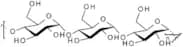
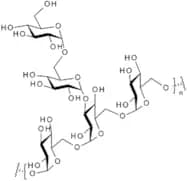
CAS:Starch consists of two polysaccharides, amylose and amylopectin and represents approximately 20-25% of the total polysaccharide content in starch. Amylose molecules consist of single mostly unbranched chains of 500-20,000 α-(1->4)-D-glucose residues dependent on source (e.g. wheat, rice, potato, tapioca, etc). Amylose can form an extended shape (hydrodynamic radius 7-22 nm) but generally tends to wind up into a rather stiff left-handed single helix or form even stiffer parallel left-handed double helical junction zones. Hydrogen bonding between aligned chains causes retrogradation and releases some of the bound water (syneresis). The aligned chains may then form double stranded crystallites that are resistant to amylases. These possess extensive inter- and intra-strand hydrogen bonding, resulting in a fairly hydrophobic structure of low solubility. The amylose content of starches is thus the major cause of resistant starch formation.
Fórmula:(C6H10O5)nCor e Forma:White Off-White PowderLarch arabinogalactan
CAS:Larch arabinogalactan is extracted from the heartwood of the western larch Larix occidentalis. This compound has a backbone of 1,3-linked β-D-galactopyranosyl units each of which contains a side chain at position C-6. Arabinogalactans are used as emulsifiers, stabilizers and binders in the food, pharmaceutical and cosmetic industries, as low viscosity dietary fibres and as a prebiotic fibres.
Pureza:Min. 95%Cor e Forma:Off-White PowderFucoidan, fucus serratus
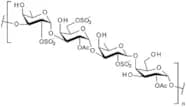
CAS:A fucan sulphate found in brown marine algae (Phaeophyta-typically Fucus serratus, Ascophyllum nodosum (illustrated), Laminaria japonica and Macrocystis pyrifyra) and has been shown to have anticoagulant activity. The main constituents are α-1,4 and α-1,2 linked L-fucose sulphates although galactose also occurs and there are many variations of the basic structure found in different species of Phaeophyta.
The image was kindly provided by Prof Mike Guiry from Cork who runs ‘The Seaweed Site’.Pureza:Min. 95%Cor e Forma:White PowderRef: 3D-YF09360
Produto descontinuadoDextran sulfate potassium salt
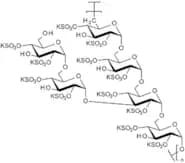
CAS:Dextran sulphate is a dextran derivative whose ulcer (colitis) -causing properties were first reported in hamsters and extrapolated a few years later to mice and rats. The exact mechanisms through which dextran sulphate induces intestinal inflammation are unclear but may be the result of direct damage of the monolayer of epithelial cells in the colon, leading to the crossing of intestinal contents (for e.g. commensal bacteria and their products) into underlying tissue and therefore induction of inflammation. The dextran sulphate sodium-induced ulceration model in laboratory animals has some advantages when compared to other animal models of colitis due to its simplicity and similarities to human inflammatory bowel disease.
MW is in the range of 40,000DaPureza:Min. 95%Cor e Forma:White PowderRef: 3D-YD31035
Produto descontinuadoChitin
CAS:Chitin forms the tough fibrous exoskeletons of insects, crustaceans and other arthropods, and, in addition to its presence in some fungi, it occurs in at least one alga. The structure of chitin is similar to that of cellulose but with glucose replaced with N-acetyl-D-glucosaminyl units linked β-D-(1,4) in a linear chain. Chitin is normally produced from the shells of lobster, crab or shrimp.
Fórmula:(C8H13NO5)nCor e Forma:PowderFucoidan, laminaria digitata
CAS:A fucan sulphate found in brown marine algae (Phaeophyta-typically Fucus serratus, Ascophyllum nodosum, Laminaria digitata (illustrated) and Macrocystis pyrifyra) and has been shown to have anticoagulant activity. The main constituents are α-1,4 and α-1,2 linked L-fucose sulphates although galactose also occurs and there are many variations of the basic structure found in different species of Phaeophyta.
The image was kindly provided by Prof Mike Guiry from Cork who runs ‘The Seaweed Site’.Cor e Forma:PowderLichenan - from Cetraria islandica
CAS:Lichenin, the poly β-D-Glucan of Cetraria islandica (Iceland moss), is found by enzymic degradation to differ in fine structure from the poly β-D-glucans of cereal grains. Thus, the basic structure of lichenin is a tetrameric unit in which two adjacent 1,4 linkages alternate with an isolated 1,3 linkage; occasionally four consecutive monomers are linked by 1,4 bonds. The immunomodulatory activity of isolichenan was tested in in vitro phagocytosis and anti-complementary assays, and proved to be active in both cases.
The image was kindly provided by Prof Mike Guiry from Cork who runs ‘The Seaweed Site’.Fórmula:C6H10O5Pureza:(Β-Linked Polysaccharide. 1H-Nmr) Min. 85%Cor e Forma:White PowderPeso molecular:162.14Gum karaya
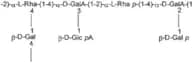
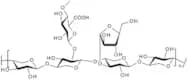
CAS:Gum karaya is exuded from Sterculia urens, a bushy tree found in dry regions of North India. Due to its extensive swelling capacity in water it is used as a laxative and as a denture adhesive. The structure consists of D-galactose, D-glucuronic acid and L-rhamnose but the detailed molecular structure is still incompletely known.
Pureza:Min. 95%Cor e Forma:PowderHyaluronic sodium - Average MW 0.2-0.5 million Daltons
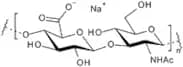
CAS:The sodium salt of hyaluronic acid is a glycosaminoglycan found in many organs, where it functions as a joint lubricant and shock absorber. It is obtained principally from synovial fluid, vitreous humor of the eye, umbilical tissue and cocks comb. The chemical structure of hyaluronic is a disaccharide repeat of β-(1,3) glucuronic acid and β-(1,4) N-acetyl glucosamine.Fórmula:(C14H20NO11Na)nPureza:Min. 95%Cor e Forma:PowderRef: 3D-YH72470
Produto descontinuadoHydroxyethyl cellulose - Viscosity 2400 to 2800(1% aqueous solution)
CAS:Water thickener; rheological control additive; has industrial appplications
Pureza:Min. 95%Dextran 5 - MW 4,000 to 6,000
CAS:Dextran is α-(1,6)-linked α-D-glucan with α-(1,3)-linked glucose branch points produced by fermentation of Leuconostoc mesenteroides via the action of the enzyme dextransucrase on sucrose. The main use for native dextran is as an extender in blood transfusions and products having a range of sharp cut-off molecular weights are produced commercially for this and other applications. A complex of iron with dextran, known as iron dextran, is used as a source of iron for baby piglets which are often anaemic at birth.
Cor e Forma:White PowderMannan (ex Saccharomyces cerevisiae)
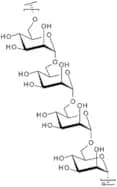
CAS:The main cell-wall components of baker’s yeast (Saccharomyces cerevisiae) as well as β-glucan are mannans with an α-1,6 mannose backbone and α-1,2 and α-1,3 mannose branches.
The image was kindly provided by Dr. Chris Lawson.Cor e Forma:White Slightly Brown PowderArabinoxylan
CAS:Arabinoxylans consist of α-L-arabinofuranose residues attached as branch-points to β-(1,4)-linked D-xylopyranose main chains. These may be 2- or 3-substituted or 2- and 3- di-substituted. The arabinose residues may also be linked to other groups attached such as glucuronic acid residues, ferulic acid cross links and acetyl groups. Arabinoxylans generally consist of between 1500 - 5000 residues.
Pureza:Min. 95%Cor e Forma:PowderGlycogen - from oyster
CAS:Glycogen is a highly branched polysaccharide of glucose that serves as a form of energy storage in animals and fungi. It is the main storage form of glucose in the body. In humans, glycogen is made and stored primarily in liver and muscle cells and functions as the second most important energy storage molecule to fat which is held in adipose tissue. Glycogen is analogous to starch and has a structure similar to amylopectin, but is more extensively branched and compact than starch. It occurs as granules in the cytosol/cytoplasm in many cell types, and plays an important role in the glucose cycle.
Fórmula:C24H42O21Cor e Forma:PowderPeso molecular:666.58 g/molRef: 3D-YG40133
Produto descontinuadoLM Pectin
CAS:Pectins are regarded as linear chains of α-1,4-linked D-galacturonic acid, a homogalacturonan (pectic acid). In the products of commerce, the degree of methylation has a vital influence on the properties of pectin, especially the solubility and gel forming characteristics.
Cor e Forma:PowderRef: 3D-YL158537
Produto descontinuadoFucogalactan - from Undaria pinnatifida
CAS:Fucogalactan (GFS) is a polysaccharide isolated and purified from the brown seaweed Undaria pinnatifida. The polysaccharide is a sulphated galactose containing fucan. Fucogalactan is currently under investigation for possible therapeutic indications including anti-inflammatory properties, immuno- modulating activities, inhibition of tumor growth, stem cell replentishment, antiviral activity, dementia and ulcer healing.Fucoidan ≥ 75 %
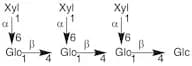
The image was kindly provided by Prof Mike Guiry from Cork who runs ‘The Seaweed Site’.Pureza:(%) Min. 75%Cor e Forma:Off-White PowderHeptasaccharide Glc4Xyl3
CAS:Fórmula:C39H66O33Pureza:>80.0%(HPLC)Cor e Forma:White to Almost white powder to crystalPeso molecular:1,062.92