Substratos enzimáticos
Subcategorias de "Substratos enzimáticos"
Foram encontrados 1529 produtos de "Substratos enzimáticos"
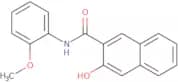
Naphthol AS-OL
CAS:Naphthol AS-OL is a widely used chromogenic enzyme substrate that forms a colored product upon reaction with specific enzymes. It is commonly employed in histochemical and cytochemical staining techniques to visualize enzyme activity in cells and tissues. Naphthol AS-OL is particularly useful for detecting the presence of enzymes such as alkaline phosphatase, acid phosphatase, and esterases. The resulting colored product can be easily observed under a microscope, allowing researchers to study the distribution and localization of these enzymes in various biological samples.
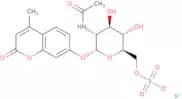
Fórmula:C18H15NO3Pureza:Min. 95%Cor e Forma:PowderPeso molecular:293.32 g/mol4-Methylumbelliferyl 2-acetamido-2-deoxy-α-D-glucopyranoside-6-sulfate potassium
CAS:4-Methylumbelliferyl 2-acetamido-2-deoxy-alpha-D-glucopyranoside-6-sulfate potassium is a fluorogenic substrate for N-acetylglucosamine-6-sulfatase. After enzymatic cleaveage, free 4-methylumbelliferone (also known as hymecromone) is released, exhibiting blue fluorescence upon excitation with UV light. The strongest fluorescence of 4-methylumbelliferone requires deprotonation of the hydroxyl group (thus requires alkaline pH), with a maximal fluorescence intensity obtained with excitation at 350 to 370 nm and emission at 440 to 470 nm. The use of 4-methylumbelliferyl 2-acetamido-2-deoxy-alpha-D-glucopyranoside-6-sulfate potassiumas a substrate for measuring the N-acetylglucosamine-6-sulfatase activity is used for screening of Mucopolysaccharidosis IIID (MPS IIID) (a rare lysosomal storage disorder) and Sanfilippo D syndrome diagnosis.Fórmula:C18H20KNO11SPureza:Min. 95%Cor e Forma:White PowderPeso molecular:497.52 g/molD-Psicose 6-phosphate sodium
CAS:D-Psicose 6-phosphate sodium is an analog from D-psicose, a rare, natural monosaccharide with 70% the sweetness of sucrose. It is used as a low-calorie sweetener in food industry. In research, it is used to investigate its effects on metabolism, diabetes, and other health conditions.Fórmula:C6H13O9P•NaPureza:90%MinCor e Forma:PowderPeso molecular:283.14 g/molOstazin brilliant red H-3B galactomannan
Ostazin Brilliant Red H-3B Galactomannan is a chemiluminescent substrate used for the detection of β-1,4-galactomannans. It reacts with the glucose residues on the mannan backbone to produce a red fluorescent product. This product can be detected by spectrophotometry at an excitation wavelength of 395 nm and emission wavelength of 510 nm. The Ostazin Brilliant Red H-3B Galactomannan substrate is useful in detecting Staphylococcus aureus, Streptococcus pyogenes, Streptococcus pneumoniae, Group A streptococci, Group B streptococci, Group D streptococci, Group G streptococci, and Group C streptococci.
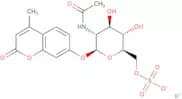
Pureza:Min. 95%4-Methylumbelliferyl 2-acetamido-2-deoxy-β-D-glucopyranoside-6-sulfate potassium salt
CAS:4-Methylumbelliferyl 2-acetamido-2-deoxy-beta-D-glucopyranoside-6-sulfate potassium salt is a fluorogenic substrate for beta-N-acetylglucosaminidase. After enzymatic cleaveage, free 4-methylumbelliferone (also known as hymecromone) is released, exhibiting blue fluorescence upon excitation with UV light. The strongest fluorescence of 4-methylumbelliferone requires deprotonation of the hydroxyl group (thus requires alkaline pH), with a maximal fluorescence intensity obtained with excitation at 350 to 370 nm and emission at 440 to 470 nm. The use of 4-methylumbelliferyl 2-acetamido-2-deoxy-beta-D-glucopyranoside-6-sulfate potassium saltas a substrate for measuring the beta-N-acetylglucosaminidase activity is used for diagnosis of Mucopolysaccharidosis IIIB (MPS IIIB) (a rare lysosomal storage disorder) and Sanfilippo B syndrome screening.
Fórmula:C18H20KNO11SPureza:Min. 95%Cor e Forma:White Off-White PowderPeso molecular:497.52 g/molLuciferin-alpha-D-galactoside, sodium salt
Luciferin-alpha-D-galactoside, sodium salt is a fluorogenic substrate for use in food testing and environmental testing. It can be used as a chromogenic substrate for the detection of conjugates of bile acids and cholesterol. This product is also used in diagnostic medical tests, such as ligand binding assays, chemiluminescence, and bioluminescence.Pureza:Min. 95%6-Chloro-3-indoxyl-beta-D-galactopyranoside, plant origin
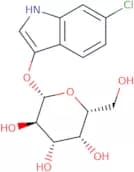
CAS:6-Chloro-3-indoxyl-beta-D-galactopyranoside is a chromogenic substrate for beta-galactosidase that yields a salmon or rose-coloured precipitate and hence is also known as Salmon-Gal. It can be used in conjunction with isopropyl-beta-D-thiogalactopyranoside (IPTG) as an alternative to the chromogenic substrate 5-bromo-4-chloro-3-indolyl beta-D-galactopyranoside (X-Gal) for detection of beta-galactosidase activity in bacterial colonies in colorimetric assays. Where beta-galactosidase expressed from a reporter gene in molecular biology experiments, recombinant colonies on growth plates are salmon-coloured while non-recombinants appear as white. Use of nitroblue tetrazolium salt (NBT) with Salmon-Gal may provide faster results, yielding a clear, purple precipitate, than for Salmon-Gal alone. In conjunction with 5-bromo-4-chloro-3-indolyl-beta-D-glucoside (X-Glc), Salmon-Gal is useful for simultaneous detection of GUS and Lac activities in the same medium.Fórmula:C14H16ClNO6Pureza:Min. 98.0 Area-%Peso molecular:329.74 g/mol5-Nitro-3-indoxyl-β-D-galactopyranoside
For the detection of beta-galactosidase activityFórmula:C14H16N2O8Peso molecular:340.29 g/mol6-Nitro-3-indoxyl-β-D-galactopyranoside
For the detection of beta-galactosidase activityFórmula:C14H16N2O8Peso molecular:340.29 g/mol8-Hydroxyquinoline-beta-D-glucuronic acid, sodium salt
CAS:8-Hydroxyquinoline-beta-D-glucuronic acid, sodium salt is a fluorogenic substrate that can be used for enzymatic detection of peroxidase. The substrate is available in a variety of forms, including powder and liquid. This product has been tested for environmental and bioluminescence activity, as well as food safety. It has also been shown to be a useful ligand in immunoassays.
Fórmula:C15H14NNaO7Pureza:Min. 98 Area-%Cor e Forma:White PowderPeso molecular:343.26 g/molAldol® 584 β-D-glucuronic acid, triethylammonium salt, Biosynth Patent: EP 2427431 and US 8940909
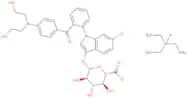
CAS:Aldol 584 is a chromogenic substrate that is used in enzymatic assays to detect the presence of an enzyme. It is a triethylammonium salt with beta-D-glucuronic acid. Aldol 584 is used in diagnostic procedures and can be used as a substrate for fluorogenic substrates and chemiluminescent substrates. This product has been shown to be effective in detecting the presence of bile in feces, erythrocyte hemolysis, and the presence of proteinases in human urine. It can also be used as a food testing agent or to measure bacterial activity in culture media.Fórmula:C37H46ClN3O10Pureza:Min. 95%Cor e Forma:PowderPeso molecular:728.2 g/mol4-Nitrophenyl 2-acetamido-3-O-[2-O-a-L-fucopyranosyl-b-D-galactopyranosyl)-2-deoxy-b-D-galactopyranoside
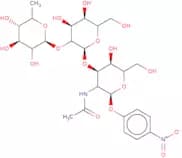
CAS:4-Nitrophenyl 2-acetamido-3-O-[2-O-a-L-fucopyranosyl-b-D-galactopyranosyl)-2-deoxyb-D-galactopyranoside is a water soluble, fluorescent probe that can be used for detecting the presence of β-(1→4) -linked galactosaminoglycans. The dye is a substrate for enzymes such as α--mannosidase, β--glucuronidase and β--galactosidase. The dye is also an excellent ligand for lectins such as concanavalin A and wheat germ agglutinin. This product is a diagnostic reagent that has been shown to have high purity and quality. It has CAS No. 93496-53-8 and can be used in food testing, bioluminescence, environmental testing, or high purity applications.
Fórmula:C26H38N2O17Pureza:Min. 95%Peso molecular:650.58 g/molNaphthol AS-E phosphate, 60%
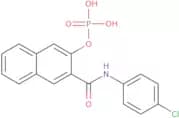
CAS:Histochemical substrate for alkaline phosphatase
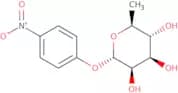
Fórmula:C17H13ClNO5PPureza:(%) Min. 60%Cor e Forma:SolidPeso molecular:377.72 g/mol4-Nitrophenyl α-L-rhamnopyranoside
CAS:Chromogenic substrate for alpha-L-rhamnosidase
Fórmula:C12H15NO7Pureza:Min. 99 Area-%Cor e Forma:White Slightly Yellow PowderPeso molecular:285.25 g/molBCM® O157:H7(+)
BIOSYNTH Culture Medium for the isolation andidentification of Escherichia coli O157:H7
L-Lysine 7-amido-4-methylcoumarin, acetate salt
CAS:Produto ControladoL-Lysine 7-amido-4-methylcoumarin, acetate salt is a fluorogenic peptide substrate for aminopeptidase. This AMC peptide substrate is normally used to rapidly profile the N-terminal specificity of proteases.Fórmula:C18H25N3O5Peso molecular:363.42 g/molResorufin-β-D-glucuronic acid, sodium salt
CAS:Resorufin-beta-D-glucuronic acid, sodium salt is a fluorogenic substrate that can be used in diagnostic applications. It is a conjugate of resorufin and beta-D-glucuronic acid. The enzyme substrate reacts with the enzyme luciferase to produce light. The high purity and quality of this product make it ideal for use in the detection of the presence of glucose in urine, which can be used to diagnose diabetes mellitus.Fórmula:C18H14NNaO9Pureza:Min. 90.0 Area-%Peso molecular:411.30 g/molRef: 3D-R-2150
2mgA consultar5mgA consultar10mgA consultar25mgA consultar50mgA consultar-Unit-ggA consultar5-Bromo-4-chloro-3-indoxyl sulfate, potassium salt
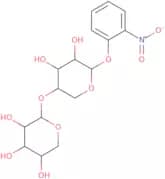
CAS:Chromogenic substrate for aryl-sulfatase. Yields a blue precipitate upon cleavage.Fórmula:C8H4BrClKNO4SPureza:Min. 98.0 Area-%Peso molecular:364.65 g/mol2-Nitrophenyl b-D-xylobioside
CAS:2-Nitrophenyl b-D-xylobioside is a chromogenic substrate for the enzyme xylanase.
Pureza:Min. 95%Cor e Forma:PowderPeso molecular:403.34 g/mol4-Methylumbelliferyl lignocerate
CAS:This botanical is a download for the Floral Database.
Fórmula:C34H54O4Pureza:Min. 95 Area-%Peso molecular:526.81 g/molRef: 3D-M-5720
1gA consultar5gA consultar250mgA consultar500mgA consultar2500mgA consultar-Unit-ggA consultar