Substratos enzimáticos
Substratos enzimáticos são moléculas sobre as quais as enzimas atuam para catalisar reações químicas. O substrato liga-se ao sítio ativo da enzima, onde passa por uma transformação específica para formar o produto da reação. Os substratos enzimáticos são ferramentas essenciais na pesquisa para estudar a cinética enzimática, especificidade e mecanismo de ação. Eles também são usados em ensaios diagnósticos e estudos bioquímicos. Na CymitQuimica, oferecemos uma seleção diversificada de substratos enzimáticos de alta qualidade para apoiar suas pesquisas em enzimologia e bioquímica.
Subcategorias de "Substratos enzimáticos"
Foram encontrados 1529 produtos de "Substratos enzimáticos"
Ordenar por
Pureza (%)
0
100
|
0
|
50
|
90
|
95
|
100
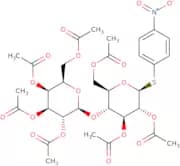
4-Nitrophenyl 4-O-(2,3,4,6-tetra-O-acetyl-b-D-galactopyranosyl)-2,3,6-tri-O-acetyl-b-D-thioglucopyranoside
CAS:4-Nitrophenyl 4-O-(2,3,4,6-tetra-O-acetyl-b-D-galactopyranosyl)-2,3,6-tri-O-acetyl-b-D-thioglucopyranoside is a superior chromogenic substrate for the detection of enzymes. Specifically designed for optimal performance, it provides exquisite sensitivity and definitive results in enzyme assays. Its exceptional properties make it a top choice among researchers and professionals in biochemistry, enabling accurate analysis and quantification of enzymatic activities.Pureza:Min. 95%Peso molecular:773.71 g/molLuc-phosphate Na enhanced
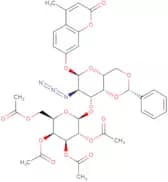
<p>Luc-phosphate Na enhanced is a chemiluminescent substrate that is used to detect the presence of an enzyme or a protein. This substrate is formed by the combination of luciferin and phosphate, which react with each other to produce light. Luc-phosphate Na enhanced is stable in solution and can be stored at room temperature for up to three months. It has been shown to be particularly effective in detecting the presence of DNAase, an enzyme that breaks down DNA. Luc-phosphate Na enhanced has also been used as a fluorogenic substrate in diagnostics, chromogenic substrate in enzymatic reactions, and conjugate for food testing.</p>Pureza:Min. 95%4-Methylumbelliferyl 2-azido-2-deoxy-3-O-(tetra-O-acetyl-b-D-galactopyranosyl)-4,6-O-benzylidene-a-D-galactopyranoside
CAS:<p>4-Methylumbelliferyl 2-azido-2-deoxy-3-O-(tetra-O-acetyl-b-D-galactopyranosyl)-4,6-O-benzylidene a D galactopyranoside is a chemiluminescent substrate for detecting ligands. It has been used to detect the presence of bacteria, fungi, and parasites in food samples and as an indicator for enzymatic activity. This product is an excellent fluorescent substrate for the detection of nucleic acids such as DNA. This product is a conjugate with high purity, which makes it suitable for use in various types of applications.</p>Fórmula:C37H39N3O16Pureza:Min. 95%Peso molecular:781.72 g/molLuc-B.cereus Na
<p>Bacillus cereus is a rod-shaped β hemolytic bacterium commonly found in food and soil. Some strains can be associated with food intoxications, mainly from raw meat and poultry products. One example is the so called “fried rice syndrome”, that occurs when dishes containing cooked rice are left for several hours at room temperature. Typical symptoms of the infection include severe nausea, vomiting and diarrhea. Some strains of Bacillus cereus on the contrary are not harmful at all and they are used as probiotics food additives in animal farming to reduce the presence of other pathogens like Salmonella in the cecum end intestine. Bacillus cereus expresses phosphatidyl-choline specific phospholipase C (PC-PLC), encoded by the plc gene, which is regulated by PlcR. In addition, the expression of PlcR is dependent on the growth medium. Luc-B.cereus Na (L-8275) is a synthetic chemiluminescent substrate for the phosphatidyl-choline specific phospholipase C. The enzyme cleaves off phosphocholine from L-8275, leading to the release of D-Luc, and consequent strong light emission B. cereus culture exhibited strong luminescence, while RLU values were much lower for samples with B. thuringiensis.</p>Fórmula:C16H17N3NaO6PS2Pureza:Min. 95 Area-%Peso molecular:465.41 g/mol4-Methylumbelliferyl 2-O-(2,3,4-tri-O-benzoyl-a-L-fucopyranosyl)-b-D-galactopyranoside
<p>4-Methylumbelliferyl 2-O-(2,3,4-tri-O-benzoyl-a-L-fucopyranosyl)-b-D-galactopyranoside is a fluorescent substrate for β–galactosidase. It is used to detect the enzyme in biological samples and as a diagnostic agent. This substrate can be used to develop chemiluminescent, chromogenic, and fluorogenic substrates for use in diagnostics. 4MUF 2OBG can also be conjugated to various ligands for use in bioluminescence assays or as a marker in immunoassays.</p>Pureza:Min. 95%Peso molecular:796.77 g/molColchicine fluorescein
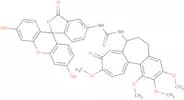
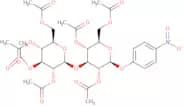
CAS:<p>Colchicine fluorescein is the fluorogenic form of colchicine. It is used for staining assembly of tubulin. Colchicine-site inhibitors (abbrevated as CBSIs) disrupt tubulin polymerization. Colchicine fluorescein serves as a probe to study the binding of colchicine to tubulin, as the colchicine binding site is a promising target for discovering novel antitumour agents.</p>Fórmula:C41H34N2O10SPureza:Min. 90 Area-%Cor e Forma:Orange PowderPeso molecular:746.78 g/mol4-Nitrophenyl 2,4,6-tri-O-acetyl-3-O-(2,3,4,6-tetra-O-acetyl-b-D-glucopyranosyl)-b-D-glucopyranoside
CAS:<p>4-Nitrophenyl 2,4,6-tri-O-acetyl-3-O-(2,3,4,6-tetra-O-acetyl-β-D-glucopyranosyl)-β-D-glucopyranoside is an advanced bifunctional chromogenic pNP substrate specifically tailored for the simultaneous detection and quantification of multiple glycosidase enzymes. This dual-action substrate undergoes cleavage by two separate enzymatic reactions, which increases the range and sensitivity of detection. The resulting 4-Nitrophenol release can be easily measured spectrophotometrically, providing rapid and reliable enzyme analysis for advanced enzymology studies, enabling new discoveries in biochemistry and biotechnology.</p>Pureza:Min. 95%Peso molecular:757.65 g/mol4-Methylumbelliferyl phosphate, free acid
CAS:A sensitive fluorogenic substrate for fluorometric and UV-spectrophotometric assays of phosphatases. It is used for the detection of C. perfringens because acid phosphatase is a highly specific indicator for C. perfringens.Fórmula:C10H9O6PPeso molecular:256.15 g/molButyl 4-nitrophenyl hexyl phosphonate
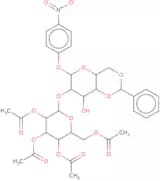
CAS:<p>Butyl 4-nitrophenyl hexyl phosphonate is a lipase suicide inhibitor that is a chromogenic substrate for lipases which upon enzymatic action, binds irreversibly to the lipase and inactivates it. The substrate can be used for the determination of active sites in lipases, especially in lipases preferring long chain leaving groups.</p>Pureza:Min. 95%Peso molecular:343.364-Nitrophenyl 2-O-(2,3,4,6-tri-O-acetyl-a-D-mannopyranosyl)-4,6-O-benzylidene-a-D-mannopyranoside
4-Nitrophenyl 2-O-(2,3,4,6-tri-O-acetyl-a-D-mannopyranosyl)-4,6-O-benzylidene-a-D-mannopyranoside is a fluorogenic substrate that is used for the detection of alpha amylase activity in food testing. It is also used as a chromogenic substrate for the detection of beta amylase activity. 4NP2ODM is a conjugate that can be used for the detection of alpha or beta amylases in environmental testing. This compound has high purity and quality and CAS No. 90105037.Pureza:Min. 95%Peso molecular:719.64 g/molH-Pro-Arg-4mbna
CAS:<p>H-Pro-Arg-4mbna is a chromogenic substrate that is specifically cleaved by trypsin, a serine protease involved in protein digestion, and thrombin, that cleave peptide bonds. Upon hydrolysis, the bond between the proline and arginine is cleaved, releasing 4MβNA. This leads to a colorimetric change that can be detected spectrophotometrically. This substrate is commonly used in the study of trypsin activity, as well as in the development of assays for the diagnosis and monitoring of pancreatic diseases, such as pancreatitis and cystic fibrosis, which are associated with trypsin dysfunction.</p>Fórmula:C22H30N6O3Pureza:Min. 95%Peso molecular:426.5 g/molAldol® 495 phosphate, disodium salt, Biosynth Patent: EP 2427431 and US 8940909
CAS:Aldol® 495 phosphate is a chromogenic and fluorogenic enzyme substrate used for detection of phosphatase activity. The colorless enzyme substrate is cleaved by acid and alkaline phosphatases secreted by bacteria in liquid or solid media, yielding orange color and green fluorescence. Aldol® 495 phosphate can also be used in Western blots and other immunoassay applications with phosphatase-coupled secondary antibodies. Aldol® 495 phosphate can be used under aerobic and anaerobic conditions.Fórmula:C20H14ClN2Na2O5PPureza:Min. 98.0 Area-%Peso molecular:474.74 g/mol4-Nitrophenyl 2-acetamido-3-O-(2-O-a-L-fucopyranosyl-b-D-galactopyranosyl)-2-deoxy-a-D-galactopyranoside
CAS:<p>4-Nitrophenyl 2-acetamido-3-O-(2-O-a-L-fucopyranosyl-b-D-galactopyranosyl)-2,6,8,10,12-pentaoxoheptaacetic acid is a chemiluminescent substrate that is used for the detection of peroxidase and other enzymes. The reaction product is a yellow fluorescent product which can be measured using a fluorometer. It is sold as an aqueous solution at 1mg/mL in phosphate buffer at pH 7.4.</p>Pureza:Min. 95%Peso molecular:650.58 g/molEspresso-Gal
Espresso-Gal (Espresso-beta-D-galactopyranoside) is a chromogenic indicator for beta-galactosidase activity. The colorless product is cleaved by lactose-utilizing bacteria in liquid media or on agar plates and yields an espresso brown colored precipitate. Espresso-Gal can also be used as detecting agent for beta-galactosidase activity in reporter gene assays or for identification of positive transformants on agar plates when using the α-complementation approach. Read more in the Application Notes.Peso molecular:495.6 g/mol4-Methylumbelliferyl 2,3,6-tri-O-benzoyl-b-D-galactopyranoside
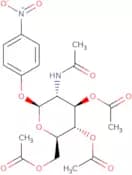
CAS:<p>4-Methylumbelliferyl 2,3,6-tri-O-benzoyl-b-D-galactopyranoside is a fluorogenic substrate that can be used in food testing. This compound is also a chromogenic substrate that can be used for environmental testing. This product is a ligand and chemiluminescent reagent that can be used in diagnostics. It is also an enzyme substrate that has high purity and high quality.</p>Pureza:Min. 95%Peso molecular:650.63 g/mol4-Nitrophenyl 2-acetamido-3,4,6-tri-O-acetyl-2-deoxy-b-D-glucopyranoside
CAS:<p>4-Nitrophenyl 2-acetamido-3,4,6-tri-O-acetyl-2-deoxy-b-D-glucopyranoside is an extracellular nucleic acid molecule that is produced by the bacterium Corynebacterium glutamicum. This compound has been shown to inhibit cancer cells by blocking the transport of glucose through the cell membrane and may be a potential drug target for cancer treatment. 4NPTAPG has also been shown to have diagnostic properties and can identify corynebacterium glutamicum strains. It is a fluorescent molecule that can be used to detect the presence of this bacterium in culture media.</p>Pureza:Min. 95%Peso molecular:468.41 g/mol4-Nitrophenyl 2,3,4,6-tetra-O-acetyl-a-D-glucopyranoside
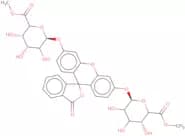
CAS:<p>4-Nitrophenyl 2,3,4,6-tetra-O-acetyl-a-D-glucopyranoside is a useful substrate for enzymatic assays. This high-sensitivity chromogenic pNP substrate offers enhanced selectivity and increased detection ability, allowing for a broad range of applications in the field of glycosidase research. Featuring rapid colorimetric readouts with easily detectable endpoint determination, this substrate delivers clear and accurate results every time.</p>Pureza:Min. 95%Peso molecular:469.4 g/molFluorescein di-b-D-glucuronide dimethyl ester
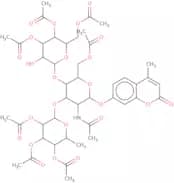
Fluorogenic substrate for beta-glucuronidasePureza:Min. 95%Cor e Forma:PowderPeso molecular:712.61 g/mol4-Methylumbelliferyl 2-acetamido-3-O-(2,3,4-tri-O-acetyl-a-L-fucopyranosyl)-4-O-(2,3,4,6-tetra-O-acetyl-b-D-galactopyranosyl)-6-O-ac etyl-2-deoxy-b-D-glucopyranoside
<p>4-Methylumbelliferyl 2-acetamido-3-O-(2,3,4-tri-O-acetyl-a-L-fucopyranosyl)-4-O-(2,3,4,6 -tetra-O-acetylbDgalactopyranosyl)-6-O-acetyldEoxybDglucopyranoside is a chemiluminescent substrate that has been used in the detection of beta galactosidase activity. It is a ligand for beta galactosidases and can be used for the study of enzyme kinetics. This compound also exhibits high purity and is available in CAS number: 916071. 4MUFAGAALF is suitable for use in culture media and environmental testing as well as diagnostics (e.g., bioluminescence), staining (fluorogenic substrate), and chromogenic substrates</p>Pureza:Min. 95%Peso molecular:1,023.94 g/mol4-Methylumbelliferyl-b-D-cellobiose heptaacetate
CAS:<p>4-Methylumbelliferyl-beta-D-cellobioside heptaacetate is a fluorogenic substrate for beta-D-glucosidase and can be used to detect this enzyme in the presence of other glycosidases. It is also used as a chromogenic substrate for beta-galactosidase, alpha-mannosidase, alpha-fucosidase, and alpha-N-acetylgalactosaminidase. 4MMB Cellobiose Haptaacetate is a conjugate that can be used to measure the activity of beta-glucuronidase and beta-xylosidase. This product is suitable for use in diagnostics, ligands, food testing, environmental testing, and culture media.</p>Pureza:Min. 95%Peso molecular:794.71 g/mol