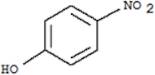
CAS 100-02-7
:Phenol, 4-nitro-
Description:
4-Nitrophenol, with the CAS number 100-02-7, is an organic compound characterized by a hydroxyl group (-OH) and a nitro group (-NO2) attached to a benzene ring. It appears as a yellow crystalline solid and is known for its distinct aromatic odor. This compound is soluble in water and organic solvents, such as ethanol and ether, due to its polar functional groups. 4-Nitrophenol exhibits acidic properties, with a pKa value indicating its ability to donate a proton in solution. It is commonly used in various applications, including as a reagent in organic synthesis, a precursor for dyes, and in the production of pesticides. Additionally, it serves as a pH indicator and is utilized in biochemical assays. However, 4-nitrophenol is also recognized for its toxicity and potential environmental hazards, necessitating careful handling and disposal. Its presence in wastewater and industrial effluents is a concern, prompting regulatory measures to limit exposure and mitigate its impact on human health and ecosystems.
Formula:C6H5NO3
InChI:InChI=1/C6H5NO3/c8-6-3-1-5(2-4-6)7(9)10/h1-4,8H/p-1
InChI key:InChIKey=BTJIUGUIPKRLHP-UHFFFAOYSA-N
SMILES:N(=O)(=O)C1=CC=C(O)C=C1
Synonyms:- 1-Hydroxy-4-nitrobenzene
- 4-Hydroxy-1-nitrobenzene
- 4-Hydroxynitrobenzene
- 4-Nitrofenol
- 4-Nitrophenol
- Niphen
- Nsc 1317
- P-Nitrophenol
- Phenol, p-nitro-
- p-Hydroxynitrobenzene
- Phenol, 4-nitro-
- P-Nitro phenol
- Para-Nitrophenol
- 4-nitro-pheno
- NCI-C55992
- Mononitrophenol
- AKOS BBS-00004351
- ACETAMINOPHEN IMPURITY F
- HONP
- 4-NITROHYDROXYBENZENE
- ACETAMINOPHENE IMP F
- Paranitrofenol
- See more synonyms
Filter by
Purity percentage
0
100
|
0
|
50
|
90
|
95
|
100
- Lower prices
- Higher prices
- Lower purities
- Higher purities
- Faster estimated delivery
p-Nitrophenol (High Purity) extrapure AR, 99.5%
CAS:Formula:C6H5NO3Purity:min. 99.5%Color and Shape:Pale yellow to yellow and slightly dark yellow, Powder / crystalline powder, Clear, Pale yellow to yellowMolecular weight:139.11p-Nitrophenol pure, 98%
CAS:Formula:C6H5NO3Purity:min. 98%Color and Shape:Pale yellow to yellow and slightly dark yellow, Powder / crystalline powder / Crystals, Almost clear, Pale yellow to yellowMolecular weight:139.11p-Nitrophenol for Spectrophotometry, 99.5%
CAS:Formula:C6H5NO3Purity:min. 99.5%Color and Shape:Pale yellow to yellow and slightly dark yellow, Powder/crystalline powder, Clear, Pale yellow to yellowMolecular weight:139.11