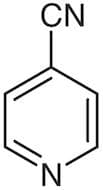
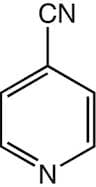
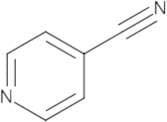
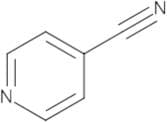
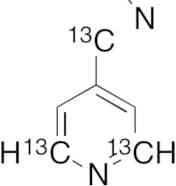
CAS 100-48-1
:4-Cyanopyridine
- 4-Azabenzonitrile
- 4-Nitrilopyridine
- 4-Pyridinecarbonitrile
- 4-Pyridinenitrile
- 4-Pyridyl cyanide
- 4-Pyridylcarbonitrile
- 4-cyano Pyridine
- Isonicotinic acid nitrile
- Isonicotinonitril
- Isonicotinonitrile
- Isonicotinonitrilo
- Nsc 60681
- Pyridine, 4-Cyano-
- Pyridine-3-Carbonitrile
- Pyridine-4-carbonitrile
- γ-Cyanopyridine
- See more synonyms
4-Cyanopyridine
CAS:Formula:C6H4N2Purity:>98.0%(GC)(T)Color and Shape:White to Almost white powder to crystalMolecular weight:104.114-Cyanopyridine, 98%
CAS:4-Cyanopyridine is used as an intermediate in organic synthesis and pharmaceutical substances like isonicotinylhydrazide, which is used in the treatment of tuberculosis. It is used as a precursor for the preparation of isonicotinic acid and 4-diemthylaminopyridine (DMAP). It is involved in the synFormula:C6H4N2Purity:98%Color and Shape:Colorless to white to cream to pale brown, Crystals or powder or crystalline powder or lumps or fused solid or solidMolecular weight:104.114-Cyanopyridine
CAS:4-CyanopyridineFormula:C6H4N2Purity:98%Color and Shape: white solidMolecular weight:104.11g/mol4-Cyanopyridine
CAS:4-Cyanopyridine is a pyridine derivative widely used in biochemical experiments and drug synthesis research.Formula:C6H4N2Purity:99.77%Color and Shape:SolidMolecular weight:104.11Pyridine-4-carbonitrile
CAS:Controlled ProductFormula:C6H4N2Color and Shape:NeatMolecular weight:104.114-Cyanopyridine
CAS:Controlled ProductApplications 4-Cyanopyridine is a reagent for the synthesis of 1-tolyl-5-benzylthiotetrazole and 2-hexylthio-4-pyridinecarbonitrile, an antituberculotics. Preparation of the antihypertensive agent Pinacidil using the chemoselective and green oxidative rearrangement of an amidine and addition of an amine to a guanidine as the key step. Structure-based discovery of human L-xylulose reductase inhibitors from database screening and molecular docking. Human L-xylulose reductase (XR) is an enzyme of the glucuronic acid/uronate cycle of glucose metabolism with the possible target for treatment of the long-term complications of diabetes.
References Waisser, K., et al.: Folia Pharmaceutica Universitatis Carolinae, 18, 31 (1995); Carbone, V., et al.: Bioorg. Med. Chem., 13, 301 (2004); Baeten, M., et al.: Adv. Synth. Catal., 358, 826 (2016)Formula:C6H4N2Color and Shape:WhiteMolecular weight:104.114-Cyanopyridine
CAS:4-Cyanopyridine is an organic compound with the chemical formula (CN)N. It is a white solid that is soluble in water and polar solvents. When exposed to hydrochloric acid, 4-cyanopyridine undergoes a reaction that converts it to picolinic acid. This reaction proceeds through a mechanism in which the nucleophilic hydroxyl group of 4-cyanopyridine attacks the protonated nitrogen atom of hydrochloric acid. The resulting intermediate then loses a proton and becomes picolinic acid. Kinetic data on this reaction has been obtained from UV-vis spectroscopy, X-ray diffraction, and mass spectrometry experiments. The crystal structures of the bound form of 4-cyanopyridine and its quinoline derivatives have also been determined by x-ray crystallography.Formula:C6H4N2Purity:Min. 95%Color and Shape:PowderMolecular weight:104.11 g/mol4-Cyanopyridine-13C3
CAS:Controlled ProductFormula:C3C3H4N2Color and Shape:NeatMolecular weight:107.087