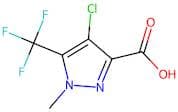
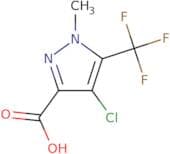
CAS 1001519-38-5
:4-Chloro-1-methyl-5-(trifluoromethyl)-1H-pyrazole-3-carboxylic acid
Description:
4-Chloro-1-methyl-5-(trifluoromethyl)-1H-pyrazole-3-carboxylic acid is a heterocyclic organic compound characterized by its pyrazole ring structure, which includes a chloro substituent and a trifluoromethyl group. This compound features a carboxylic acid functional group, contributing to its acidic properties. The presence of the trifluoromethyl group enhances its lipophilicity and can influence its biological activity, making it of interest in pharmaceutical research. The chlorine atom introduces additional reactivity and can affect the compound's solubility and stability. Typically, compounds like this are studied for their potential applications in agrochemicals or medicinal chemistry, where modifications to the pyrazole framework can lead to diverse biological activities. Its molecular structure suggests it may exhibit interesting interactions with biological targets, making it a candidate for further investigation in drug development or as a biochemical tool. Safety and handling precautions should be observed due to the presence of halogenated groups, which can pose environmental and health risks.
Formula:C6H4ClF3N2O2
InChI:InChI=1S/C6H4ClF3N2O2/c1-12-4(6(8,9)10)2(7)3(11-12)5(13)14/h1H3,(H,13,14)
InChI key:InChIKey=ZGXCZXXWVJQHJG-UHFFFAOYSA-N
SMILES:C(F)(F)(F)C1=C(Cl)C(C(O)=O)=NN1C
Synonyms:- 4-Chloro-1-methyl-5-(trifluoromethyl)-1H-pyrazole-3-carboxylic acid
- 1H-Pyrazole-3-carboxylic acid, 4-chloro-1-methyl-5-(trifluoromethyl)-
Sort by
Purity (%)
0
100
|
0
|
50
|
90
|
95
|
100
Found 2 products.
4-Chloro-1-methyl-5-(trifluoromethyl)-1H-pyrazole-3-carboxylic acid
CAS:4-Chloro-1-methyl-5-(trifluoromethyl)-1H-pyrazole-3-carboxylic acidPurity:≥95%Molecular weight:228.56g/mol4-Chloro-1-methyl-5-(trifluoromethyl)-1H-pyrazole-3-carboxylic acid
CAS:4-Chloro-1-methyl-5-(trifluoromethyl)-1H-pyrazole-3-carboxylic acid (4CMP) is an antimicrobial agent, which exhibits significant cytotoxicity against a number of cancer cell lines. It has been shown to have a number of biological properties, including the ability to inhibit the Mcl-1 protein and p-hydroxybenzoic acid. 4CMP has also been shown to be metabolized into picolinic acid and other analogs, which are thought to be responsible for its cytotoxic activity. The optimum concentrations of 4CMP range from 10 µM to 100 µM.Formula:C6H4ClF3N2O2Purity:Min. 95%Molecular weight:228.55 g/mol