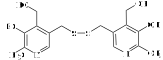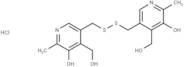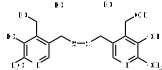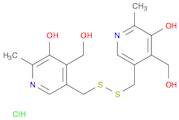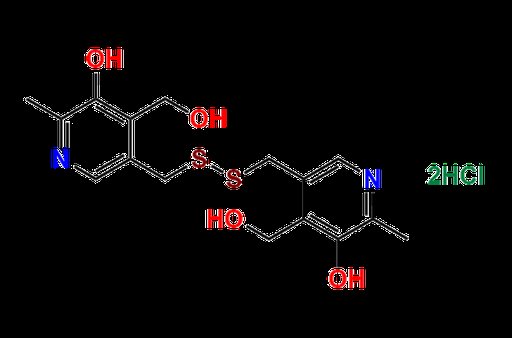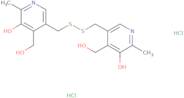
CAS 10049-83-9
:Pyritinol hydrochloride
Description:
Pyritinol hydrochloride, with the CAS number 10049-83-9, is a synthetic compound derived from vitamin B6 and is known for its nootropic properties. It is a water-soluble, yellowish crystalline powder that is often used in the treatment of cognitive disorders and to enhance memory and learning capabilities. Pyritinol functions as an antioxidant and is believed to improve cerebral blood flow, thereby potentially enhancing neuronal function. The compound is typically administered in the form of its hydrochloride salt, which increases its solubility and bioavailability. In terms of safety, pyritinol is generally well-tolerated, but like any pharmacological agent, it may have side effects, including gastrointestinal disturbances or allergic reactions in some individuals. Its mechanism of action involves modulation of neurotransmitter systems, particularly those related to acetylcholine, which plays a crucial role in memory and learning processes. Overall, pyritinol hydrochloride is of interest in both clinical and research settings for its cognitive-enhancing effects.
Formula:C16H20N2O4S2·2ClH
InChI:InChI=1S/C16H20N2O4S2.2ClH/c1-9-15(21)13(5-19)11(3-17-9)7-23-24-8-12-4-18-10(2)16(22)14(12)6-20;;/h3-4,19-22H,5-8H2,1-2H3;2*1H
InChI key:InChIKey=HRZWYHGGJOWGRI-UHFFFAOYSA-N
SMILES:C(SSCC=1C(CO)=C(O)C(C)=NC1)C=2C(CO)=C(O)C(C)=NC2.Cl
Synonyms:- 4-Pyridinemethanol, 3,3′-(dithiodimethylene)bis[5-hydroxy-6-methyl-, dihydrochloride
- 4-Pyridinemethanol, 3,3′-[dithiobis(methylene)]bis[5-hydroxy-6-methyl-, dihydrochloride
- 4-Pyridinemethanol, 3,3′-[dithiobis(methylene)]bis[5-hydroxy-6-methyl-, hydrochloride (1:2)
- 5,5'-(Disulfanediyldimethanediyl)Bis[4-(Hydroxymethyl)-2-Methylpyridin-3-Ol]
- 5,5'-(Disulfanediyldimethanediyl)Bis[4-(Hydroxymethyl)-2-Methylpyridin-3-Ol] Dihydrochloride
- Biocefalin
- Enbol
- Encephabol
- Enerbol
- Pyriditol
- Pyrithioxin hydrochloride
- Pyrithioxine hcl
- Pyrithioxine hydrochloride
- Pyritinol Dihydrochloride
- Pyritinol HCl
- Pyritinol hydrochloride
- See more synonyms
Filter by
Purity percentage
0
100
|
0
|
50
|
90
|
95
|
100
Found 7 products.
- Lower prices
- Higher prices
- Lower purities
- Higher purities
- Faster estimated delivery
Pyrithioxin dihydrochloride
CAS:Pyrithioxin dihydrochloride (Pyrithioxine HCl) has anti-nociceptive and anti-allodynic effects and can be used to study neurological diseases.Formula:C16H22Cl2N2O4S2Purity:99.92%Color and Shape:SolidMolecular weight:441.393Pyrithioxin dihydrochloride
CAS:Pyrithioxin dihydrochlorideFormula:C16H22Cl2N2O4S2Purity:99.5%Molecular weight:441.39Pyrithioxin DiHCl
CAS:Formula:C16H20N2O4S2·2HClColor and Shape:White To Off-White SolidMolecular weight:368.48 2 36.46Pyrithioxin Dihydrochloride
CAS:Formula:C16H22Cl2N2O4S2Purity:99%Color and Shape:SolidMolecular weight:441.3929Pyrithioxin dihydrochloride
CAS:Pyrithioxin dihydrochloride is a pharmaceutical dosage form used to treat degenerative diseases. It has been shown to have an inhibitory effect on the activity of cholinergic neurons, and can be used to treat symptoms such as muscle weakness, muscle atrophy, and difficulty with movement. Pyrithioxin dihydrochloride may also be used in long-term treatment for Alzheimer's disease or Parkinson's disease. Pyrithioxin dihydrochloride inhibits the synthesis of acetylcholine by binding to the enzyme choline acetyltransferase and blocking the transfer of acetyl-coenzyme A from the coenzyme A pool. This drug also inhibits brain infarction in animal models by preventing accumulation of fatty acids in the blood vessels.Formula:C16H20N2O4S2·2HClPurity:Min. 95%Color and Shape:White To Off-White To Light (Or Pale) Yellow SolidMolecular weight:441.39 g/mol