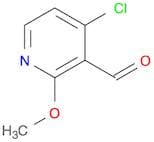
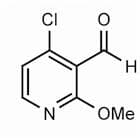
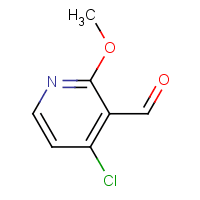
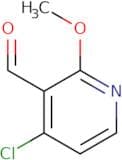
CAS 1008451-58-8
:4-Chloro-2-methoxynicotinaldehyde
Description:
4-Chloro-2-methoxynicotinaldehyde is an organic compound that belongs to the class of nicotinic aldehydes. It features a pyridine ring, which is characteristic of nicotinic compounds, and contains both a chloro and a methoxy substituent, contributing to its unique chemical properties. The presence of the aldehyde functional group indicates that it can participate in various chemical reactions, such as condensation and oxidation. This compound is typically a pale yellow to brown solid and is soluble in organic solvents, reflecting its moderate polarity. Its structure suggests potential applications in medicinal chemistry, particularly in the development of pharmaceuticals, due to the biological activity often associated with nicotinic derivatives. Additionally, the chloro and methoxy groups can influence the compound's reactivity and interaction with biological targets. Safety data should be consulted for handling, as halogenated compounds can pose health risks. Overall, 4-Chloro-2-methoxynicotinaldehyde is a compound of interest in both synthetic and medicinal chemistry contexts.
Sort by
Purity (%)
0
100
|
0
|
50
|
90
|
95
|
100
Found 5 products.
3-Pyridinecarboxaldehyde, 4-chloro-2-methoxy-
CAS:Formula:C7H6ClNO2Purity:97%Color and Shape:SolidMolecular weight:171.58104-Chloro-2-methoxypyridine-3-carbaldehyde
CAS:4-Chloro-2-methoxypyridine-3-carbaldehyde
Purity:≥95%Molecular weight:171.58g/mol4-Chloro-2-methoxynicotinaldehyde
CAS:Formula:C7H6ClNO2Purity:97%Color and Shape:SolidMolecular weight:171.584-Chloro-2-methoxypyridine-3-carbaldehyde
CAS:4-Chloro-2-methoxypyridine-3-carbaldehyde is a synthetic compound that is used for the production of enantiomerically pure 2,4,5-trichloropyridine. It has been shown to be an efficient and cost-effective method for the synthesis of methanesulfonates. 4-Chloro-2-methoxypyridine-3-carbaldehyde also has been found to act as an inhibitor of indoleamine 2,3 dioxygenase (IDO). This drug has been developed as a treatment for cancer and autoimmune diseases such as arthritis and multiple sclerosis.Formula:C7H6ClNO2Purity:Min. 95%Molecular weight:171.58 g/mol