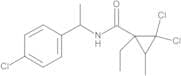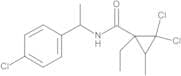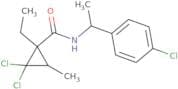
CAS 104030-54-8
:CARPROPAMID
- 2,2-dichloro-N-[1-(4-chlorophenyl)ethyl]-1-ethyl-3-methylcyclopropanecarboxamide
- Carpropamid (Bsi,Paiso)
- Carpropamid 97 %
- Carpropamid Standard
- Carpropamide
- Cyclopropanecarboxamide, 2,2-dichloro-N-[1-(4-chlorophenyl)ethyl]-1-ethyl-3-methyl-
- Ktu 3616
- Protiga
- WIN
- Carpropamid
- Carpropamid Solution,100ppm
- Carpropamid@100 μg/mL in Acetonitrile
- Carpropamid 0
- Carpropamid@1000 μg/mL in Acetonitrile
- Carpropamid Soluton
- 2,2-dichloro-N-[1-(4-chlorophenyl)ethyl]-1-ethyl-3-methylcyclopropane-1-carboxamide
- See more synonyms
LC PestiMix 5 10 µg/mL in Acetonitrile
CAS:- 100986-85-4
- 101-27-9
- 1014-69-3
- 104030-54-8
- 106700-29-2
- 112143-82-5
- 1134-23-2
- 115-26-4
- 117718-60-2
- 127-79-7
- 131341-86-1
- 14086-35-2
- 1491-41-4
- 15310-01-7
- 153197-14-9
- 1593-77-7
- 1596-84-5
- 183675-82-3
- 18854-01-8
- 1918-11-2
- 1929-77-7
- 210880-92-5
- 219714-96-2
- 22936-86-3
- 2307-68-8
- 23564-06-9
- 25366-23-8
- 2588-03-6
- 2588-04-7
- 2588-05-8
- 2588-06-9
- 26087-47-8
- 2686-99-9
- 299-86-5
- 30043-49-3
- 31120-85-1
- 314-40-9
- 3244-90-4
- 3813-05-6
- 3983-45-7
- 470-90-6
- 4726-14-1
- 51218-45-2
- 535-89-7
- 53780-34-0
- 59756-60-4
- 61676-87-7
- 62850-32-2
- 64249-01-0
- 644-64-4
- 6552-12-1
- 6552-13-2
- 67018-59-1
- 672-99-1
- 673-04-1
- 70217-36-6
- 70630-17-0
- 741-58-2
- 759-94-4
- 7700-17-6
- 78-30-8
- 79540-50-4
- 80214-83-1
- 81335-37-7
- 83657-22-1
- 85785-20-2
- 86763-47-5
- 88283-41-4
- 89784-60-1
- 947-02-4
- 95-06-7
- 96491-05-3
- 99485-76-4
- 99675-03-3
Color and Shape:MixtureCarpropamide
CAS:Controlled ProductFormula:C15H18Cl3NOColor and Shape:Off-WhiteMolecular weight:334.67Carpropamide
CAS:Carpropamide is a medicinal compound that acts as an analog of kinase inhibitors. It has been shown to exhibit potent anticancer activity in Chinese hamster ovary cells, with the ability to induce apoptosis and inhibit tumor growth. Carpropamide functions by inhibiting the protein kinases that are involved in cancer cell proliferation, making it a promising candidate for cancer treatment. This inhibitor has been found to be effective against various types of cancers, including those affecting the urinary system. Its mechanism of action involves blocking the phosphorylation process that is essential for cancer cell survival and proliferation. Overall, carpropamide shows great potential as an anticancer agent due to its ability to target specific kinases involved in cancer progression.
Formula:C15H18Cl3NOPurity:Min. 95%Molecular weight:334.7 g/mol